
Trunk comparison: Audi A3 Sportback vs Audi Q7
Key Differences
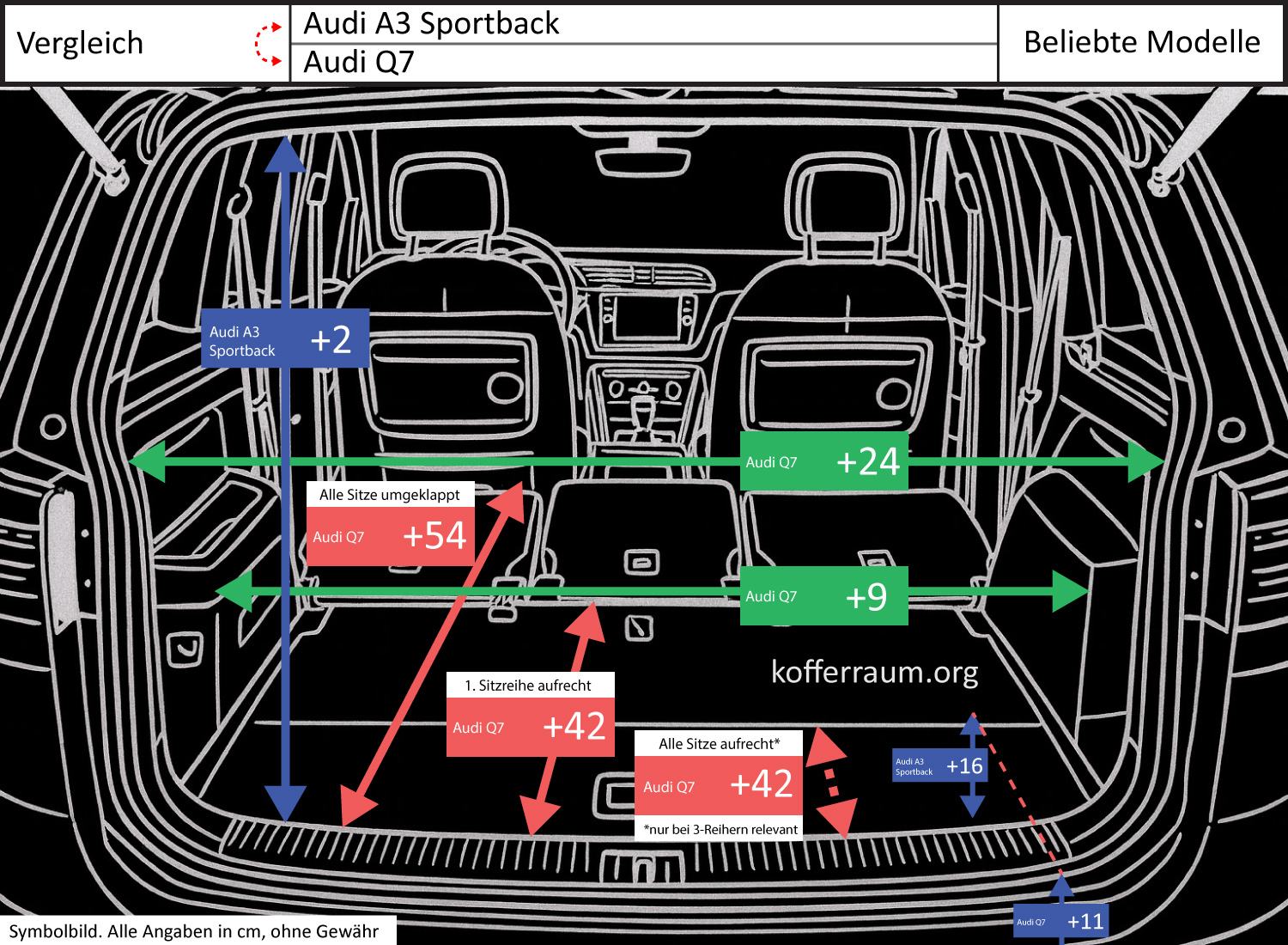
The Audi Q7 offers significantly more cargo length: with the seats folded down, the trunk of the Q7 is +21.3 in (≈36%) longer than that of the A3, and with the first row upright, it is +16.5 in (≈55%) longer. The width of the trunk opening is +9.4 in (≈25%) larger on the Q7, making it easier to load wider items.
The depth of the trunk (loading edge → trunk floor) is +6.3 in (≈1500%) higher on the A3, meaning the cargo area in the A3 sits significantly lower beneath the loading edge. Additionally, the loading edge of the Q7 is +4.3 in (≈16%) higher above the road than that of the A3.
Smaller differences (not >10%): The width at the narrowest point is 9% greater on the Q7; the height of the trunk opening is 0.8 in (≈3%) higher on the A3.
Impact on Usability
With the significantly greater cargo length (both with folded seats and upright first row) and the wider opening, the Q7 is better suited for long or wide loads — such as skis, long furniture parts, or wide boxes. The larger opening width makes loading and unloading bulky items much easier.
The higher loading edge of the Q7 (≈4.3 in) makes lifting heavy items into the trunk more strenuous and less ergonomic compared to the lower-lying A3. Combined with the greater depth from edge to trunk floor in the A3, cargo sits deeper and thus more stably in the A3; this reduces shifting of tall loads and lowers the cargo’s center of gravity.
At the same time, the greater recess can make reaching into the rear area somewhat less comfortable.
In summary: For transports requiring length and width (long, wide, or bulky goods), the Q7 is the more practical choice. For frequent lifting of heavy items or when a lower entry is desired (easier loading and unloading of heavy items), the A3 has advantages thanks to its lower loading edge and deeper cargo floor.