
Trunk comparison: Audi A3 Sportback vs BMW i4
Key Differences
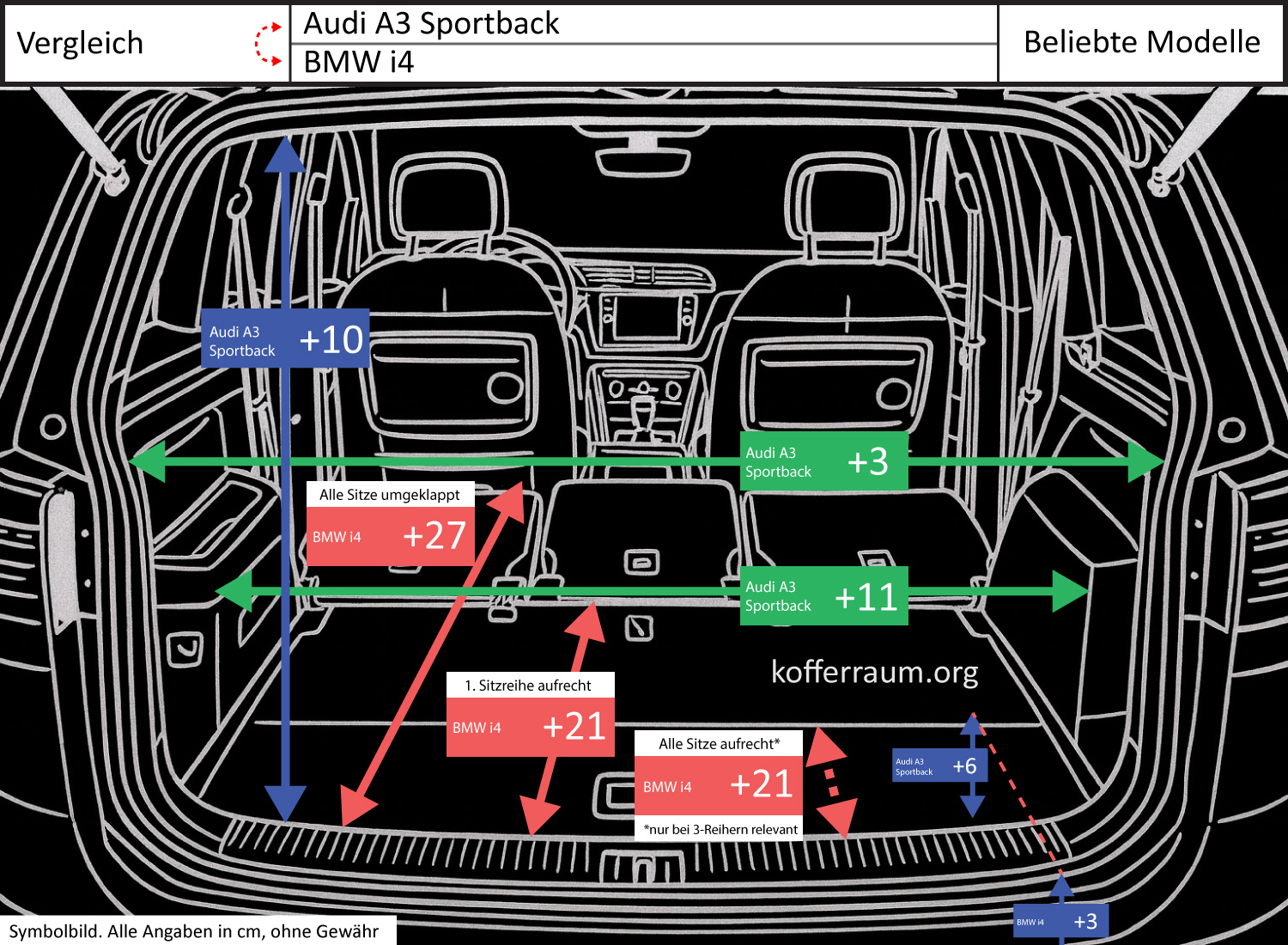
The BMW i4 primarily offers more cargo length: with the seats folded down, the trunk is 10.6 in (18%) longer, and with the front seats upright, it is 8.3 in (27%) longer than the Audi A3 Sportback.
The Audi A3, on the other hand, has larger cross-sectional dimensions: the height of the trunk opening is 3.9 in (15%) higher, the depth of the trunk (loading edge → trunk floor) is 2.4 in (60%) greater, and the width at the narrowest point is 4.3 in (13%) wider than the BMW.
Smaller differences under 10% include the loading edge height of the BMW i4 (+1.2 in / 4% higher) and the width of the trunk opening of the Audi (+1.2 in / 3%).
Impact on Usability
The BMW i4 is better suited for long items (e.g., skis, long furniture parts, or slats) because the longer cargo area with folded seats and in the normal position provides more flexible length capacity. Those who frequently transport long but narrow items have a clear advantage with the i4.
The Audi A3 is more practical for wide or tall cargo in everyday use: the greater width at the narrowest point and the higher trunk opening make loading bulky or wide objects easier.
The greater depth (distance from loading edge to floor) creates more usable volume near the loading edge — practical for stacking or for bulky luggage that requires height.
The 1.2 in (4%) higher loading edge on the BMW makes lifting heavy items slightly more strenuous but is not a decisive disadvantage in everyday use.
Conclusion
BMW i4: better for longer cargo. Audi A3 Sportback: better for wider, taller, or bulky cargo and easier handling when loading. The choice depends on the typical transport profile (long vs. wide/tall).