
Trunk comparison: Audi A3 Sportback vs BMW X3
Key Differences and Their Impact on Usability
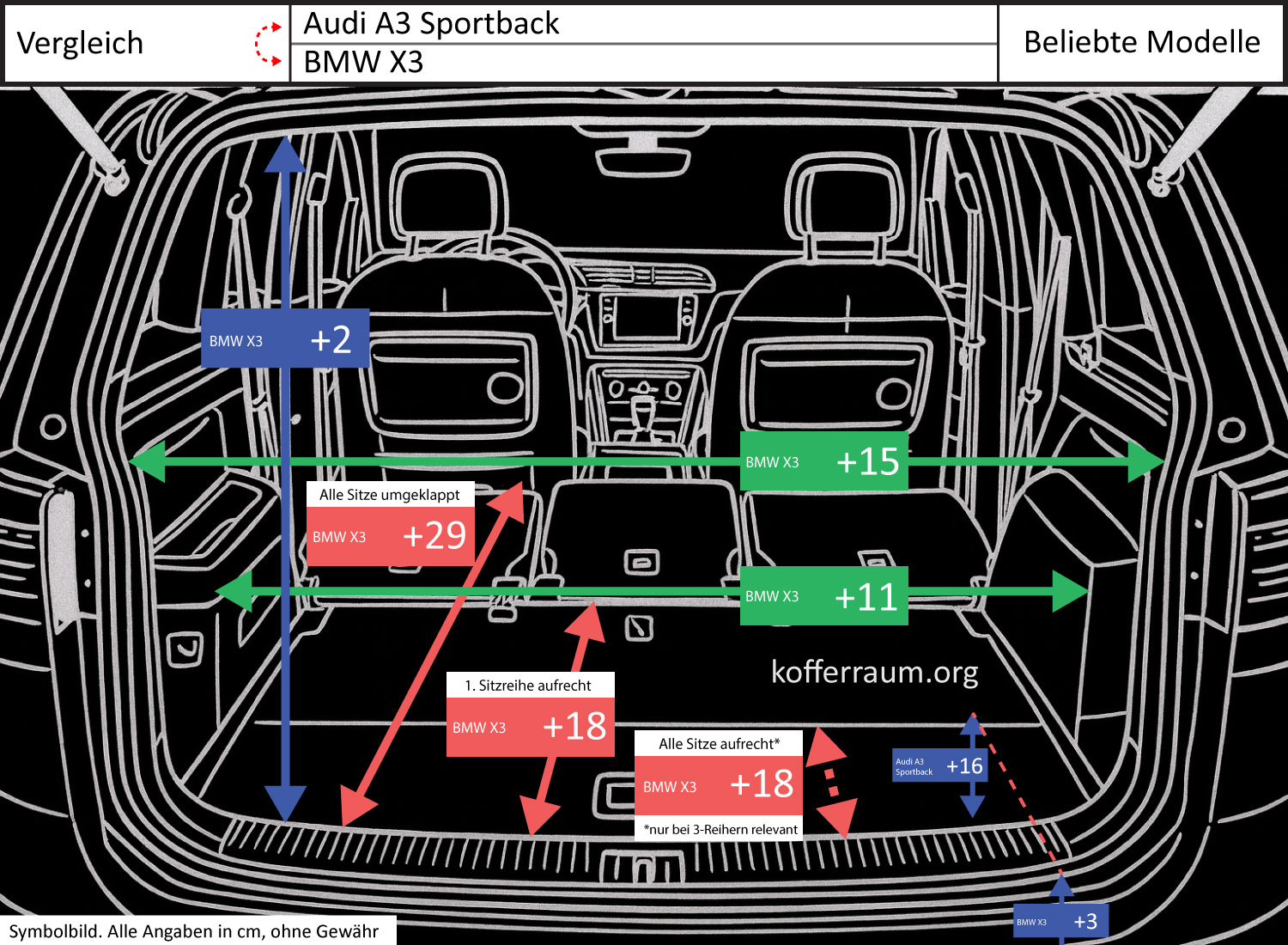
Significant differences lie in trunk volume and dimensions: The BMW X3 offers +11.4 in (+19%) more cargo length with the seats folded down and +7.1 in (+23%) more with the front seats upright compared to the Audi A3 Sportback.
Additionally, the narrowest trunk width of the BMW is +4.3 in (+11%) larger and the width of the trunk opening is +5.9 in (+15%) wider. In contrast, the Audi A3 has a significantly greater depth from the loading edge to the trunk floor: +6.3 in (+1500%) compared to the BMW X3.
In practice, this means: The BMW X3 is better suited for long and wide cargo — such as long items, several large suitcases, or flat furniture parts — because more length and width are available and the opening is significantly larger.
The X3 offers a more flexible cargo area overall when the seats are folded down or when wide items need to pass through the opening.
The Audi A3 scores with the significantly deeper trunk floor below the loading edge. This creates a deep cargo well where luggage and smaller loads can be "sunk" — practical when you want to transport items stably and out of sight (shopping bags, toolboxes, delicate items).
Additionally, the loading edge of the A3 is slightly lower than that of the X3 (BMW loading edge +1.2 in), which slightly reduces lifting effort for heavy items. However, in the A3 configuration, the width and length of the loading opening are more limited, making it more difficult to load very wide or long parts.
Smaller differences such as the height of the trunk opening (+0.8 in on the BMW, about 3%) are insignificant for most uses.
Conclusion: Those who frequently transport long or wide cargo and need maximum flexibility benefit from the BMW X3. Those who prefer a deep cargo well, easier lifting due to a lower loading edge, and practical storage for everyday shopping will find advantages in the Audi A3 Sportback.