
Trunk comparison: Audi A3 Sportback vs Durchschnitt Compact SUV

Key Differences and Impact on Usability
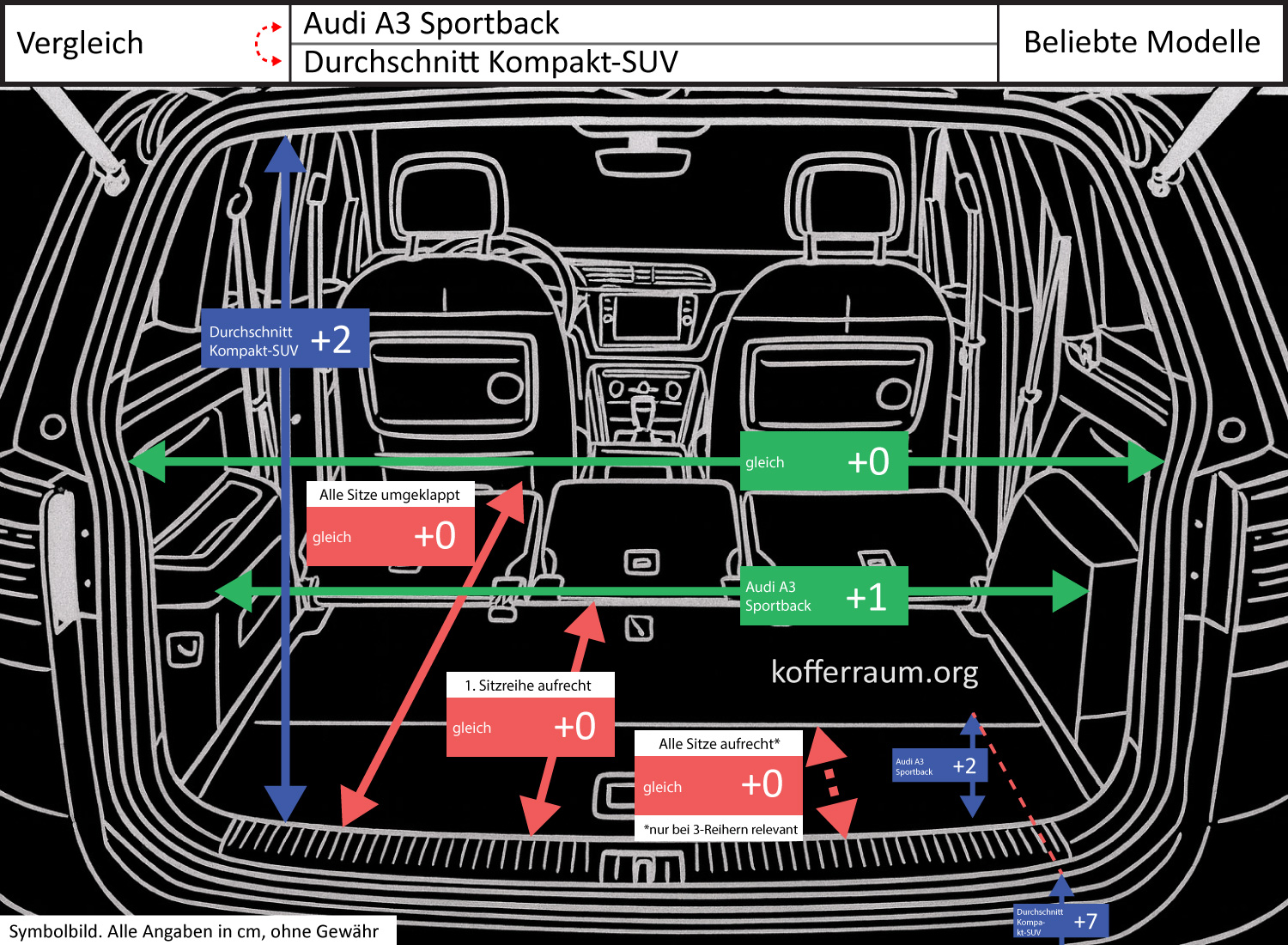
Both models offer the same trunk length, both with the seats folded down and with the first row upright, and the width of the trunk opening is also identical. This means: in length and pass-through width, the A3 Sportback and the average compact SUV behave the same — long or wide items fit similarly well in both vehicles.
The depth of the trunk (loading edge to trunk floor) of the Audi A3 Sportback is 0.8 in or 14% greater than that of the average compact SUV. Practically, this means more usable volume in the vertical direction: in the A3, items can be stacked higher or positioned deeper in the cargo area without protruding over the loading edge. For transporting boxes, crates, or bulky items that benefit from height, the A3 is often more practical. Other, smaller differences: The loading edge of the average compact SUV is 2.8 in (10%) higher above the road than that of the A3 Sportback — making lifting heavier items in and out more difficult. The trunk opening of the compact SUV is 0.8 in (3%) higher than the A3, a rather marginal advantage for very tall items. The minimum width in the trunk is only 0.4 in (1%) larger in the A3 and thus negligible. Conclusion for usability: Because length and opening width are the same, both models are comparable for long or wide loads. The Audi A3 Sportback has the practical advantage of significantly greater depth (14%) for stacking and maximum usable interior space vertically. The compact SUV requires more effort to load and unload due to the higher loading edge; its slightly higher opening dimension offers only a small advantage for very tall items. Overall, the A3 tends to be more ergonomic and usable for frequent loading with stackable or heavy loads.