
Trunk comparison: Audi A3 Sportback vs Jeep Avenger Electric
Key Differences
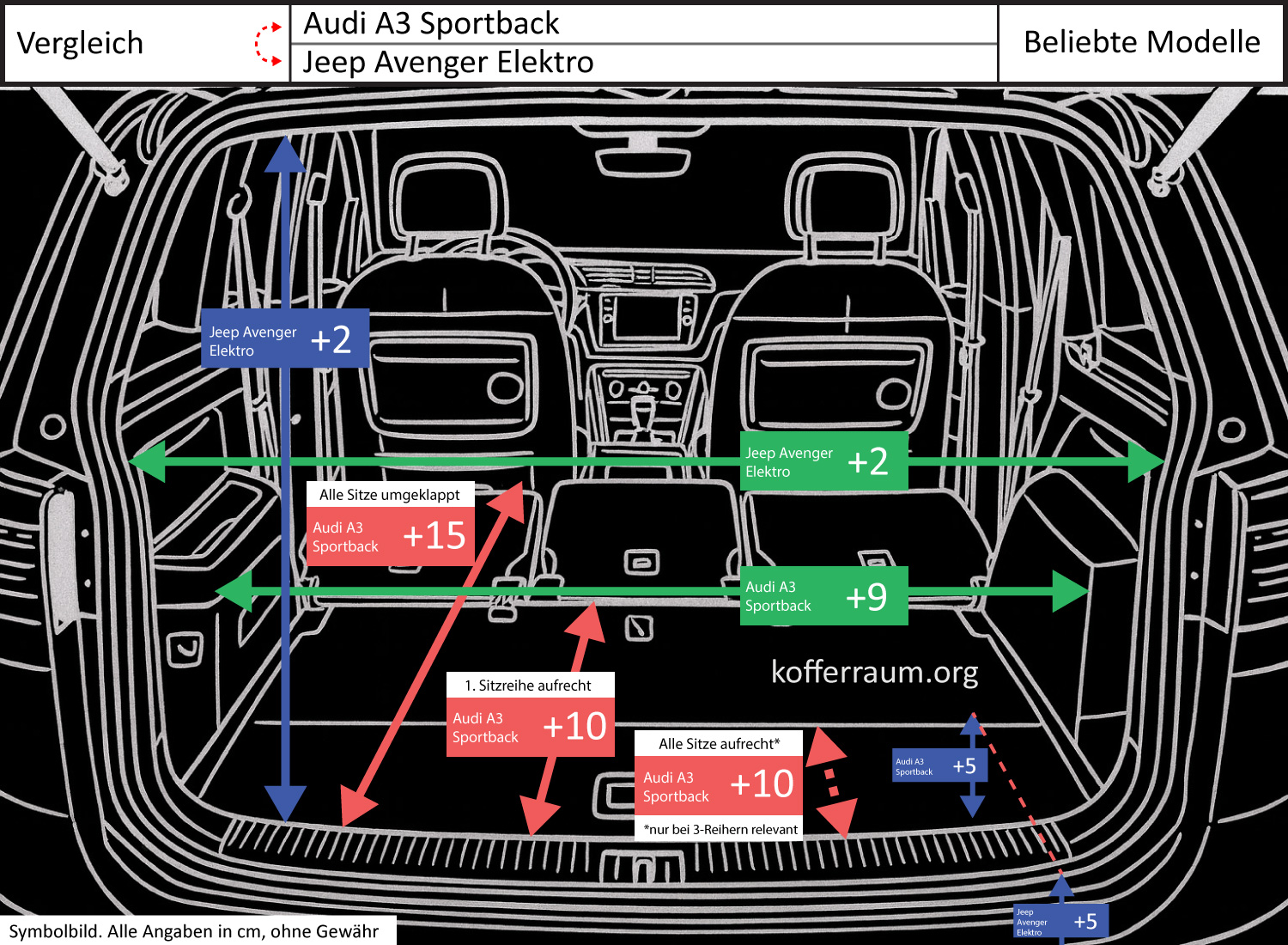
The Audi A3 Sportback offers significantly more cargo length and depth overall than the Jeep Avenger Electric. With the seats folded down, the Audi's trunk is 5.9 in (+11%) longer, and with the first row upright, it is 3.9 in (+15%) longer than the Avenger's.
Additionally, the trunk depth (loading edge to trunk floor) is 2 in (+45%) greater in the Audi.
Smaller differences: the Avenger's trunk opening is 0.8 in (+3%) higher and its opening width is 0.8 in (+2%) wider; the Avenger's loading edge is 2 in (+7%) higher above the ground, and the narrowest interior width is 3.5 in (10%) larger in the Audi.
Impact on Usability
The extra length of the Audi (each +11% and +15%) makes it more practical for long items like slats, furniture pieces, or skis — these fit more easily without complicated pushing or tilting.
The significantly greater depth of the Audi (+45%) increases usable cargo volume and allows for deeper stacking, which stabilizes the load and leaves more space for bulky luggage.
The Avenger scores with its slightly higher opening and minimally wider opening width; this makes it easier to load very tall or bulky items through the rear opening.
However, the shorter interior length and lesser depth limit actual usability for long or deeply stackable cargo. The higher loading edge of the Avenger (+2 in) makes lifting heavy items somewhat more strenuous; loading is therefore more comfortable in the Audi.
Conclusion: For longer items and more usable volume, the Audi A3 Sportback is clearly advantageous. The Jeep Avenger Electric can offer benefits for bulky entry dimensions due to the slightly higher and marginally wider opening but loses out on practical transport capacity due to a shorter and shallower loading area.