
Trunk comparison: Audi A3 Sportback vs Volvo V90
Key Differences
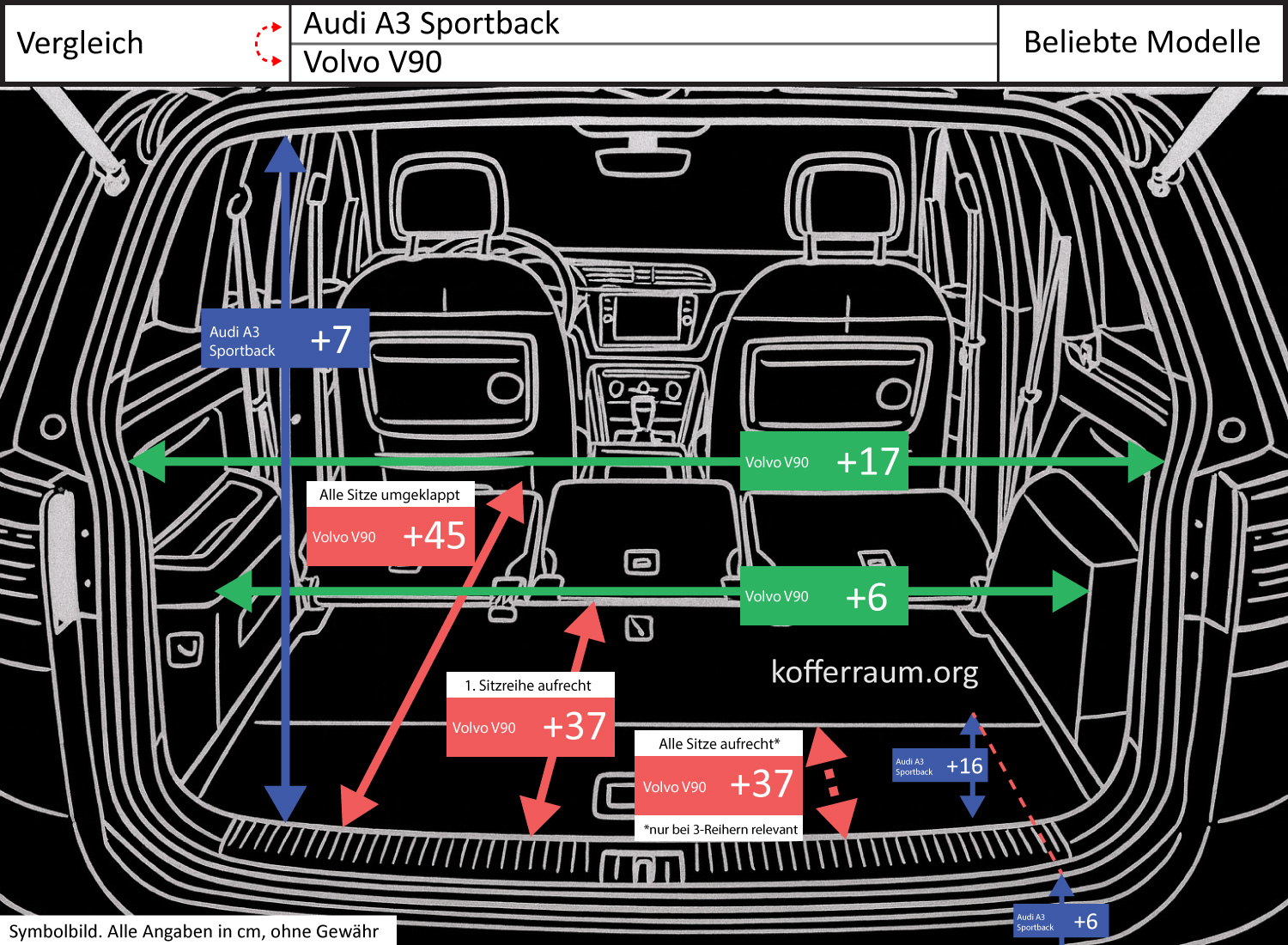
Four differences stand out clearly from the data: The Volvo V90 offers a significantly longer cargo area, both with folded seats at +17.7 in (≈+30%) and with the first row upright at +14.6 in (≈+48%).
The loading opening of the Volvo is also noticeably wider by +6.7 in (≈+18%). In contrast, the Audi A3 Sportback has a significantly greater depth between the loading edge and the trunk floor, namely +6.3 in (≈+1500%) compared to the Volvo.
Impact on Usability
More length in the Volvo means: longer items (skis, slats, furniture parts, roller shutters) can be transported more easily, even when the rear seats are upright.
The wider loading opening simplifies loading and unloading wider or bulky goods and reduces maneuvering when loading. This clearly gives the V90 an advantage for transport tasks that require a lot of cargo length or wide openings (craftsmen, moving, vacations with bulky luggage).
The greater depth in the Audi A3 (loading edge → trunk floor) works differently: items lie deeper in the cargo space, which creates “invisible” volume for flat or unloaded parts and makes smaller items more secure against slipping.
However, this reduces the usable interior height above the trunk floor for tall loads and can make pushing heavy items over the loading edge more difficult.
In practice, this means: the A3 is practical when you want to store some things that don’t need to be tall or fit well in the deep compartment; for long or wide parts, it is less suitable.
Brief Assessment
For regular transport of long or wide loads, the Volvo V90 is the better choice.
Those who prefer more “deep” storage space and often use bulky but flat items or hidden storage compartments will find advantages in the Audi A3. Smaller differences (e.g., loading edge height) exist but do not significantly change the fundamental usability.