
Trunk comparison: Audi A3 Sportback vs Volvo XC60

Key Differences (highlighted)
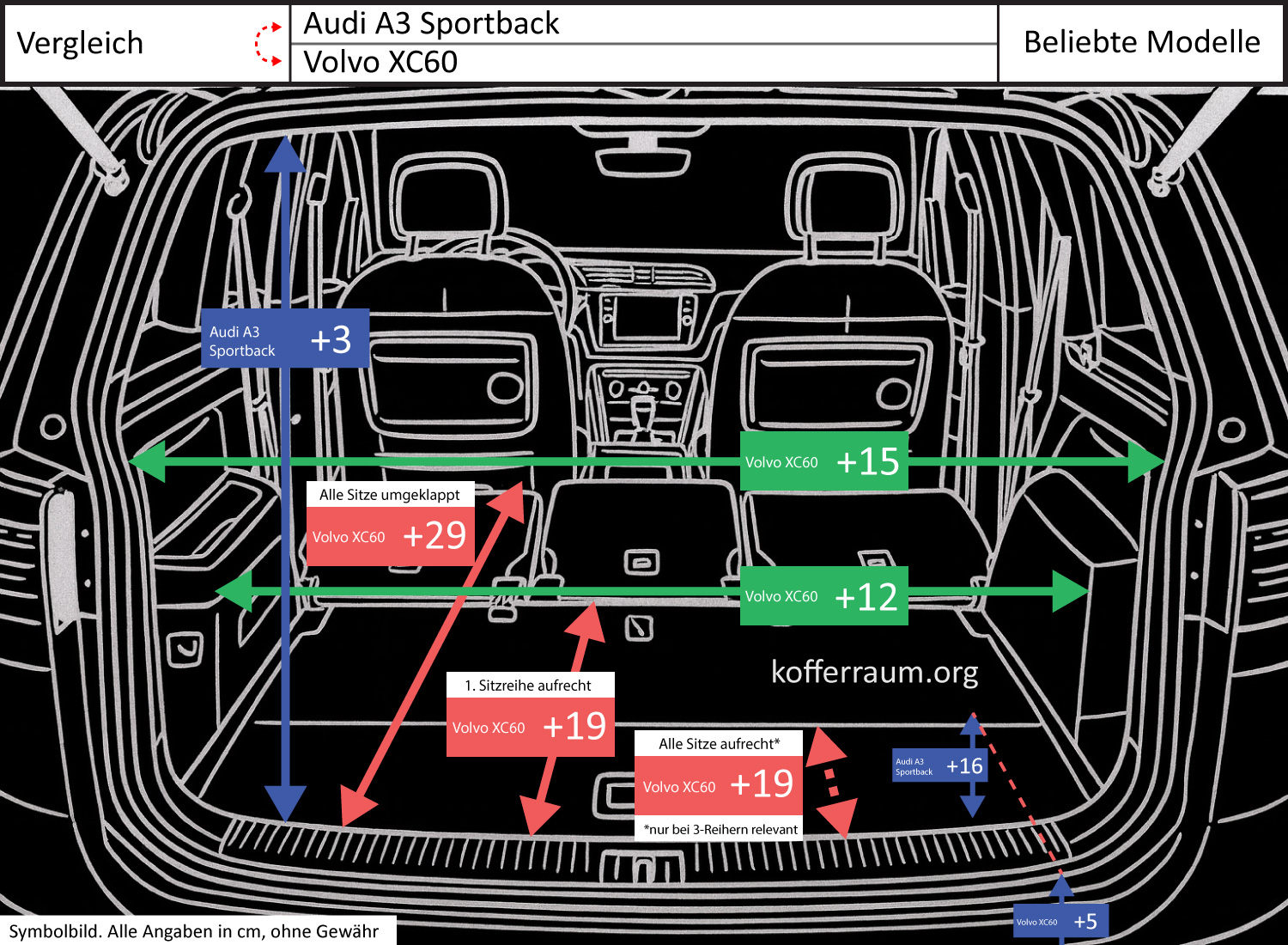
The Volvo XC60 offers significantly more cargo length and width: with the seats folded down, the trunk of the Volvo is 11.4 in (19%) longer, and with the rear seat upright, it is 7.5 in (25%) longer than in the Audi A3 Sportback.
Additionally, the smallest width in the Volvo's trunk is 4.7 in (12%) larger and the width of the Volvo's trunk opening is 5.9 in (15%) larger than the Audi's. In contrast, the Audi has a significantly greater depth from the loading edge to the trunk floor: the Audi is 6.3 in (1500%) deeper here.
What are the implications for usability?
Volvo XC60: The greater length and width (both interior dimensions and opening) make the XC60 more practical for bulky or flat loads — long items, wide boxes, several large suitcases, or furniture parts can be transported more easily and with less rearranging.
The wider opening facilitates maneuvering wide items in and out.
Audi A3 Sportback: The significantly greater depth from the loading edge to the floor means that items sit deeper in the cargo space.
This is advantageous when you want to store luggage securely and out of sight (less shifting, better tie-down options), but it can make handling heavy items more difficult because they are farther from the tailgate and require more lifting effort when loading.
Practical trade-off: For users who regularly transport wide or long loads (skis, bicycles with front wheel removed, furniture parts, multiple suitcases), the Volvo XC60 is clearly more practical due to its length, width, and opening size.
For users who value a deep, well-secured cargo space (e.g., heavy luggage, shopping bags, local goods that should sit low), the Audi A3 Sportback offers advantages.
Note on smaller differences: The trunk opening height of the A3 is only 1.2 in (4%) higher and the loading edge height of the Volvo is 2 in (7%) above the road — both small effects that have little impact on daily loading.