Trunk comparison: Audi A3 Sportback vs VW ID.3
Key Differences and Their Impact on Usability
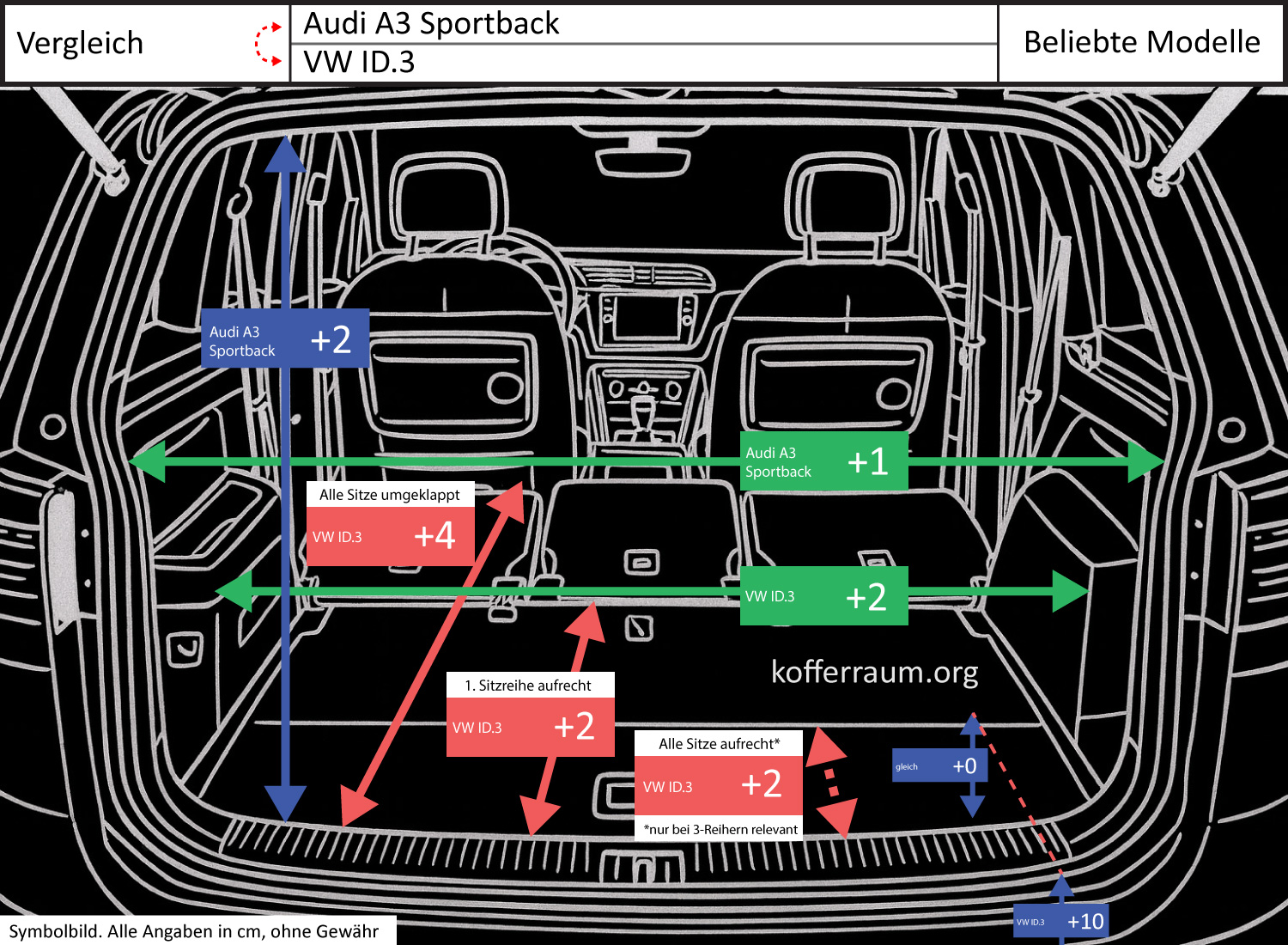
The VW ID.3 offers slightly more length in the cargo space: with the seats folded down, its trunk is 1.6 in (3%) longer, and with the rear seatback upright, it maintains a 0.8 in (3%) advantage over the Audi A3 Sportback. The total depth from the loading edge lip to the trunk floor is the same in both models. At the narrowest cross-section, the ID.3 is minimally wider (+0.8 in / 2%), while the width of the trunk opening is 0.4 in (1%) larger on the A3. The trunk opening of the A3 is also 0.8 in (3%) higher, making it easier to load tall items. The most significant and practically relevant difference is the loading edge height: the loading edge of the VW ID.3 sits 3.9 in (15%) higher above the ground than that of the Audi A3.
the higher loading edge of the ID.3 makes lifting heavy or bulky items into the trunk more difficult and increases strain during loading and unloading (back, arm strength). For frequent transport of heavy loads or for users needing physical relief, the lower loading edge of the A3 is noticeably more advantageous. Conversely, the ID.3 can score points with its slightly greater interior length when transporting longer items, provided that lifting to the higher loading edge is not an obstacle. Overall, the differences aside from the loading edge height are minor: the ID.3 is marginally longer and somewhat roomier at the narrowest point, the A3 has a slightly higher opening and especially a significantly lower loading edge. For everyday use and luggage, this means: those who often transport long but relatively light items benefit from the ID.3; those who frequently lift heavy or bulky loads or prefer a low loading edge have the more practical advantages with the Audi A3 Sportback.