
Trunk comparison: Audi A4 Avant vs BMW iX1
Key Differences
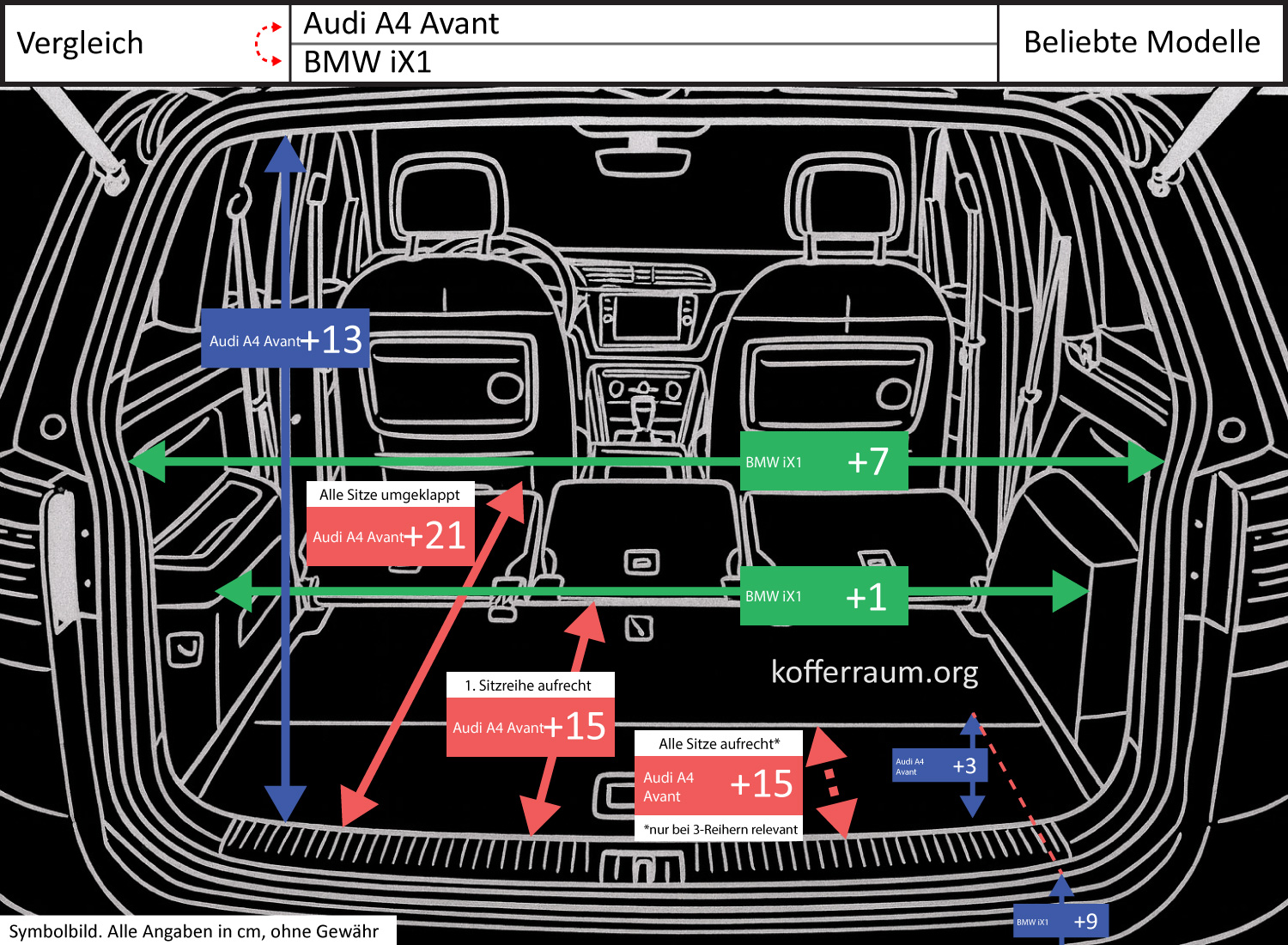
The Audi A4 Avant offers 8.3 in (+13%) longer cargo space with the seats folded down and 5.9 in (+17%) longer cargo space with the first row of seats upright compared to the BMW iX1. The trunk opening of the Audi is 5.1 in (+18%) higher, and the distance from the loading edge to the trunk floor is 1.2 in (+150%) greater in the Audi.
In contrast, the loading edge of the BMW iX1 is 3.5 in (+14%) higher above the ground than that of the Audi.
Implications for Usability
The longer cargo space of the Audi (both with folded and upright seats) makes it significantly better suited for long items such as slatted bed bases, long furniture parts, skis, or long boxes — less frequent seat folding or tilting of the load is necessary.
The higher trunk opening in the Audi makes loading tall items easier because they need to be tilted or angled less.
The greater depth of the Audi (loading edge to trunk floor) creates more usable vertical space inside and allows better stacking or recessing of cargo; this can be especially advantageous for bulky or tall loads, but it makes reaching items at the very bottom slightly deeper — which can be somewhat less comfortable with heavy loads.
The higher loading edge of the BMW (+3.5 in) means a noticeably higher lift when placing heavy items; this increases physical effort and makes sliding heavy boxes inside more difficult.
Smaller advantages of the BMW (at the narrowest point +0.4 in, opening width +2.8 in) are minor in practice: wide, flat items can be inserted slightly more easily, but this does not compensate for the length and height advantages of the Audi.
Conclusion: Those who frequently transport long or tall cargo will find the Audi A4 Avant the more practical solution. The BMW iX1 offers slight advantages in opening and passage width but overall seems less suitable for long/tall loads and requires more lifting effort when loading.