
Trunk comparison: Audi A4 Avant vs Hyundai IONIQ
Key Differences
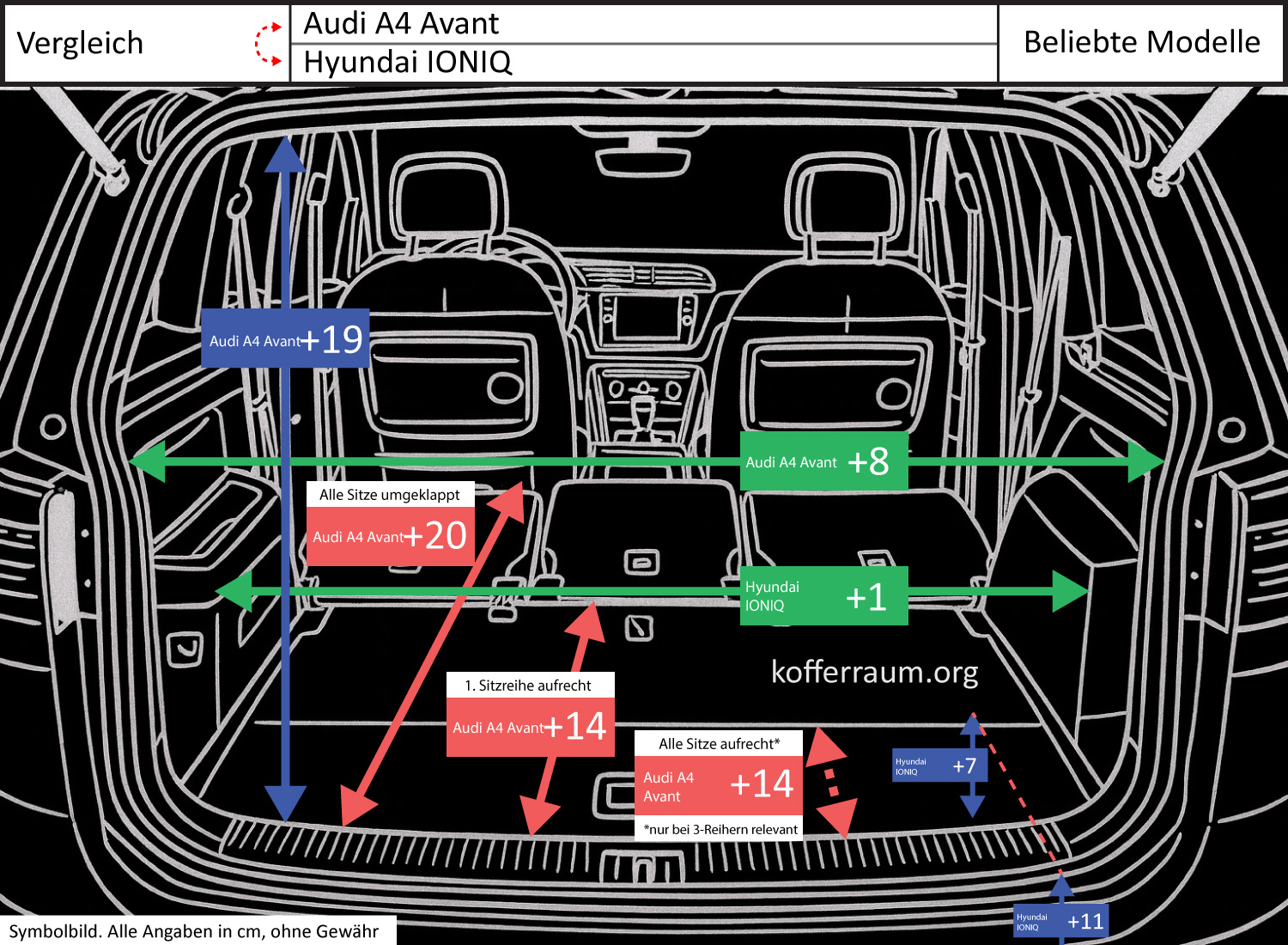
Clear focuses emerge in cargo volume and loading geometry: The Audi A4 Avant offers with folded seats a cargo floor that is 7.9 in (≈12%) longer and with the front seats upright a cargo floor that is 5.5 in (≈15%) longer than the Hyundai IONIQ.
The trunk opening height is 7.5 in (≈29%) higher in the Audi, while the Hyundai has a significantly greater interior trunk depth (distance from loading edge → trunk floor) — 2.8 in (≈140%) higher than in the Audi.
Additionally, the Hyundai's loading edge sits 4.3 in (≈17%) higher above the ground than the Audi's. Smaller deviations (narrowest width +0.4 in / opening width +3.1 in) are below the 10% threshold and hardly have a decisive effect.
Implications for Usability
- Long items and luggage: Thanks to the longer cargo floor (both with folded and upright seats), the A4 Avant is better suited for long items like skis, furniture parts, or longer luggage. This makes it more flexible for trades, leisure, and moves.
- Tall items: The significantly higher trunk opening in the Audi makes it easier to store tall or bulky items vertically (e.g., plants, boxes), as less bending or edge clearance is required.
- Lifting and back strain: Due to the higher loading edge of the Hyundai (≈4.3 in), handling heavy items is more strenuous — especially with frequent use or heavy luggage. The Audi is more back-friendly here.
- Interior depth and volume utilization: The greater depth in the IONIQ can create more usable vertical volume (e.g., a deeper recessed cargo area for hidden luggage), but it makes loading large, flat items more difficult, as more bending or pulling inside is necessary.
- Practical conclusion: Those who frequently transport long or tall items and value back-friendly loading will find the Audi A4 Avant the more practical solution. Those who prioritize deeper usable storage space and can live with a higher loading edge will find advantages in the Hyundai IONIQ.