
Trunk comparison: Audi A4 Avant vs Mazda Mazda CX-60

Key Differences
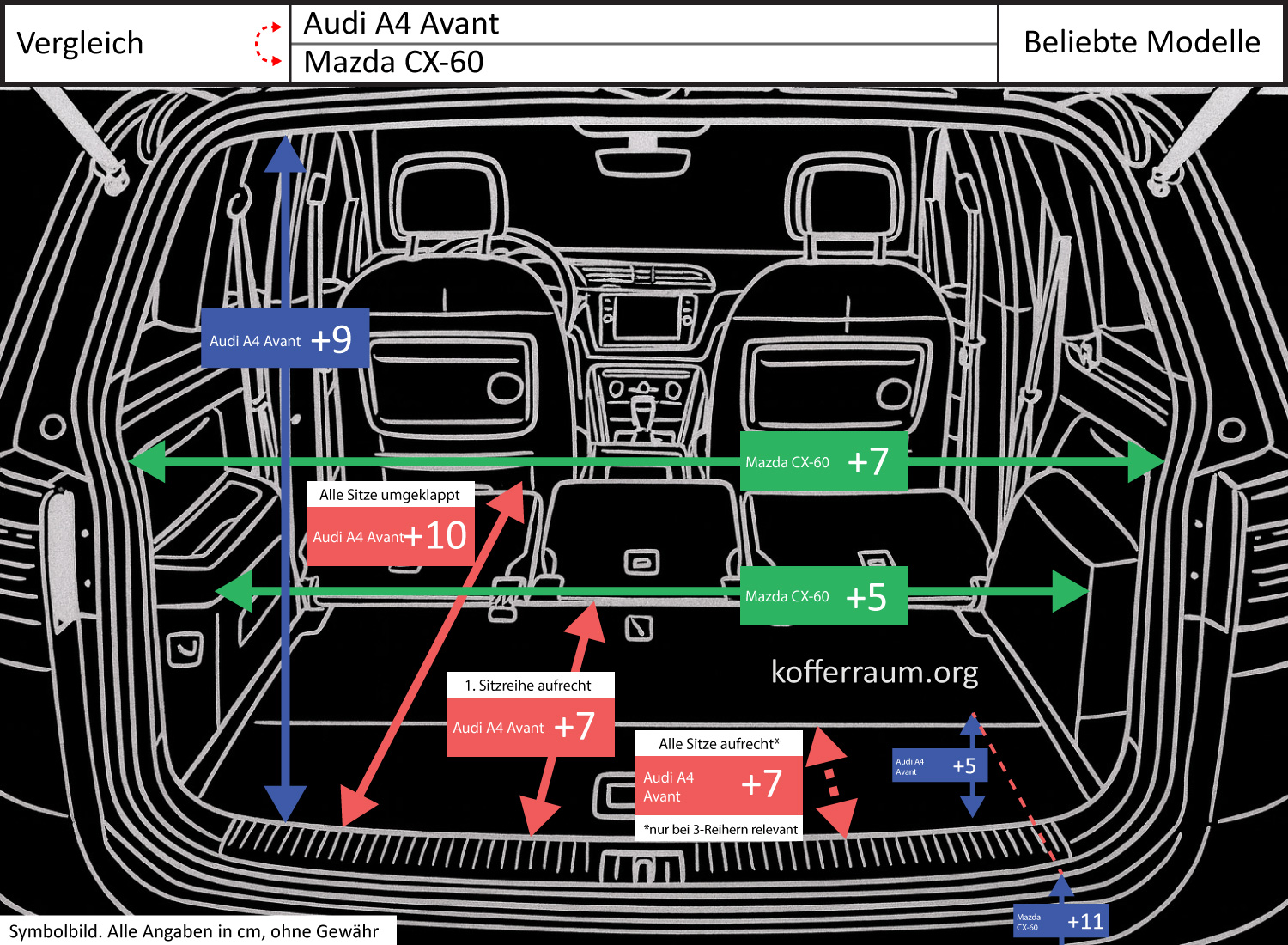
The most noticeable differences concern the height of the trunk opening, the depth of the trunk (loading edge → trunk floor), and the position of the loading edge.
The Audi A4 Avant has a trunk opening that is 3.5 in (≈12%) higher and a depth between loading edge and trunk floor that is 2 in (≈400%) greater than the Mazda CX‑60. In contrast, the Mazda's loading edge is 4.3 in (≈17%) higher above the road than the Audi's.
Smaller differences: with the trunk folded down, the Audi is 3.9 in (6%) longer and with the first row of seats upright, 2.8 in (7%) longer; the Mazda is 2 in (5%) wider at the narrowest point and the opening width is 2.8 in (7%) larger.
Implications for Usability
Due to the higher trunk opening and significantly greater depth, the Audi A4 Avant offers more usable vertical capacity: it better accommodates tall or upright items and allows for deeper storage below the opening, making bulky or stackable cargo easier to stow.
Additionally, the lower loading edge on the Audi (since the Mazda is 4.3 in higher) makes loading heavy or large items more comfortable — less effort required when lifting.
The Mazda CX‑60 has slight advantages in width and opening width (each about 5–2.8 in), which simplifies loading very wide items.
However, these advantages are moderate and are partially offset by the higher loading edge and lesser depth: wider but very heavy or tall loads are more strenuous to load in the Mazda and tend to fit less well vertically.
Conclusion: Those who frequently transport tall or stackable cargo and value easy loading benefit more from the Audi A4 Avant. Those who occasionally transport wide but not necessarily very tall or heavy items can benefit from the slightly wider opening of the Mazda CX‑60 but must accept the higher loading edge.