
Trunk comparison: Audi A6 Avant vs Hyundai Elantra GT Wagon


Key Differences
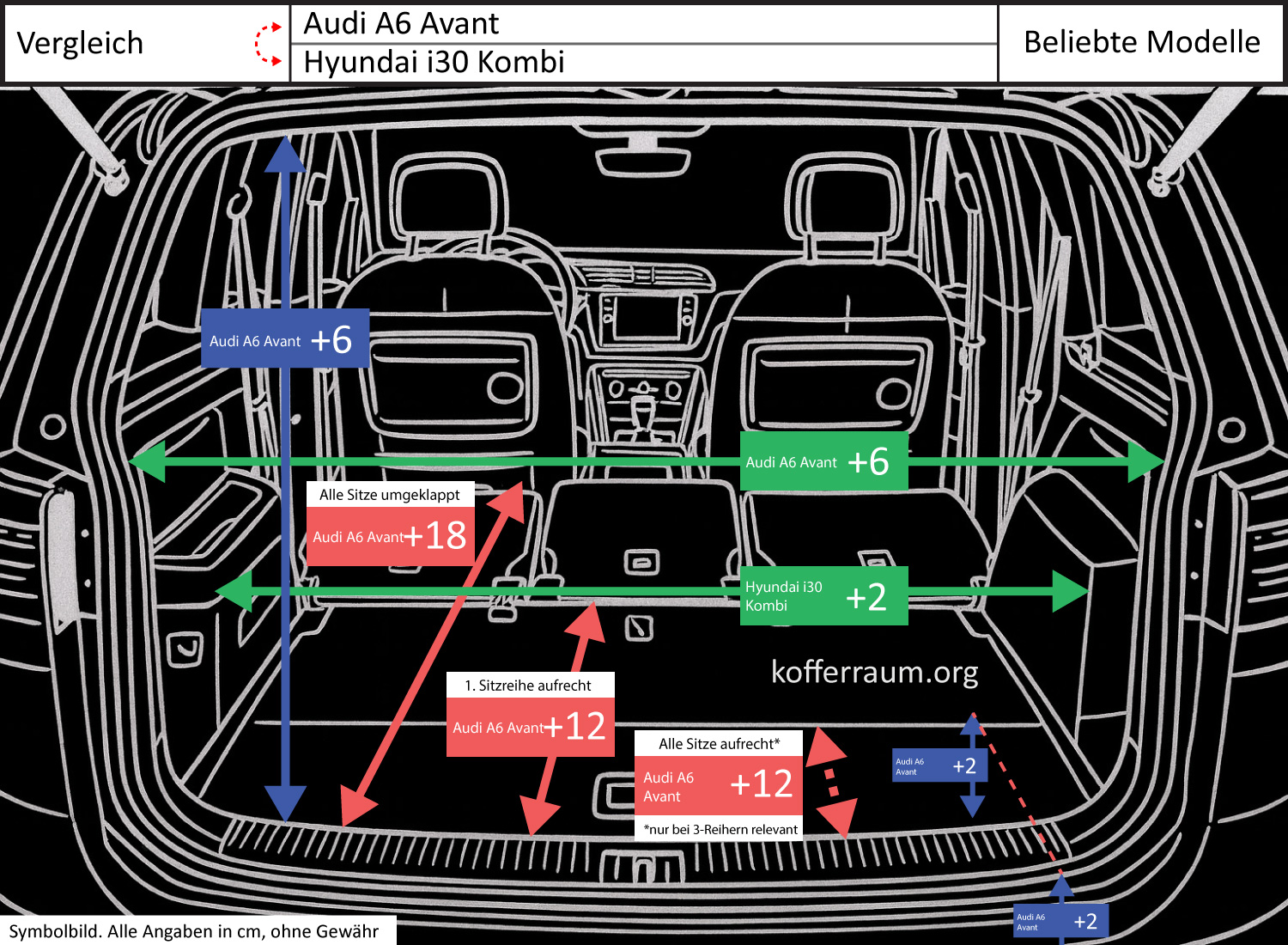
The Audi A6 Avant offers a cargo floor length that is +4.7 in (11%) longer than the Hyundai i30 Wagon with the first row of seats upright.
Also notable is the depth measurement between the loading edge and the trunk floor: the A6 is +0.8 in (100%) larger here — a significant percentage difference, even though the absolute value is small.
Additional Differences
With the seats folded down, the A6 is +7.1 in (10%) longer than the i30. The trunk opening of the A6 is +2.4 in (9%) higher and the width of the opening is +2.4 in (6%) more favorable.
The loading edge of the A6 sits +0.8 in (3%) higher above the road. The narrowest width in the trunk is minimally +0.8 in (2%) larger in the i30 than in the A6.
Impact on Usability
The longer cargo floor with the first row of seats upright (+4.7 in / 11%) makes the A6 more practical for everyday use when transporting long items without folding down the rear seats (e.g., long packages, slats, skis with a suitable opening).
The greater depth between the loading edge and floor (percentage-wise a strong deviation) suggests a different floor arrangement; practically, this means hardly any more storage space but may affect how flat items slide over the loading edge — the effect is limited due to only +0.8 in absolute difference.
The slightly greater overall length with folded seats (+7.1 in / 10%) and the higher opening of the A6 (+2.4 in) make it easier to store larger, bulky items.
Conversely, the i30 offers slightly more width at the narrowest point, which can be advantageous when transporting very wide but flat loads through tight spots. The higher loading edge of the A6 (+0.8 in) makes lifting heavy cargo somewhat more strenuous.
Conclusion
The Audi A6 Avant is overall better suited for longer and bulkier loads, especially without folding down the seats. The Hyundai i30 Wagon offers minimally more width in very narrow cross-sections.
Some percentage differences (e.g., depth +100%) are relatively large but have limited practical significance due to small absolute values.