
Trunk comparison: Audi A6 Avant vs Hyundai IONIQ
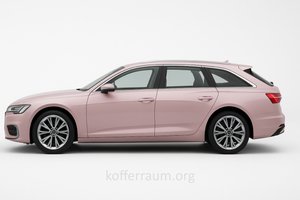
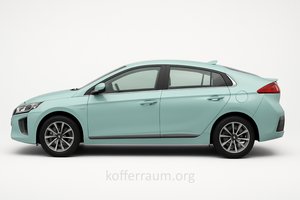
Key Differences
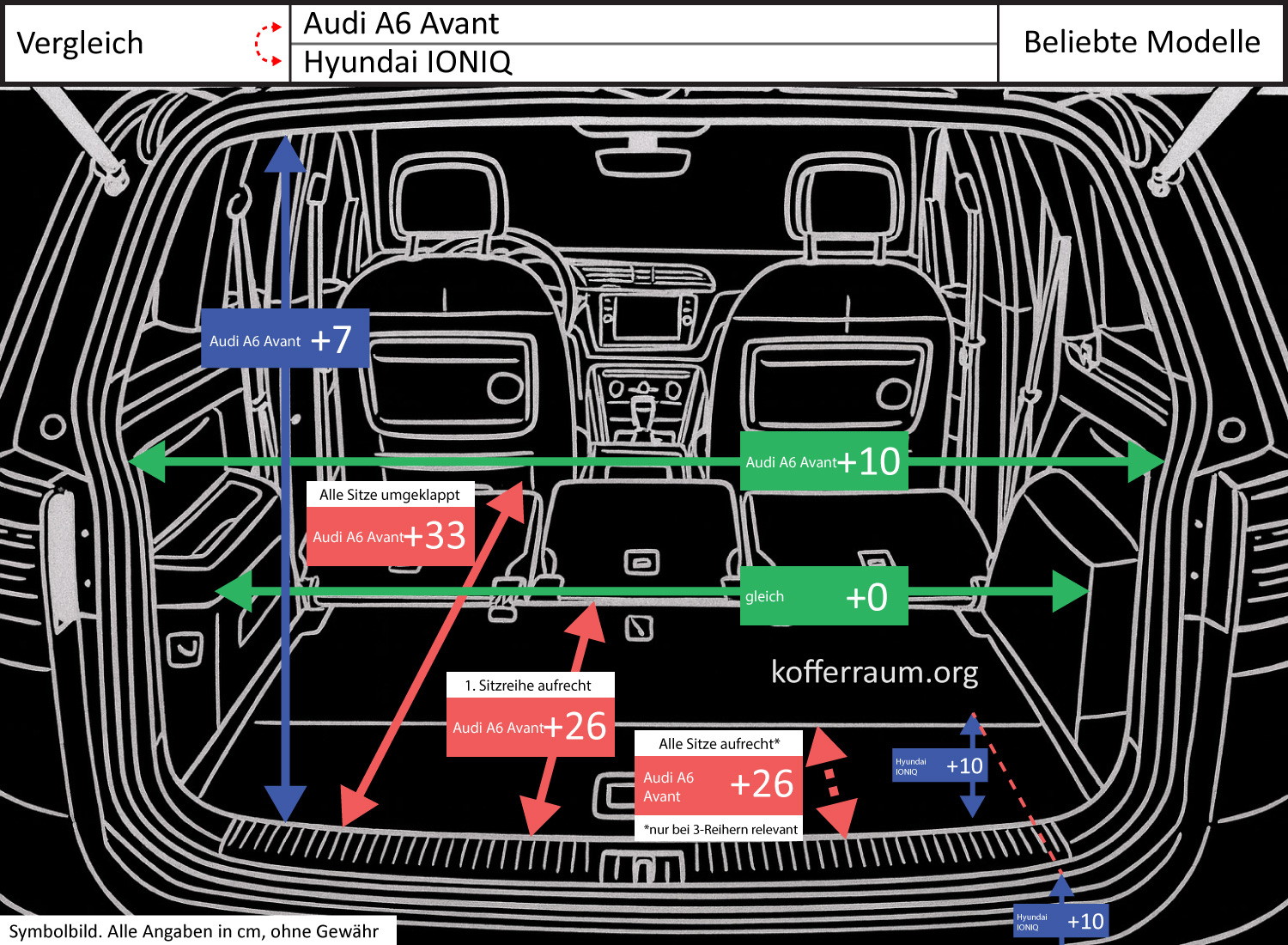
The Audi A6 Avant offers significantly more cargo length: with the seats folded down, the A6 is 13 in (20%) longer, and with the first row upright, 10.2 in (29%) longer than the Hyundai IONIQ.
The trunk opening of the A6 is also larger: the opening height is 2.8 in (11%) higher and the opening width 3.9 in (11%) wider than the IONIQ.
In contrast, the Hyundai IONIQ has a significantly greater distance between the loading edge and the trunk floor: the depth is 3.9 in (500%) greater than the A6, and the loading edge itself sits 3.9 in (16%) higher above the ground. The width at the narrowest point is the same for both models.
Implications for Usability
For long or bulky items (e.g., roof box accessories, long furniture pieces, skis), the Audi A6 Avant clearly has the advantage: the noticeably greater interior length with folded and upright seats makes transporting long goods easier.
The larger opening width and higher opening height of the A6 make loading wider or taller parts simpler.
The Hyundai IONIQ scores with a deeper trunk well: smaller items can be recessed deeper and remain less visible or shift less during braking.
However, the deeper cargo floor can make loading and unloading very flat, large items (which must fit between the loading edge and floor) more difficult because more bending is required.
The higher loading edge of the IONIQ means more lifting effort when loading heavy loads into the vehicle; the A6 with its lower loading edge is more practical for frequent loading and unloading of heavy or bulky items.
In summary: Those who frequently transport long or wide loads will find the Audi A6 Avant the more practical choice. Those who value a deep cargo well for stored, unseen luggage will find advantages in the Hyundai IONIQ—at the expense of a higher lifting limit when loading and unloading.