
Trunk comparison: Audi A6 Avant vs Mazda Mazda CX-60

Key Differences and Usability
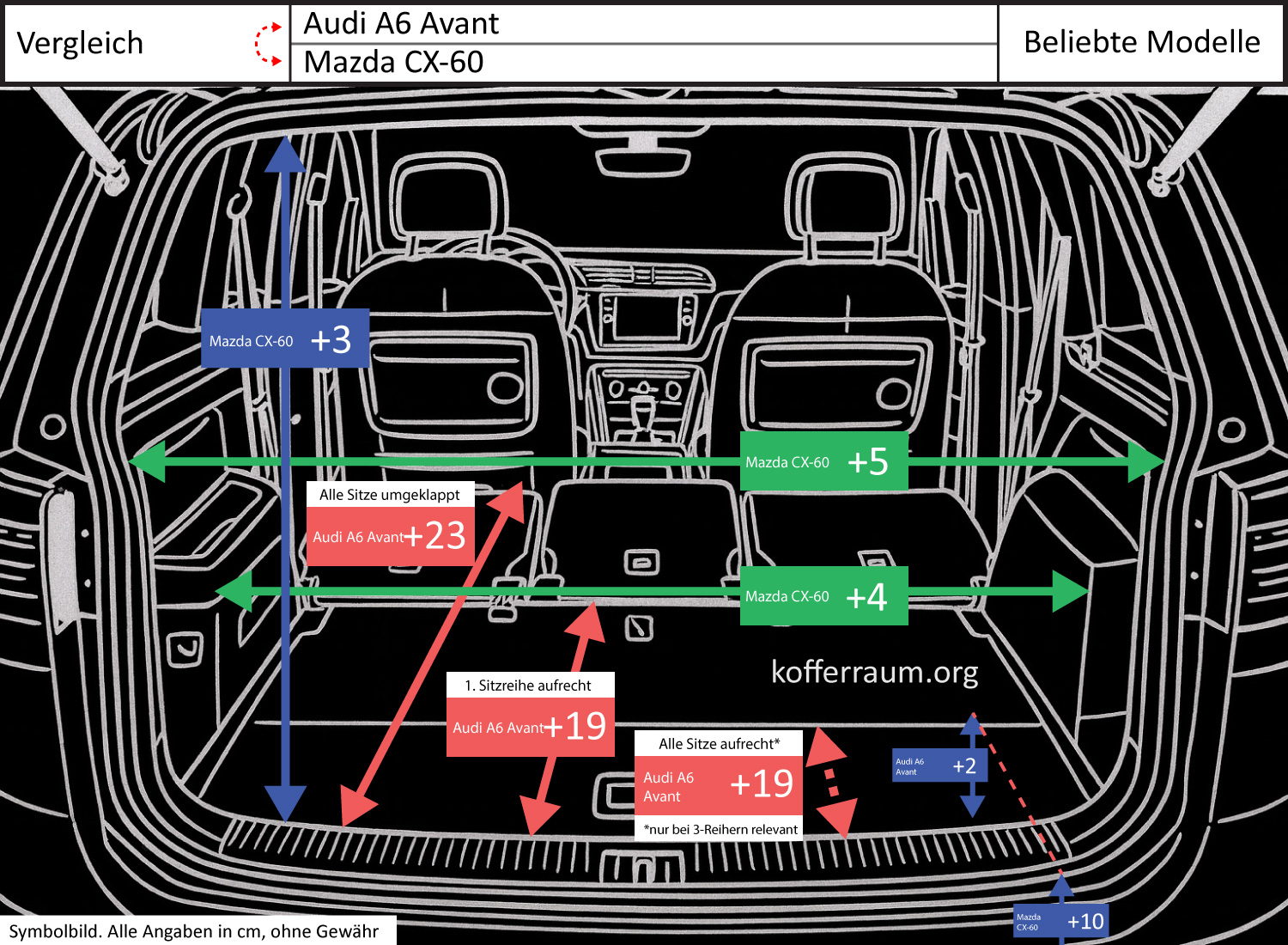
The Audi A6 Avant offers significantly more cargo length: with the seats folded down, the trunk is 9.1 in (13%) longer, and with the first row upright, even 7.5 in (19%) longer than in the Mazda CX‑60. Practically, this means the A6 can accommodate longer items (skis, slats, furniture parts) more easily and is overall more flexible for loading tasks where depth/length matters.
The trunk depth (distance from loading edge → trunk floor) is 0.8 in (100%) greater in the Audi. This means a slightly deeper cargo area below the loading edge, creating more usable volume at the bottom, but lifting heavy items requires a slight lowering and raising motion.
The Mazda's loading edge sits 3.9 in (16%) higher above the road than the Audi's. For users, this means heavy luggage must be lifted higher in the Mazda, while the Audi is more ergonomic for loading heavy loads (lower lever effort).
Other smaller differences (under 10%) moderately affect usability: The Mazda's trunk opening is 1.2 in higher, its narrowest interior width is 1.6 in larger, and the opening width is 2 in wider.
These advantages make the CX‑60 somewhat better suited for bulky, wide, or tall items, but they are smaller than the length and height/loading edge differences mentioned above.
Conclusion: Those who often load long or heavy items and prefer a lower loading edge are better served by the Audi A6 Avant. Those who value a slightly higher opening and marginally more width for bulky/taller items have slight advantages with the Mazda CX‑60.