
Trunk comparison: Audi A6 Avant vs Mercedes Benz CLA Shooting Brake

Key Differences (>10%)
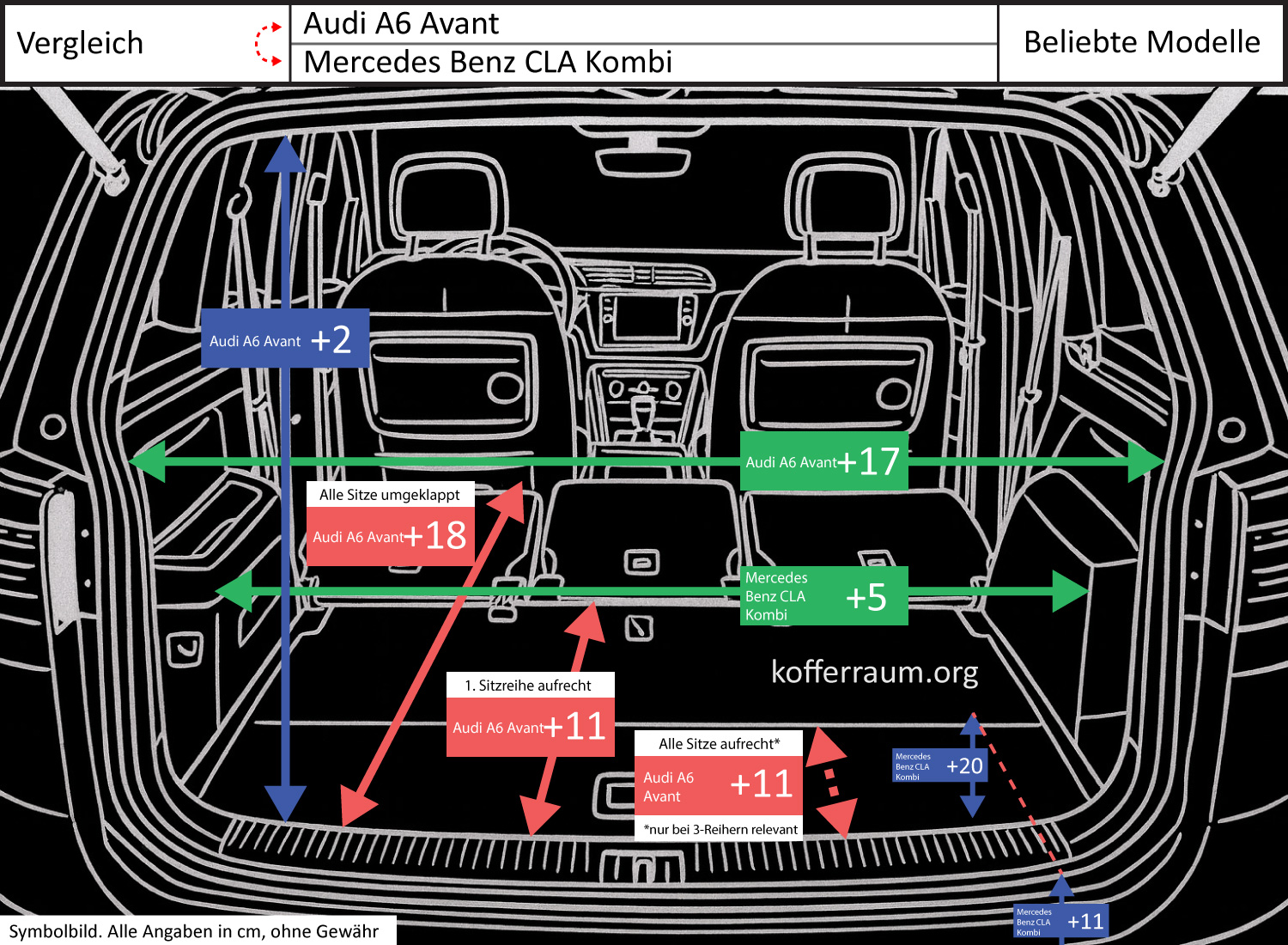
The trunk opening width of the Audi A6 Avant is 6.7 in (≈20%) larger than that of the Mercedes‑CLA Shooting Brake. This significantly facilitates loading wider or bulky items.
The loading edge of the Mercedes‑CLA Shooting Brake is 4.3 in (≈17%) higher above the ground than the Audi. This means more lifting when loading, especially with heavy loads.
The depth of the trunk (distance loading edge → trunk floor) is 7.9 in (≈1000%) greater in the Mercedes than in the Audi. This indicates a significantly deeper, more recessed cargo area.
Other Differences (≤10%)
With the rear seats folded down, the Audi offers about 7.1 in (≈10%) more length, and with the front row upright, about 4.3 in (≈10%) more cargo length. The narrowest trunk width is 2 in (≈5%) larger in the Mercedes. The trunk opening is 0.8 in (≈3%) higher in the Audi.
Impact on Usability
The wider opening in the Audi makes it easier to load wide items (e.g., furniture parts, large boxes) sideways. Those who frequently transport bulky widths or long items benefit from the A6 Avant.
The higher loading edge of the Mercedes makes lifting heavy loads more strenuous and can make frequent loading and unloading less convenient.
However, combined with the significantly greater depth, this means the CLA offers a deeper cargo area where items can slide further in and lie more stably. This can be advantageous for high cargo volume or transporting tall but narrow loads, but it complicates lifting and removing heavy items.
In short: Audi is better for a wide, easily accessible cargo area and lower lifting effort; Mercedes offers more usable cargo depth and slightly more narrow interior width, but at the cost of a higher loading edge and thus greater physical strain when loading.