
Trunk comparison: Audi A6 Sedan vs Hyundai IONIQ
Key Differences
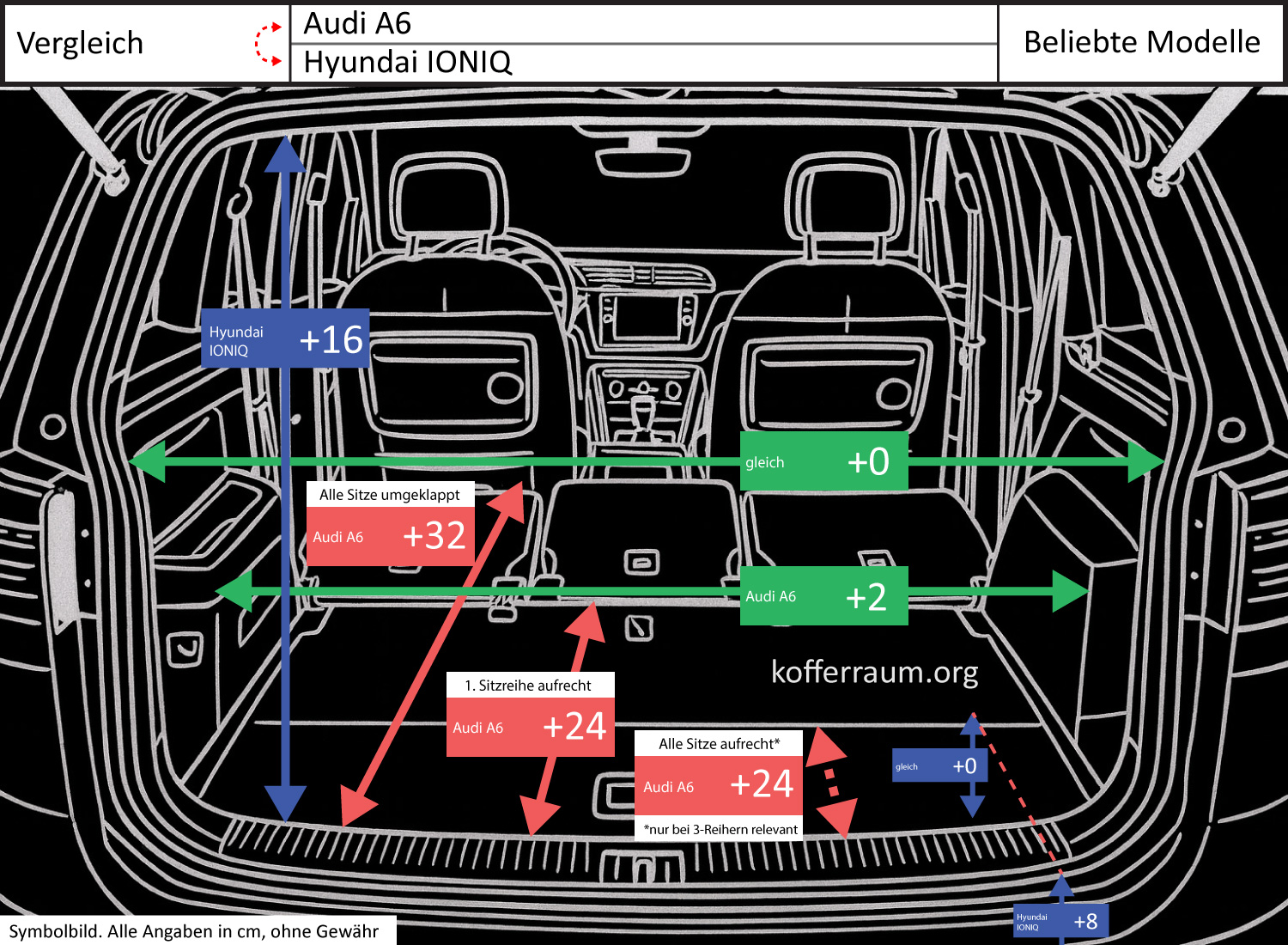
The Audi A6 offers 12.6 in (≈20%) more trunk length with the seats folded down and 9.4 in (≈26%) more length with the first row of seats upright than the Hyundai IONIQ.
The trunk opening of the IONIQ, on the other hand, is 6.3 in (≈32%) higher than that of the A6. Additionally, the loading edge of the IONIQ is 3.1 in (≈12%) higher above the ground.
Depth (loading edge → trunk floor) and width of the trunk opening are the same; the narrowest width in the A6 is only 2% larger (negligible).
What impact does this have on usability?
The longer trunk dimensions of the A6 (≈20–26% more length) make it significantly more practical for long or flat cargo — e.g., skis, long boxes, furniture parts, or opened suitcases.
Even with normal vehicle seat configurations, more usable loading length remains, making the A6 more flexible for transports with variable seat usage.
The higher opening space of the IONIQ (≈32% higher) facilitates loading tall items in the upright position (plants, tall boxes, bulky suitcases) because more vertical space is available at the entrance.
However, the higher loading edge (≈12% higher) of the IONIQ requires more lifting effort when loading and unloading heavy loads — this makes handling heavy items less comfortable compared to the A6, whose lower loading edge eases lifting.
Since depth and opening width are practically the same and the narrowest point only slightly favors the A6, width restrictions hardly matter in practice.
In summary: Audi A6 = better for long, flat, and heavy loads (more usable length, lower loading edge). Hyundai IONIQ = better for tall, bulky items thanks to greater opening height, but less comfortable when lifting heavy loads due to higher loading edge.