
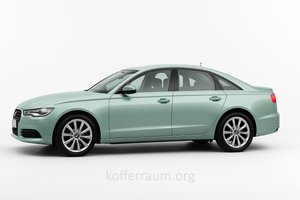
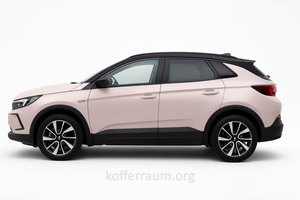
Trunk comparison: Audi A6 Sedan vs Opel Grandland
Key Differences
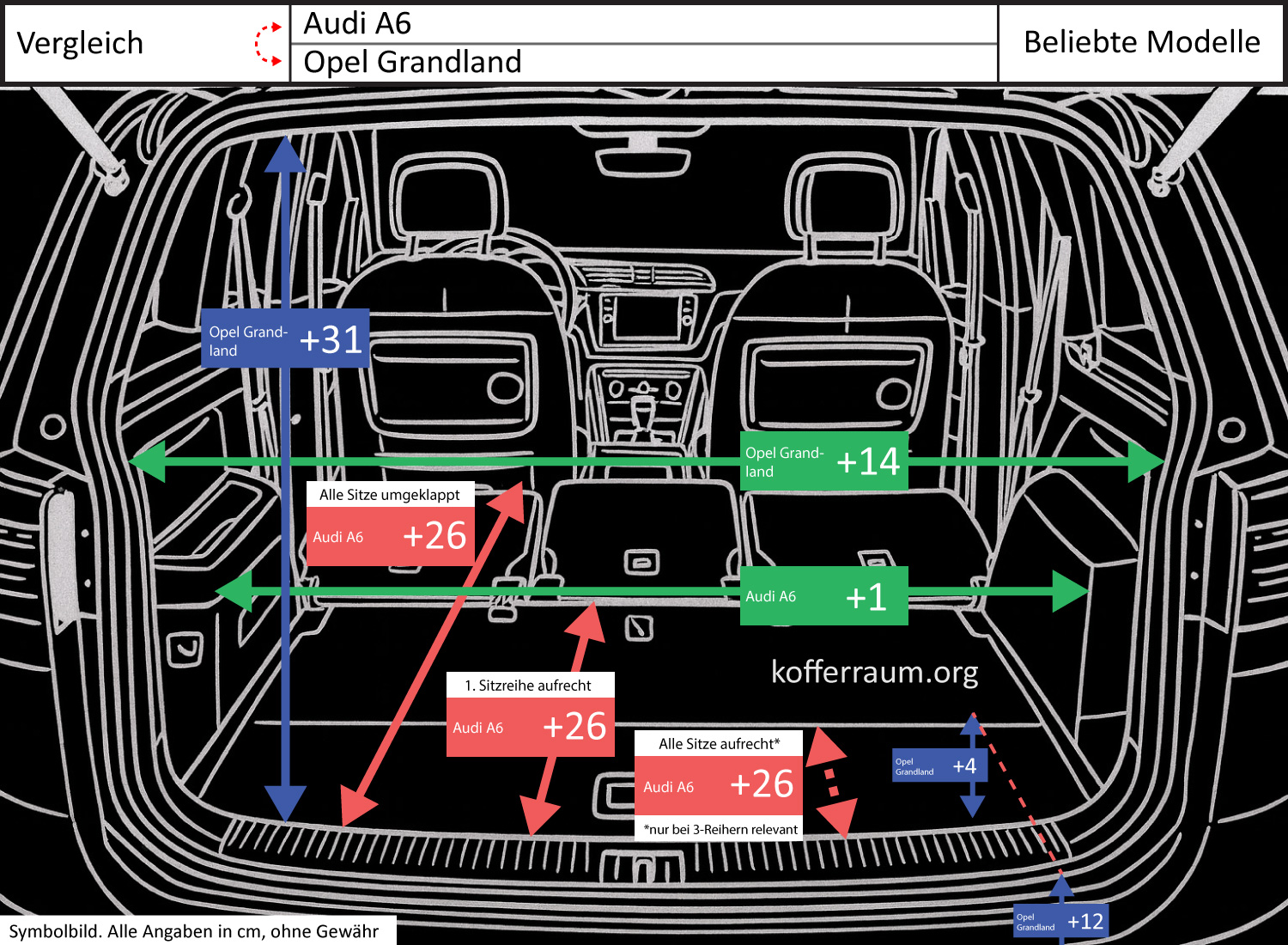
In terms of cargo space, the Audi A6 is noticeably longer: with the rear seats folded down, it is +10.2 in (15%) longer and with the front seats upright, even +10.2 in (29%) longer than the Opel Grandland.
Conversely, the Opel Grandland offers larger openings and heights: the height of the trunk opening is +12.2 in (62%) greater on the Grandland, and the width of the trunk opening is +5.5 in (15%) wider than on the A6. Additionally, the measured depth from the loading edge to the trunk floor is +1.6 in (33%) greater on the Grandland, and the loading edge above road level is +4.7 in (18%) higher than on the Audi.
The narrowest width inside the trunk differs very little (Audi +0.4 in / 1%) and is negligible.
Impact on Usability
The longer loading surface of the Audi A6 makes it better suited for long, slender items (e.g., furniture boards, skis, long pipes) and for situations where length is more important than opening dimensions. The lower loading edge of the A6 also makes handling heavy items easier, as less lifting is required.
The Opel Grandland is more advantageous when it comes to loading wide or tall, bulky items: the significantly larger opening height and width facilitate maneuvering bulky objects into the trunk.
The greater depth near the loading edge additionally provides more usable storage space immediately behind the threshold. However, the higher loading edge makes lifting heavy loads more difficult compared to the Audi.
In summary: Audi A6 = advantageous for longer and heavier loads (longer loading surface, lower loading edge). Opel Grandland = advantageous for bulky, wide, or tall items (larger opening dimensions and deeper loading sill groove), but with higher physical effort when loading due to the elevated loading edge.