
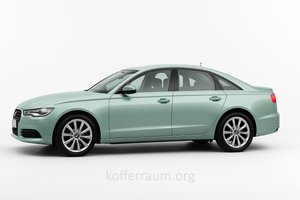
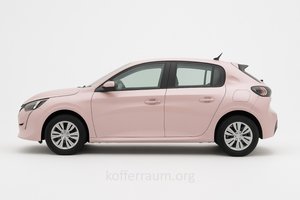
Trunk comparison: Audi A6 Sedan vs Peugeot 208
Key Differences
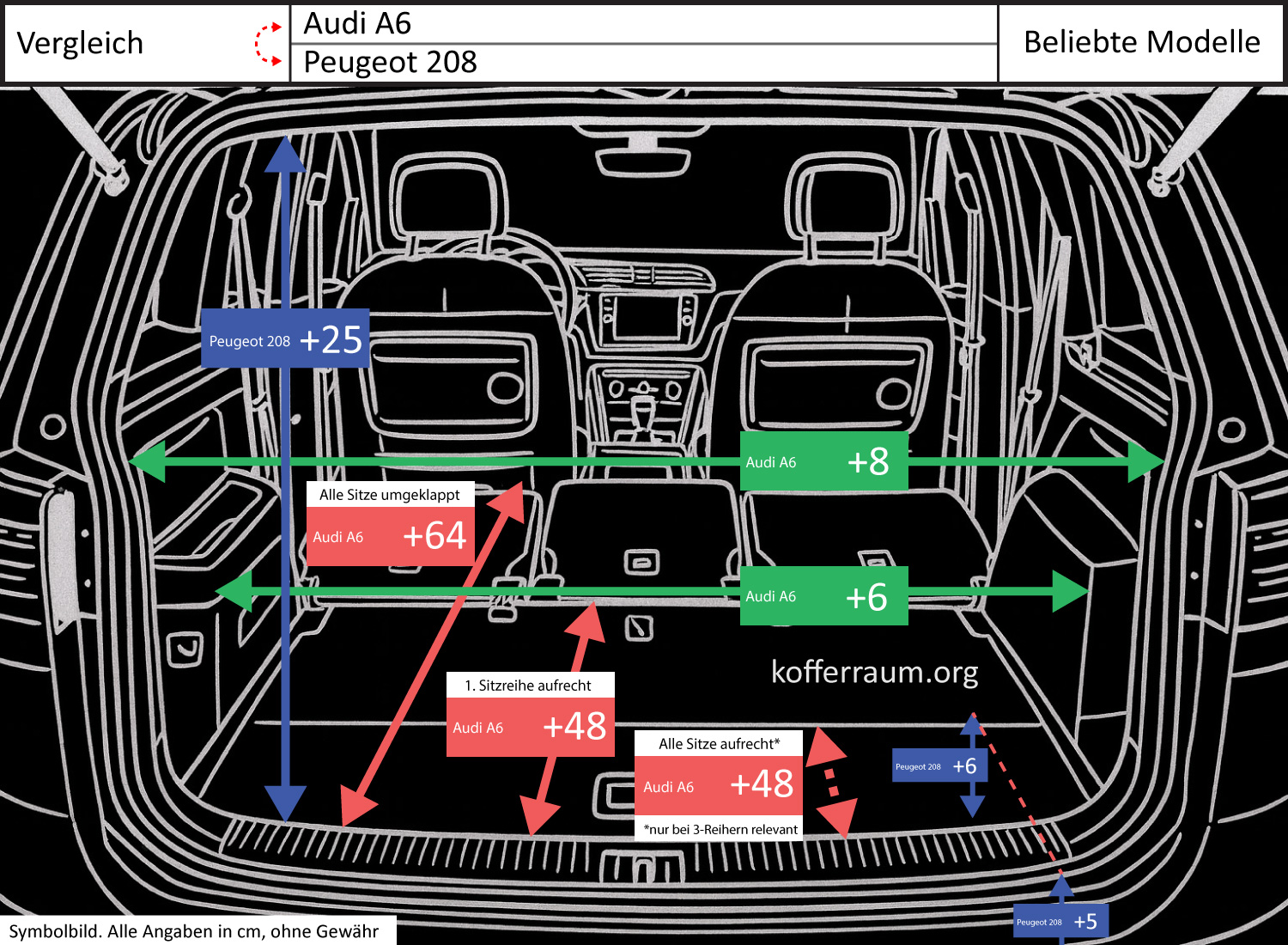
Clear focuses emerge in cargo volume and trunk shape: The Audi A6 offers significantly more cargo length — with the seats folded down, the A6 is 25.2 in (49%) longer and with the front seats upright, 18.9 in (72%) deeper than the Peugeot 208. In contrast, the Peugeot has advantages in the vertical dimension: the height of the trunk opening is 9.8 in (50%) larger and the depth (loading edge to trunk floor) is 2.4 in (50%) higher than in the A6. Smaller differences under 10% include the Peugeot's 2 in (8%) higher loading edge and the slightly greater width of the A6 at its narrowest point (+2.4 in, 6%) as well as the somewhat larger trunk opening of the A6 (+3.1 in, 9%).
Impact on Usability
The longer cargo areas in the Audi A6 make it significantly better suited for long or flat items (e.g., furniture parts, long packages, skis) and for users who frequently transport bulky, lengthwise-loaded cargo. Even with the rear seats up, the A6 maintains an advantage in volume and cargo area.
The Peugeot 208 is advantageous for tall, bulky cargo: the larger opening height and greater trunk depth make loading tall boxes, upright luggage, or bulky items easier because more vertical space is available.
However, the slightly higher loading edge (≈2 in) makes lifting heavy loads somewhat more difficult than in the A6.
In practice, this means: Those who regularly transport long or flat-loadable items benefit from the Audi A6. Those who more often load tall, bulky items or many stackable suitcases and for whom vertical capacity is more important than length reserve are better served by the Peugeot 208. Smaller width differences play only a minor role in many everyday scenarios.