Trunk comparison: Audi A6 Sedan vs Renault Austral

Loading Length and Volume
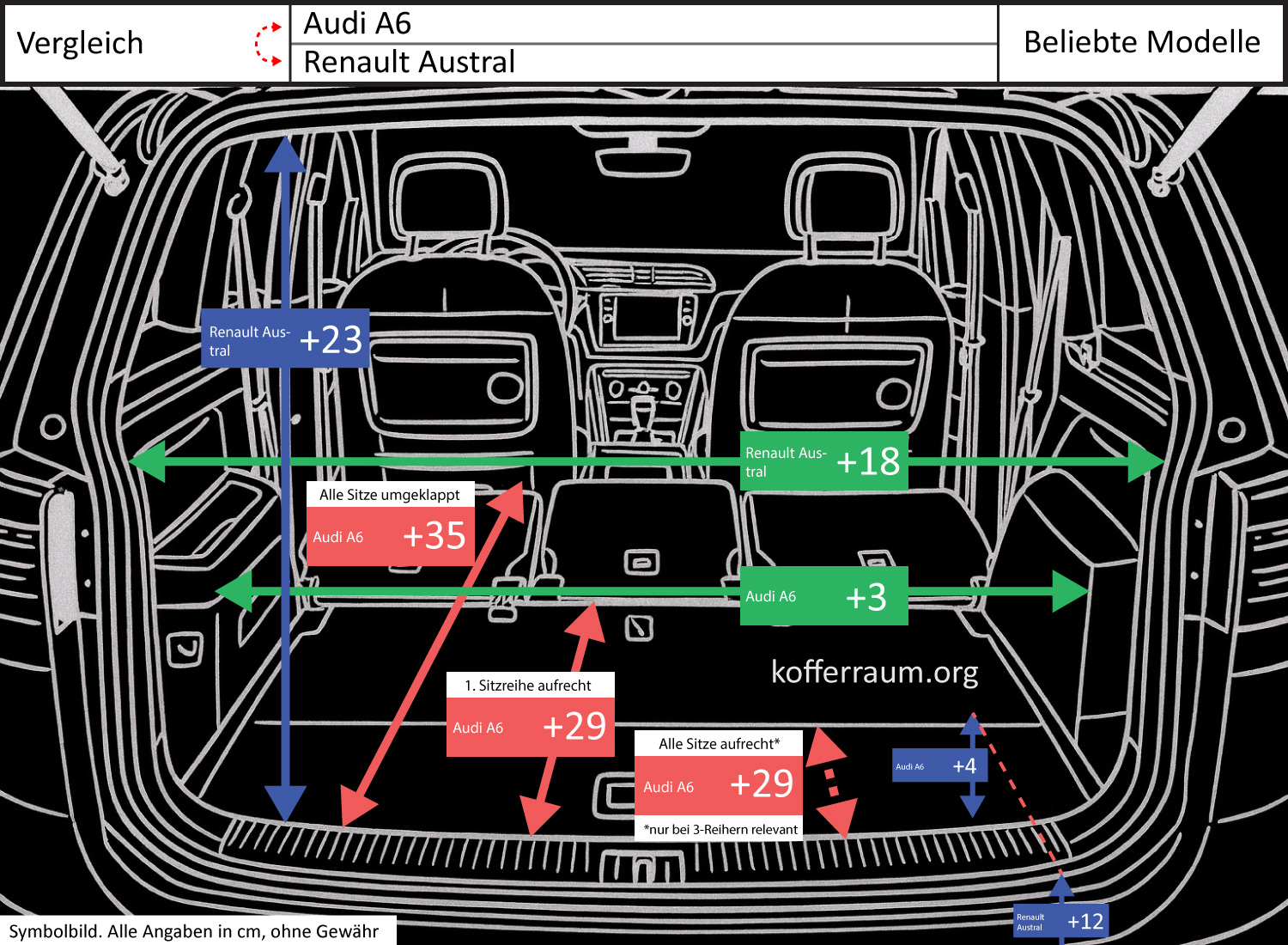
The Audi A6 offers significantly more loading length: with the seats folded down, the trunk is +13.8 in (22%) longer, and with the front seats upright even +11.4 in (34%) longer than the Renault Austral.
This makes the A6 more practical for long items (e.g., slats, skis, furniture parts) and provides more usable volume with the seats folded down.
Accessibility of the Opening and Interior Height
The Renault Austral has a significantly larger trunk opening: the opening width is +7.1 in (19%) wider and the opening height +9.1 in (46%) higher than the Audi A6. This facilitates loading bulky or tall items (e.g., strollers, boxes, bulky furniture parts) and reduces the risk of bumping into the loading opening.
Loading Height and Load Floor
The loading edge of the Renault Austral is +4.7 in (18%) higher above the road than the Audi A6, which makes lifting heavy loads more difficult.
At the same time, the depth of the trunk (loading edge to floor) in the Audi A6 is +1.6 in (50%) greater, so the Audi offers somewhat more "vertical space" behind the loading edge inside.
Practically, this means: the A6 is easier to load with heavy items (lower loading edge) and offers more insertion depth at that point, while the Austral favors inserting tall or bulky parts through the larger opening but requires lifting to the higher loading edge.
Width at the Narrowest Point
The narrowest point of the loading area differs little: the Audi is only +1.2 in (3%) wider here — which is usually negligible in practice.
Conclusion — Which Differences Affect Usability?
Key points for the decision: If you frequently transport long or heavy items and value easy loading and unloading, the Audi A6 is more practical due to its greater loading length, lower loading edge, and deeper load floor.
If, on the other hand, you often transport bulky, tall, or wide items loaded from the front (strollers, tall boxes, wider equipment), the Renault Austral scores with a significantly larger opening height and width — the downside is the higher loading edge, which makes lifting more difficult.