
Trunk comparison: Audi A6 Sedan vs Tesla Model 3
Key Differences (Brief Summary)
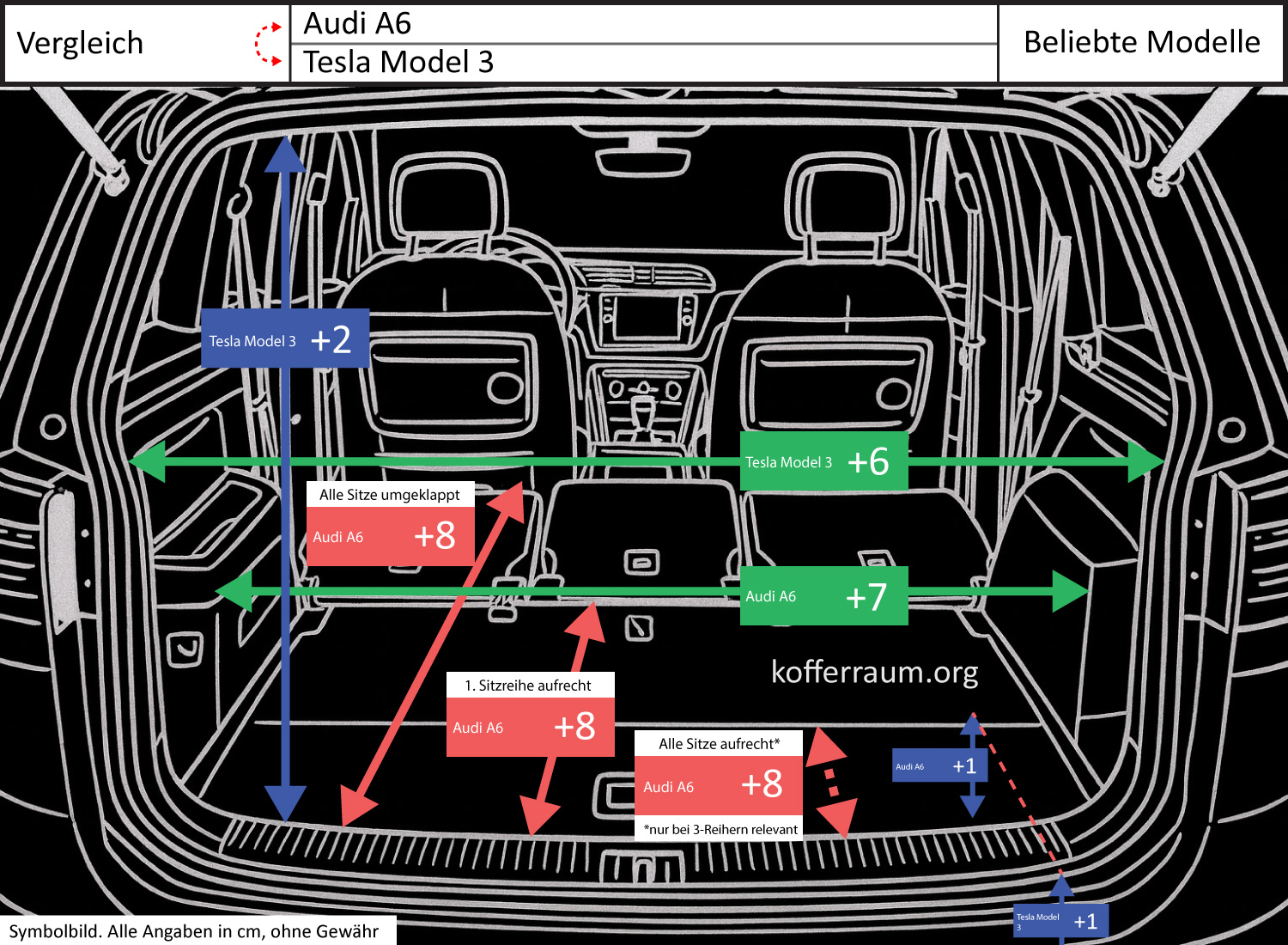
No measured difference exceeds 10%. The largest deviations in favor of the Audi A6 are: trunk length 3.1 in longer with folded seats (+4%) and 3.1 in longer with the front seats upright (+7%), trunk depth (loading edge → trunk floor) 0.4 in greater (+9%), as well as the narrowest trunk width 2.8 in wider (+7%).
In favor of the Tesla Model 3 are the trunk opening 0.8 in higher (+4%), the opening width 2.4 in wider (+6%), and the loading edge 0.4 in higher above the ground (+2%).
Impact on Usability
Since no difference is greater than 10%, all differences are rather minor and hardly decisive in most everyday scenarios. Practically, the measurements mean the following:
- Audi A6: The slightly longer loading area (each +3.1 in) and the greater depth (+0.4 in) make the A6 better suited for long items (e.g., slats, skis, longer furniture parts) and provide a bit more room for flat, longitudinally loaded items.
The larger minimum interior width (+2.8 in) makes it easier to load wider or irregularly shaped cargo when it needs to be placed deeper in the trunk.
- Tesla Model 3: The greater opening height (+0.8 in) and wider opening (+2.4 in) make it easier to maneuver bulky or tall items through the opening; in practice, this means less spreading, edge, or angle issues when loading through the opening.
However, the loading edge is 0.4 in higher, which makes lifting somewhat more strenuous than in the A6.
Conclusion
The differences are small and do not lead to a clear superiority in all use cases. The decisive factor is the usage profile: For frequent transport of longer, wider items, the Audi A6 is minimally advantageous.
For easier maneuvering of bulky items through the opening, the Model 3 is slightly more practical. In typical everyday scenarios, however, the effects are usually negligible.