
Trunk comparison: Audi A6 Sedan vs Volvo V90
Key Differences
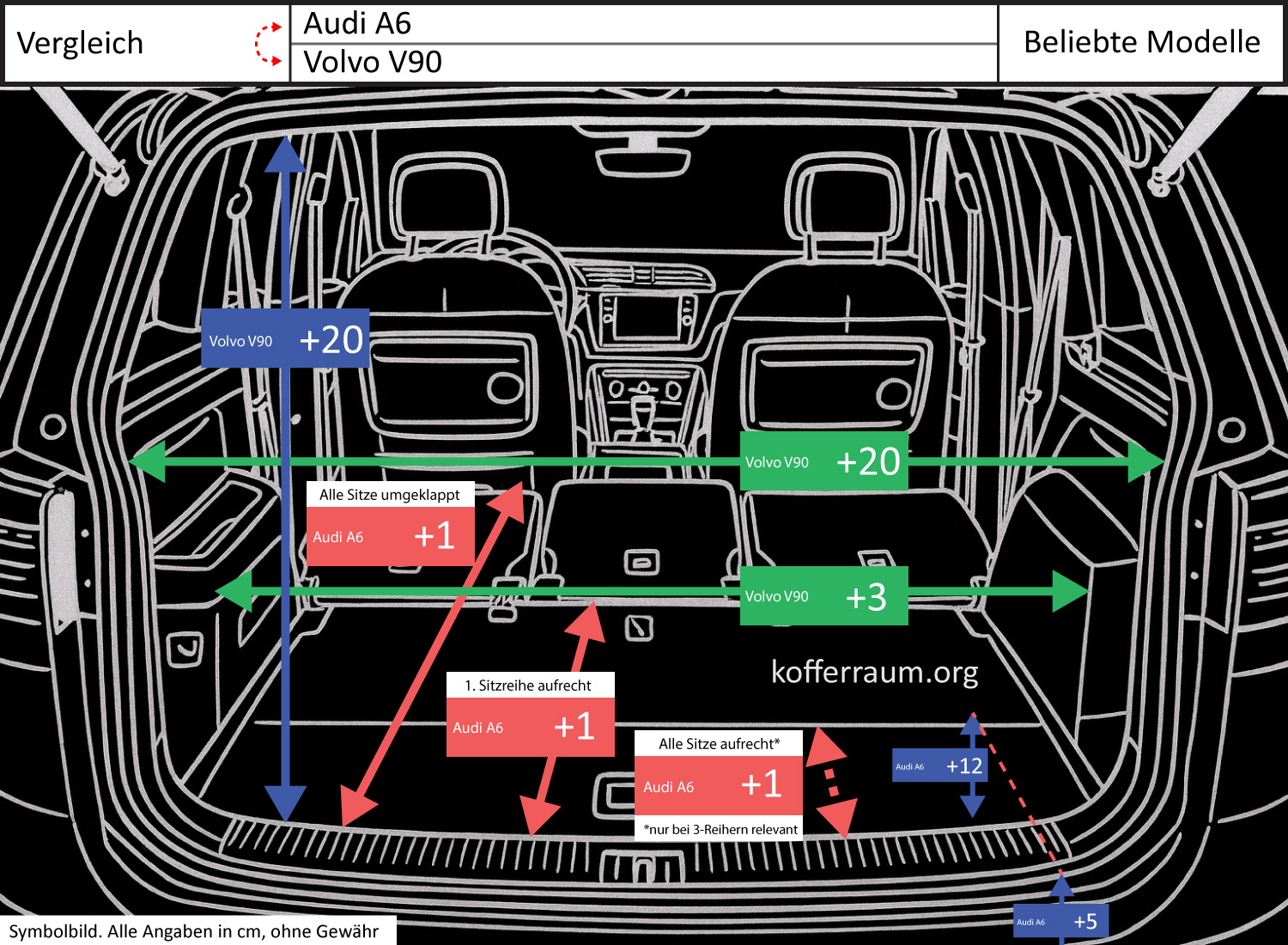
The trunk opening of the Volvo V90 is 7.9 in (≈40%) higher than that of the Audi A6. The result: tall or bulky items can be slid or stood up more easily and with less tilting through the opening.
The depth of the trunk (loading edge → trunk floor) is 4.7 in (≈1100%) greater in the Audi A6. This means the A6 offers significantly more space "downwards" behind the loading edge — advantageous for long or flat cargo that should be placed low, and for better stacking in the trunk footwell.
The width of the trunk opening is 7.9 in (≈21%) larger in the Volvo V90. This makes loading and unloading wider items (e.g., strollers, furniture parts, wide boxes) considerably easier.
Impact on Practical Usability
Volvo V90 — Practical advantages: The higher and wider opening makes it easier to load bulky, tall, or wide items. Less maneuvering when inserting large parts reduces effort and risk of damage. For families, craftsmen, or users who often transport unwieldy parts, the V90’s opening fit is more practical.
Audi A6 — Practical advantages: The significantly deeper trunk floor behind the loading edge creates more usable volume for long, flat, or stacked goods.
Those who regularly need to store longer items flat or optimize volume benefit from the A6. The slightly higher loading edge (only ~2 in difference, not >10%) can minimally complicate lifting heavy loads.
Smaller differences such as the 0.4 in longer total loading length with folded seats or the 1.2 in greater narrowest width in the V90 are negligible in practice and hardly affect everyday usability.
Conclusion
For frequent loading of tall or wide objects, the Volvo V90 is more practical due to the larger and higher opening.
For users who need more "depth" and better interior volume behind the loading edge (long, flat cargo, stacking), the Audi A6 offers clear advantages. The choice depends on typical cargo: bulky/tall/wide → V90; long/flat/stacked → A6.