Trunk comparison: Audi A6 Sedan vs VW ID.3
Key Differences
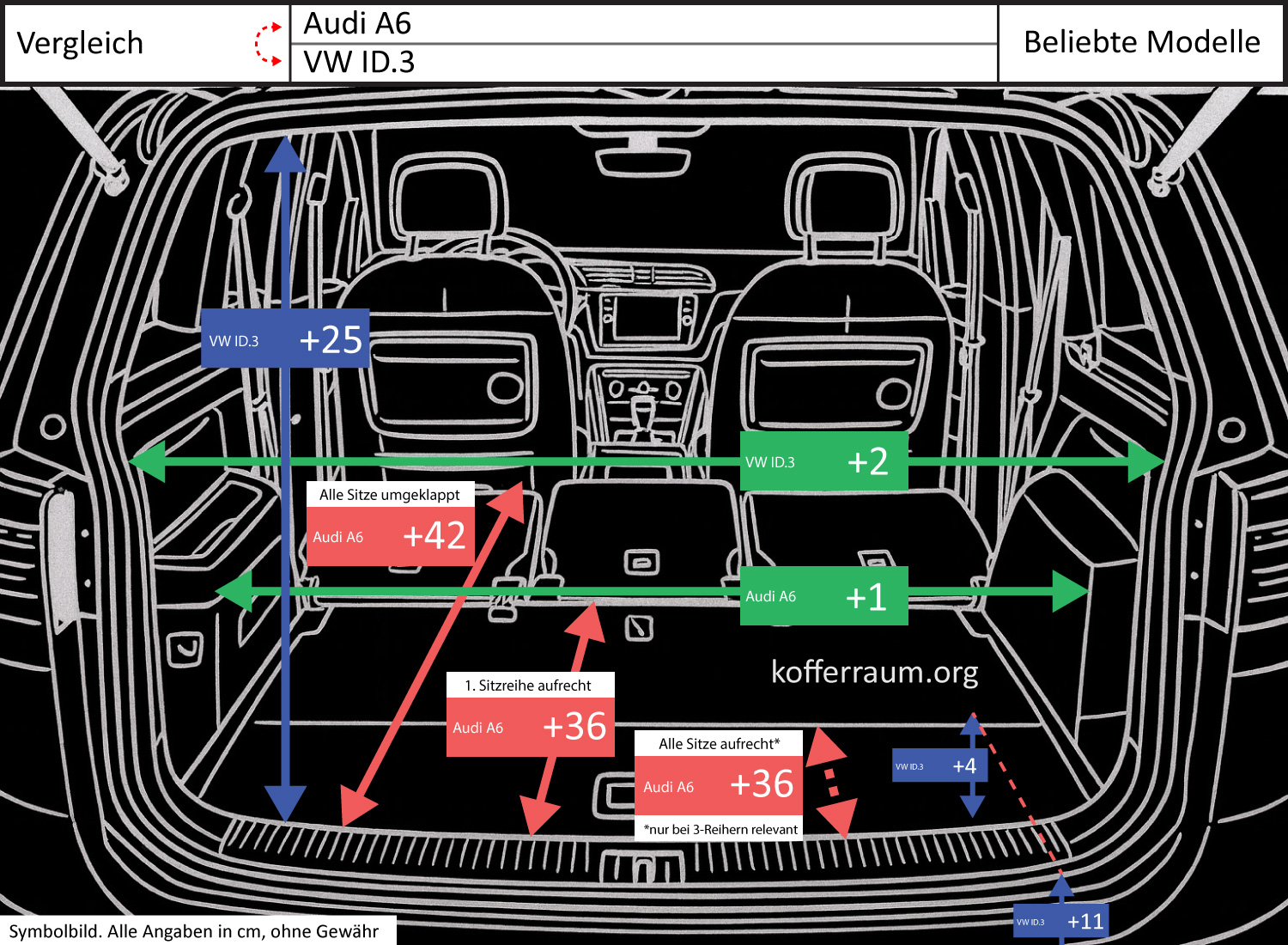
The Audi A6 offers a significantly longer loading length: with the seats folded down, the trunk of the A6 is 16.5 in (27%) longer, and with the first row of seats upright, it is even 14.2 in (46%) longer than the VW ID.3. In contrast, the VW ID.3 has a significantly higher trunk opening (+9.8 in / 50%) and a greater depth from the loading edge to the trunk floor (+1.6 in / 33%) compared to the A6. Additionally, the loading edge of the ID.3 is 4.3 in (17%) higher above the road than that of the A6. Differences in width (±1–0.8 in) are negligible.
What does this mean in practice?
More loading length in the Audi A6 means: longer items (e.g., ladders, slats, skis, long furniture parts) can be transported more easily and more often, often without additional measures like roof racks or strong angling. The A6 is also more flexible when transporting bulky, elongated cargo.
The higher trunk opening and greater installation depth of the VW ID.3 make it easier to load tall or bulky items that are more vertical than long (e.g., suitcases, boxes, tall box furniture). The larger opening allows bulky parts to be inserted more easily.
However, the higher loading edge of the ID.3 increases the effort required to lift heavy items into the vehicle and makes sliding or roll-based loading (e.g., roll cages) more difficult.
The A6, with its lower loading edge, is more practical here — especially for frequent transport of heavy loads like toolboxes or groceries.
Conclusion: Those who regularly need to transport long items or prefer less lifting effort are better served by the Audi A6. Those who more often load tall or bulky but not necessarily heavy items benefit from the higher opening and depth of the VW ID.3 — but must accept the higher loading edge.