
Trunk comparison: Audi A6 Sedan vs VW T-Cross
Key Differences and Impact on Usability
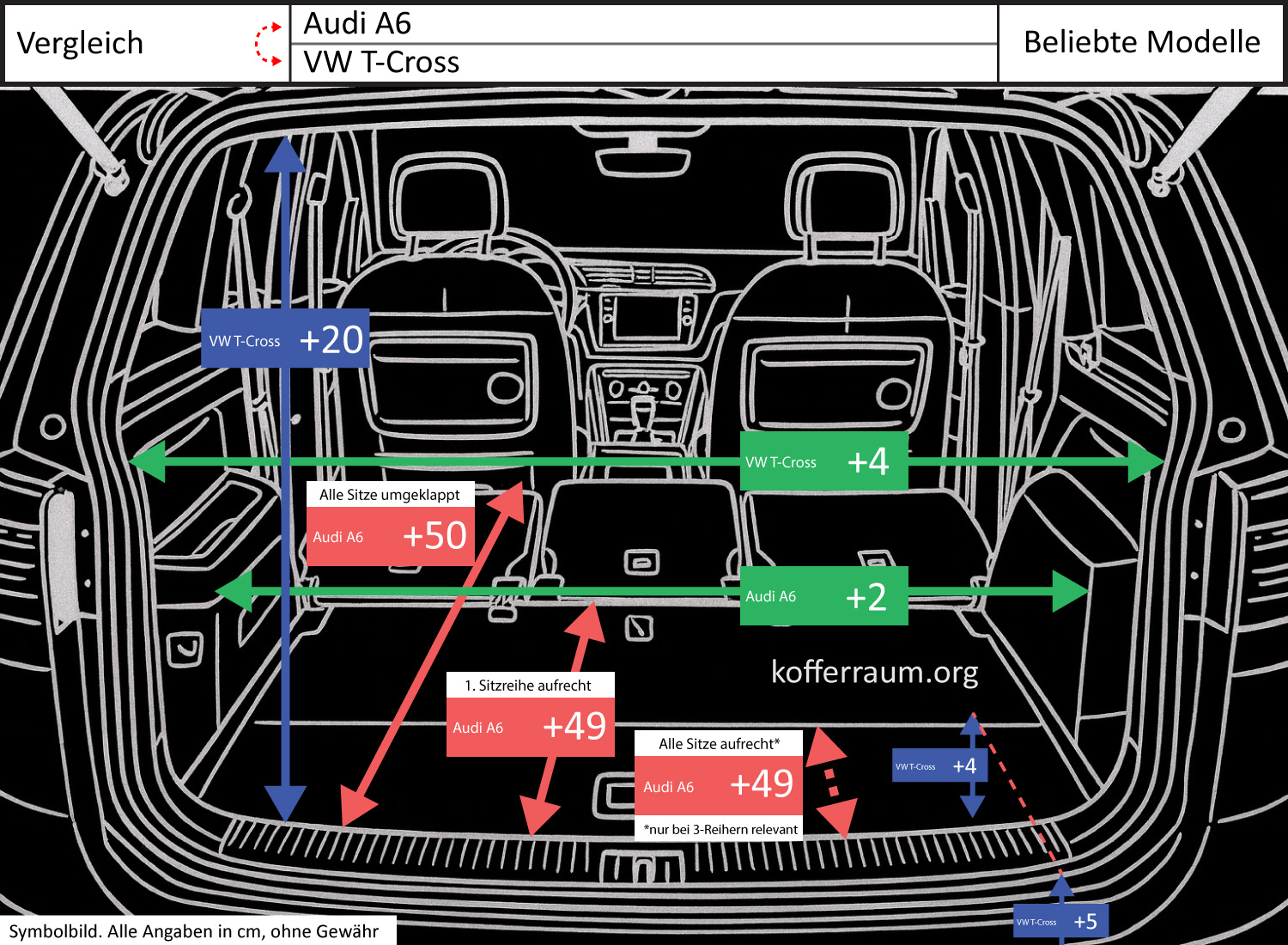
The Audi A6 offers significantly more loading length: about +19.7 in (34%) with the seats folded down and about +19.3 in (74%) with the seats upright compared to the VW T-Cross.
This makes the A6 clearly more suitable for long items (e.g., furniture parts, skis, long boxes) and for situations where a lot of usable loading length is needed without sacrificing space.
The VW T-Cross, on the other hand, scores in the height and depth of the trunk: the trunk opening is about +7.9 in (40%) higher and the depth (loading edge → trunk floor) is about +1.6 in (33%) greater than in the A6. This facilitates loading taller or bulkier items (upright boxes, beverage crates, plants) and offers more vertical storage space for stacking.
Other measured differences are less than 10%: the loading edge of the T-Cross is ~+2 in (8%) above the road — slightly more effort when lifting —, the narrowest trunk spot is about ~+0.8 in (2%) wider in the A6, and the trunk opening of the T-Cross is ~+1.6 in (4%) wider.
These deviations are usually negligible in practice.
Conclusion: For long or very length-oriented cargo, the Audi A6 is the better choice. For bulky, rather tall or upright cargo as well as more comfortable loading of tall items, the VW T-Cross is preferable.
The decision ultimately depends on the typical cargo profile (lengthwise vs. tall/bulky) and ergonomic requirements during loading/unloading.