
Trunk comparison: Audi Q3 vs Dacia Jogger

Key Differences
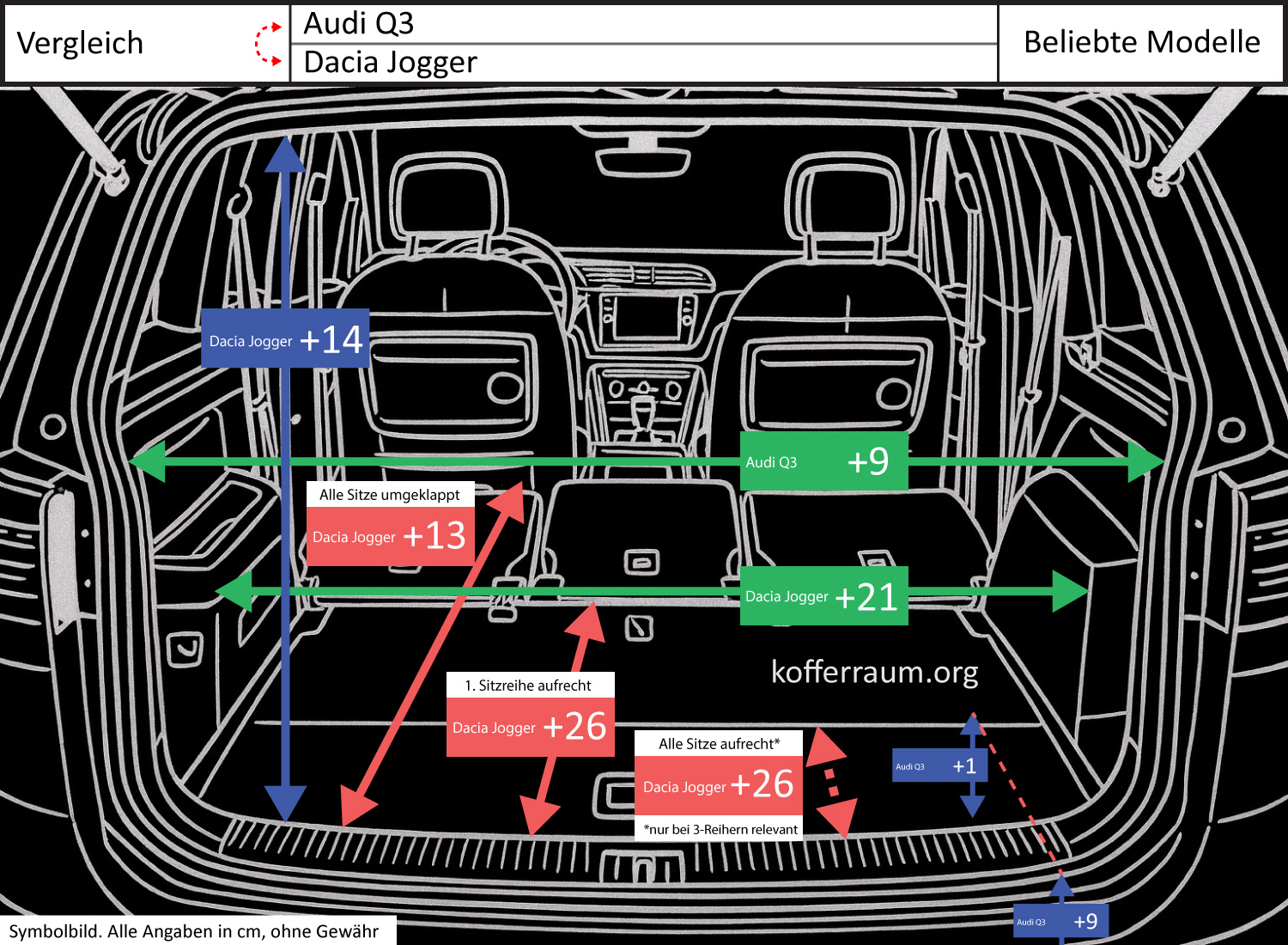
The Dacia Jogger offers +10.2 in (29%) more trunk length with the first row of seats upright than the Audi Q3 and has a trunk opening that is +5.5 in (18%) higher.
The narrowest point in the cargo area is +8.3 in (21%) wider in the Jogger than in the Q3. The Audi Q3 has two relevant advantages: the trunk depth (loading edge to trunk floor) is +0.4 in (13%) greater and the loading edge itself is +3.5 in (14%) higher above the ground than in the Jogger.
What this means for usability
- More length with rear seats upright (Jogger): Specifically means more usable cargo space when passengers are seated in the back — beneficial for families, shopping, or luggage in everyday use. Large, long items can be more easily accommodated in the Jogger with passengers on board.
- Higher trunk opening (Jogger): Increased vertical clearance makes loading tall items (e.g., crates, tall boxes, upright strollers) easier and reduces the risk of damage when inserting large parts.
- Larger minimum trunk width (Jogger): A wider narrow point means wide items (e.g., furniture parts, bulky sports equipment) are more likely to fit without disassembly or angling.
- Greater trunk depth measurement (Audi Q3): An interior that is 0.4 in deeper (according to the spec +0.4 in) can offer slightly more usable volume below the loading edge, but this is less relevant in practice than width and opening height.
- Higher loading edge (Audi Q3): The loading edge that is 3.5 in higher makes lifting heavy items into the trunk more strenuous and increases the risk of slipping while loading. For frequent loading of heavy loads, the Jogger is therefore more comfortable.
Summary
Practically, this means: The Dacia Jogger is better suited for transporting wide, tall, or long items with the rear seats occupied — it offers significantly more everyday utility when loading.
The Audi Q3 has small advantages in depth but loses practicality due to the higher loading edge when frequently lifting heavy loads. Differences below 10% (e.g., +5.1 in with seats fully folded or +3.5 in opening width in favor of the Q3) are less relevant in practice.