Trunk comparison: Audi Q3 vs Ford S-MAX

Key Differences
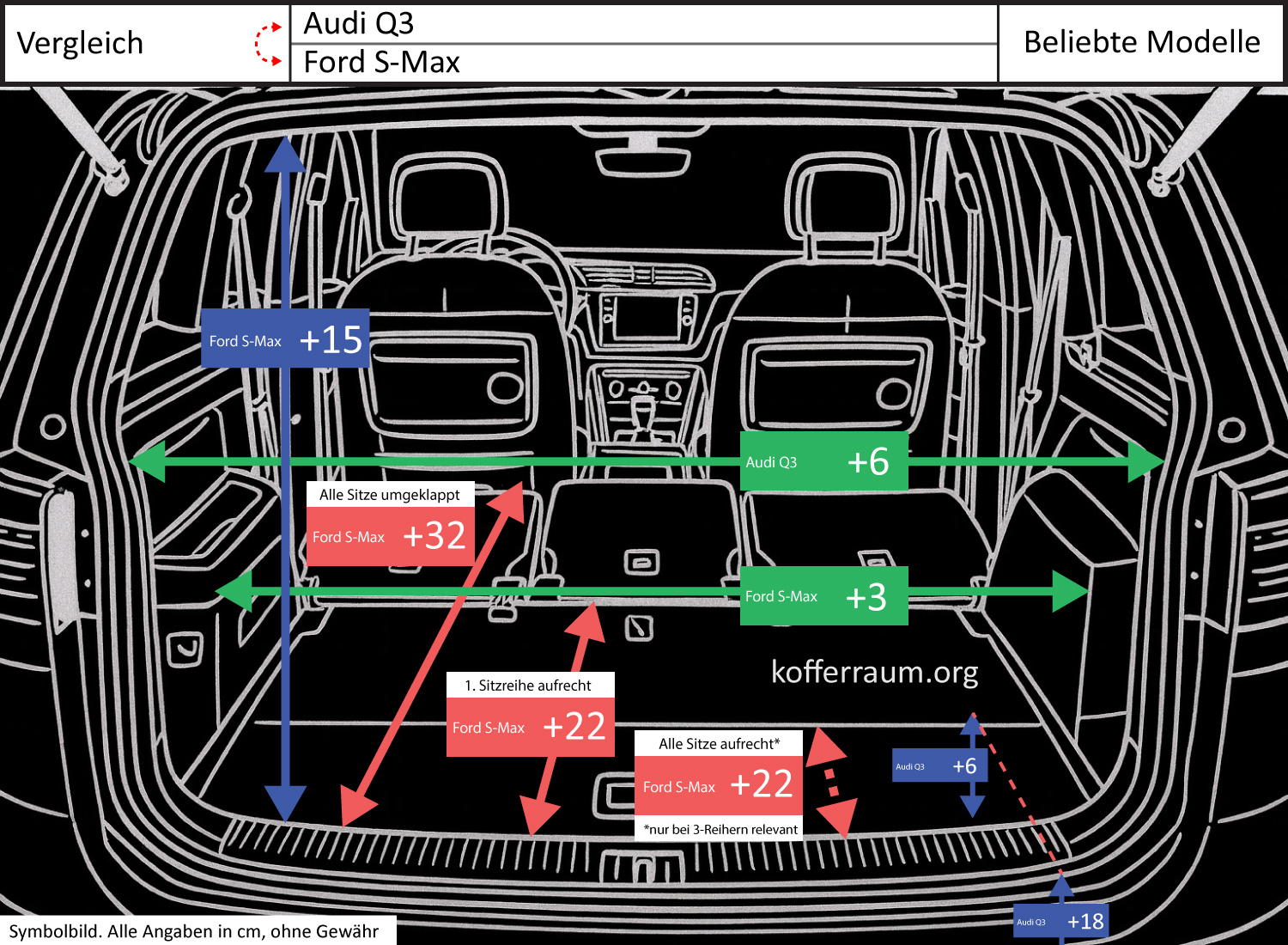
The Ford S-Max offers 12.6 in (19%) more cargo length with the seats folded down than the Audi Q3 and 8.7 in (24%) more cargo length with the first row of seats upright.
Additionally, the trunk opening of the S-Max is 5.9 in (19%) higher than that of the Q3. The Audi Q3, on the other hand, has a significantly greater depth between the loading edge and the trunk floor: 2.4 in (200%) deeper than the S-Max.
Furthermore, the loading edge of the Q3 is 7.1 in (32%) higher above the ground. Smaller differences: the narrowest width of the S-Max is only 1.2 in (3%) larger and the width of the Q3’s trunk opening is 2.4 in (6%) larger — these values are under 10% and are usually negligible in practice.
Impact on Usability
Long or bulky items: Due to the significantly greater length with folded seats (+12.6 in / 19%) and with the first row upright (+8.7 in / 24%) as well as the higher opening (+5.9 in / 19%), the Ford S-Max clearly has the advantage.
It is easier to load long furniture, boards, or trunk-height luggage because more length and a higher pass-through height are available.
Tall cargo and volume distribution: The Audi Q3 offers a deeper recess between the loading edge and trunk floor (+2.4 in / 200%), which means large items can sit deeper in the vehicle and the cargo is somewhat "embedded." This can reduce shifting and is advantageous for high interior volume.
However, this is offset by the higher loading edge of the Q3 (+7.1 in / 32%): heavy cargo must be lifted significantly higher, which makes loading and unloading more difficult.
In summary: For transporting long or tall items and convenient loading, the Ford S-Max is more user-friendly.
The Audi Q3 offers a deeper cargo floor, which can be useful for secure tie-downs and space-saving lowering of items, but the higher loading edge makes lifting heavy loads considerably more strenuous. Smaller width differences are practically hardly noticeable.