
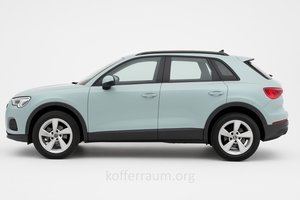
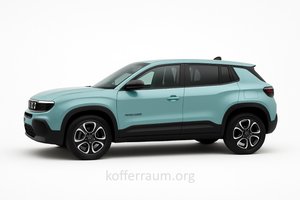
Trunk comparison: Audi Q3 vs Jeep Avenger Electric
Key Differences
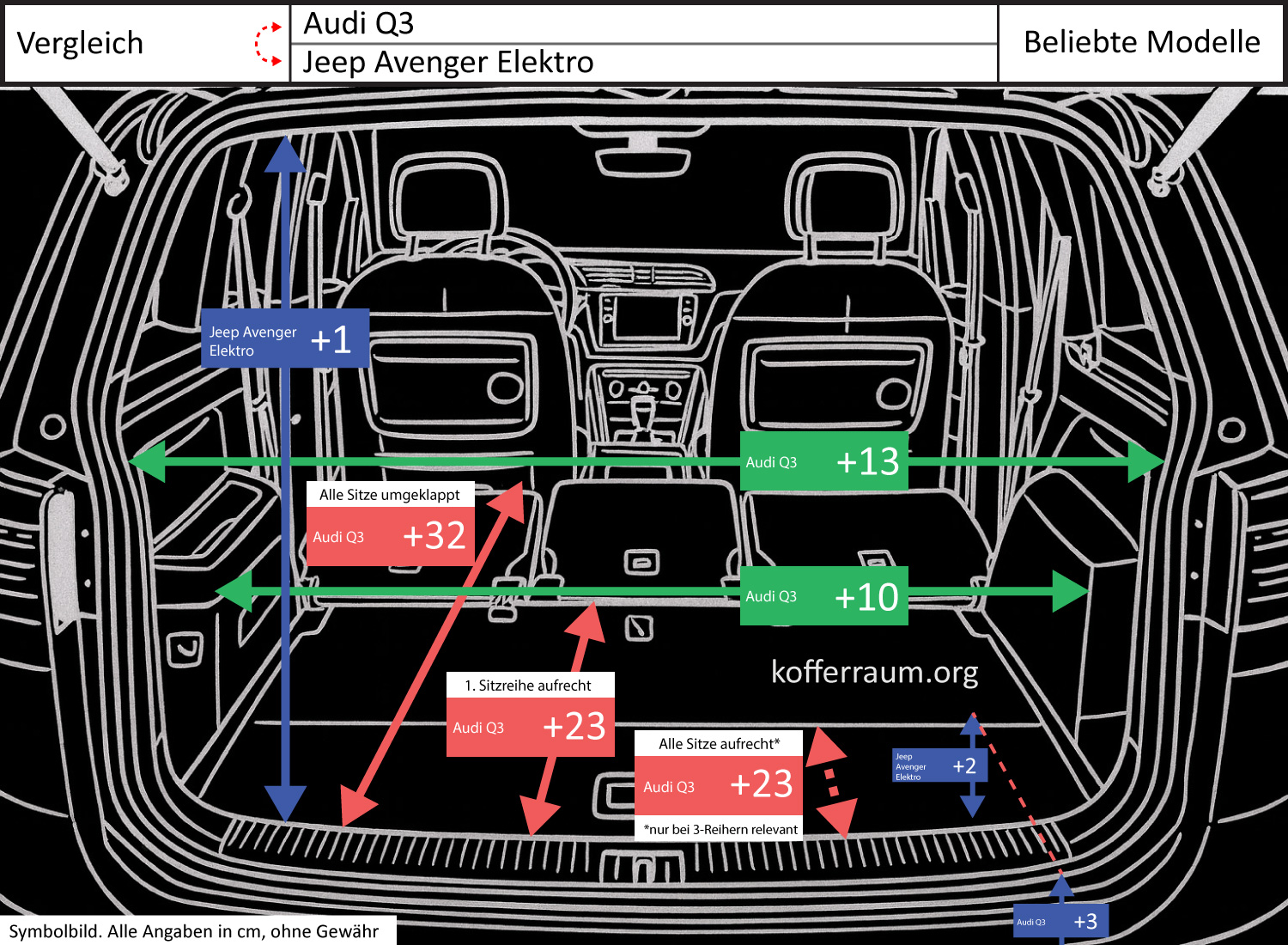
The Audi Q3 offers significantly more cargo space in length: with the seats folded down, the trunk of the Q3 is +12.6 in (24%) longer, and with the first row of seats upright, it is even +9.1 in (34%) longer than the Jeep Avenger Electric.
The Q3 also has an advantage in width: the narrowest point of the trunk is +3.9 in (11%) wider, and the width of the trunk opening is +5.1 in (13%) wider than the Avenger.
In contrast, the Jeep has a +0.8 in (22%) greater depth between the loading edge and the trunk floor. Smaller differences: the height of the trunk opening is only +0.4 in (1%) higher in the Avenger, and the loading edge of the Q3 is +1.2 in (4%) higher above the ground.
Impact on Usability
The longer loading surface and greater width of the Audi Q3 make it significantly more suitable for long and wide items (e.g., slats, furniture parts, long skis, strollers) as well as for flexible stacking of suitcases and bulky luggage.
The larger opening and greater width also make it easier to load bulky parts at an angle or from the side.
The deeper loading floor of the Jeep Avenger (greater depth between loading edge and floor) creates a deeper cargo well, which is well suited for sinking loose or unstable cargo deeper and securing it better.
Combined with the slightly lower loading edge (the Jeep has the loading edge 1.2 in lower), this means slightly easier lifting of heavy items, but the available length and width are more limited, so long or very wide parts often do not fit or must be loaded at an angle.
Conclusion: For maximum length, width, and flexibility when transporting bulky items, the Audi Q3 is more advantageous.
The Jeep Avenger offers advantages in securing lower-lying cargo and loading heavy individual parts due to the deeper cargo well and slightly lower loading edge but is overall less suitable for long or wide loads.