
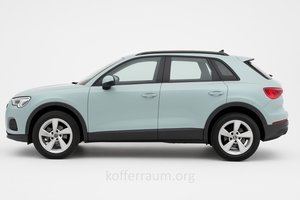
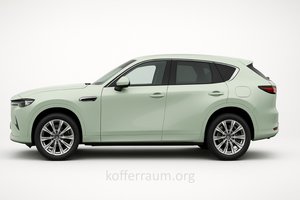
Trunk comparison: Audi Q3 vs Mazda Mazda CX-60
Key Statement
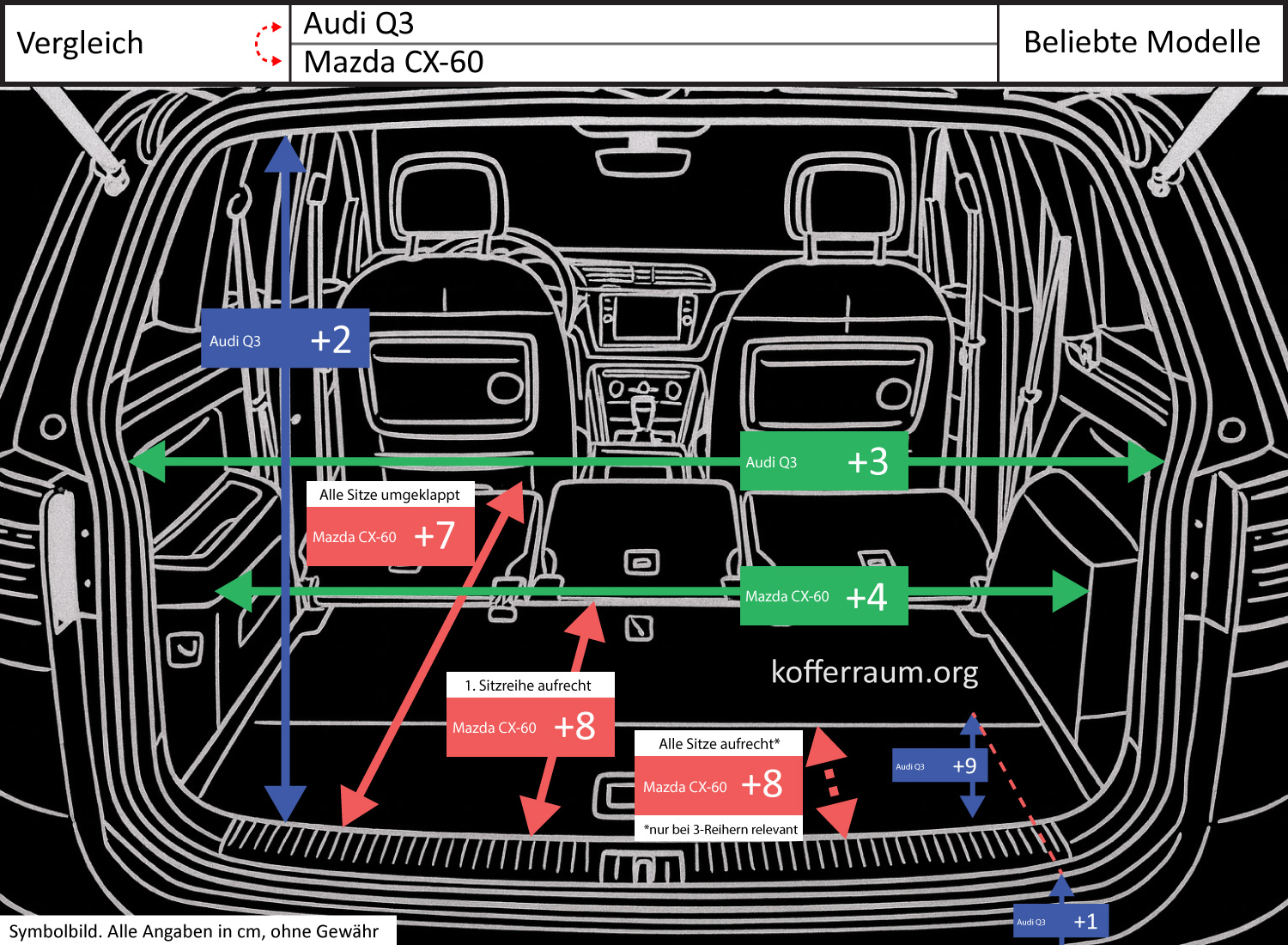
Both models differ only moderately in length and width of the cargo area; however, a significant difference in trunk depth between the loading edge and trunk floor strongly influences practical use.
Highlighted Difference
The trunk depth (loading edge → trunk floor) is 3.5 in or 800% greater in the Audi Q3 than in the Mazda CX-60. In practice, this means: the Audi has a significantly deeper, recessed cargo area below the loading edge.
Advantage: smaller or bulky items can be better recessed and shift less, the volume under the loading edge is better usable. Disadvantage: heavy luggage must be lifted higher or into a recess, and the cargo floor is less level with the loading edge.
Further Differences and Their Usability
The Mazda CX-60 offers about 2.8 in (4%) more cargo length with seats folded down and about 3.1 in (9%) more with the first row upright, making it somewhat better suited for long items (e.g., skis, poles, long boxes).
Additionally, the narrowest point in the Mazda's trunk is 1.6 in (4%) wider, which facilitates storing wider luggage.
The Audi Q3 has a 0.8 in (3%) higher opening height and a 1.2 in (3%) wider trunk opening, allowing bulkier or taller cargo to fit more easily. The loading edge in the Audi is only 0.4 in (1%) higher above the road, so the difference in loading and unloading is minimal.
Conclusion
If you frequently transport long or flat items, the Mazda CX-60 is advantageous due to the greater cargo length and slightly larger interior width.
If, on the other hand, you benefit from a deeper, recessed cargo floor (better securing of small/unstable loads, more usable volume under the loading edge) or prefer a somewhat larger opening, the Audi Q3 is the more practical choice.