Trunk comparison: Audi Q3 vs Renault Clio

Key Differences and Practical Consequences
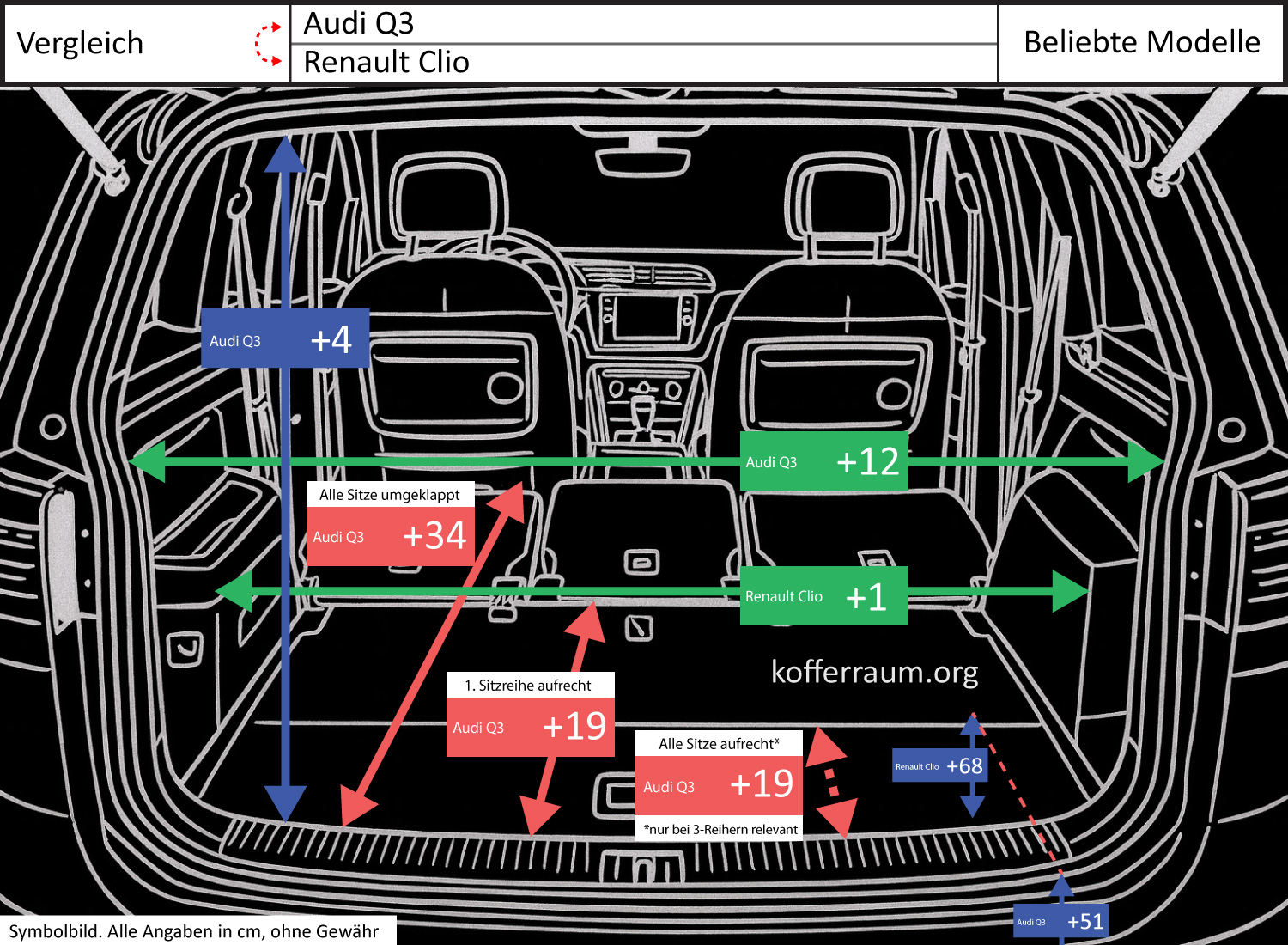
Trunk length with seats folded down: The Audi Q3 offers +13.4 in (26%) more length than the Renault Clio. In practice, this means significantly longer items (e.g., furniture parts, long boxes, skis) can be transported in the Q3 without complicated stowing.
Trunk length with front seats upright: Even in everyday use, the Q3 has a clear advantage with +7.5 in (27%) more cargo length. For shopping, suitcases, or bulky purchases, this means more usable volume behind the seats.
Trunk depth (loading edge → trunk floor): The Renault Clio differs significantly here, measuring +26.8 in (756%) compared to the Q3. This geometry changes the loading area considerably: it can provide more vertical clearance or a deeper cargo floor, which facilitates stacking and fitting certain goods but depending on the arrangement can also affect reachability or lifting heavy loads.
Loading edge height above the road: The Audi Q3’s loading edge is significantly higher at +20.1 in (213%) than the Clio’s. Practical consequence: loading and unloading heavy items requires more lifting strength in the Q3; the Clio is more ergonomic for lifting and setting down heavy loads.
Width of the trunk opening: The Audi Q3’s opening is +4.7 in (12%) wider. This makes loading wide items noticeably easier compared to the Clio.
Small differences with little impact: The height of the Q3’s trunk opening is only +1.6 in (5%) higher and the narrowest point of the loading width differs by only +0.4 in (1%) in favor of the Clio — both negligible in everyday use.
Conclusion
For users who need to transport longer or wider cargo (e.g., craftsmen, families with travel luggage), the Audi Q3 has the advantage due to its longer cargo floor and larger opening width.
Those who value ergonomic loading of heavy items or benefit from the specific trunk geometry will find practical strengths in the Renault Clio thanks to its differing depth and lower loading edge. The choice therefore depends on the type and frequency of transport tasks.