
Trunk comparison: Audi Q3 vs Seat Leon
Key Differences (highlighted)
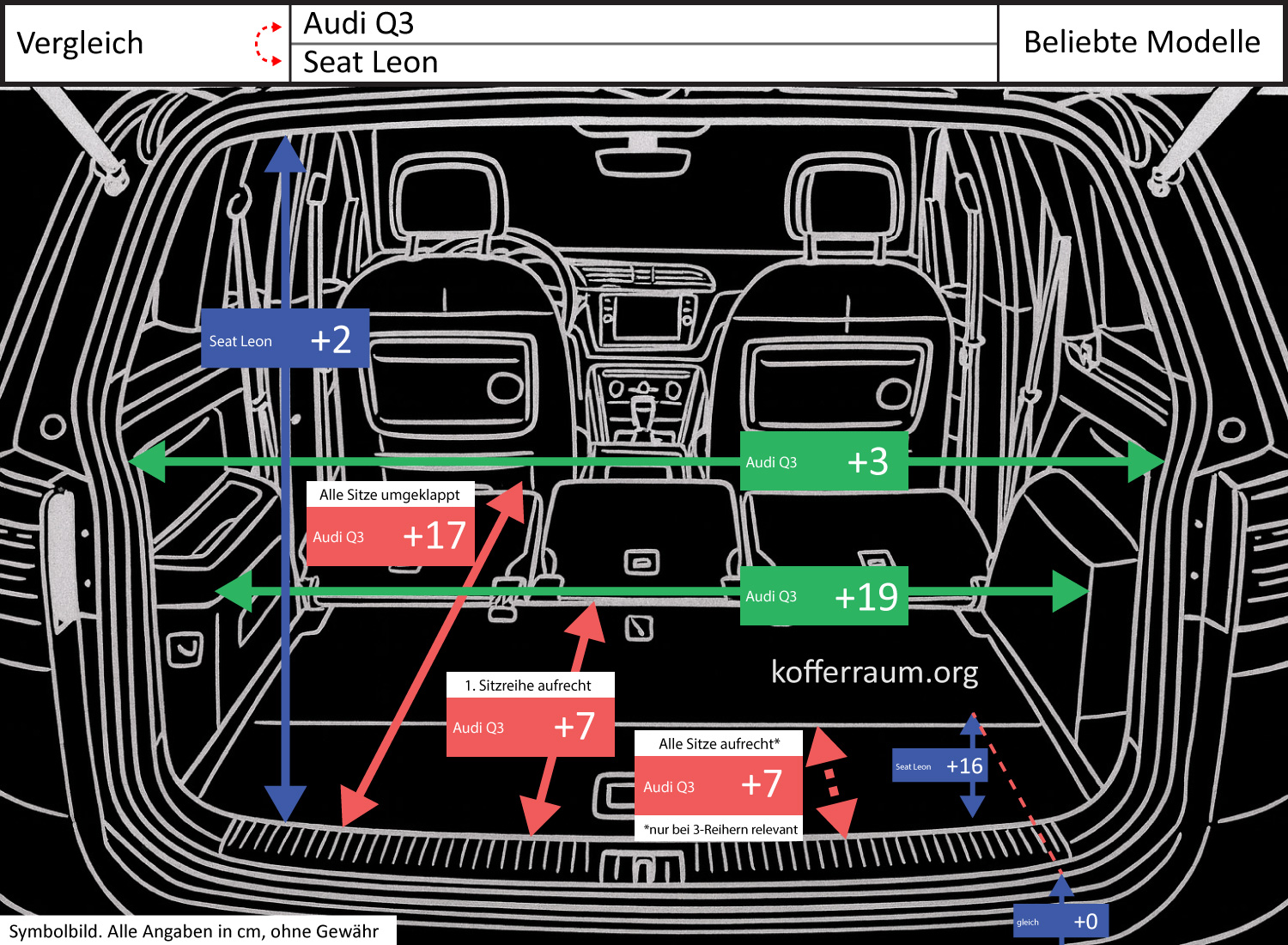
Three significant differences stand out in the comparison: The Audi Q3 offers a cargo space length that is 6.7 in or 11% longer with the rear seats folded down than the SEAT Leon.
At its narrowest point, the trunk of the Audi Q3 is 7.5 in or 23% wider. In contrast, the depth of the trunk (loading edge to trunk floor) in the SEAT Leon is 6.3 in or 178% greater.
Impact on Usability
These differences lead to clear practical consequences: The greater width and longer cargo space of the Audi Q3 make it better suited for flat, long, or wide items (e.g., furniture parts, long packages, bulky sports equipment). Wider or longer loads are easier to load and lie more stably.
The significantly greater depth of the SEAT Leon means more vertical storage space or a deeper cargo profile.
This is practical for tall or irregularly shaped items, stacking boxes, or when a lot of volume is needed with a compact floor area. However, loading and unloading heavy, hard-to-reach, deep cargo may require more bending.
Other, smaller differences: The loading edge height of both models is the same (comparable loading effort). With the rear seats upright, the Audi Q3 has only about 2.8 in (8%) longer cargo floor length compared to the Leon — this is a rather minor advantage.
The trunk opening of the SEAT Leon is about 0.8 in higher, while the opening of the Audi Q3 is about 1.2 in wider, both under 10% and uncritical for most users.
Conclusion
Those who primarily transport wide or long items benefit from the Audi Q3. Those who need deep, voluminous cargo or more usable depth have the advantage with the SEAT Leon. Both models have the same loading edge height, so the practical difference mainly arises from the combination of trunk length, width, and depth.