
Trunk comparison: Audi Q3 vs Toyota Corolla Wagon
Key Differences
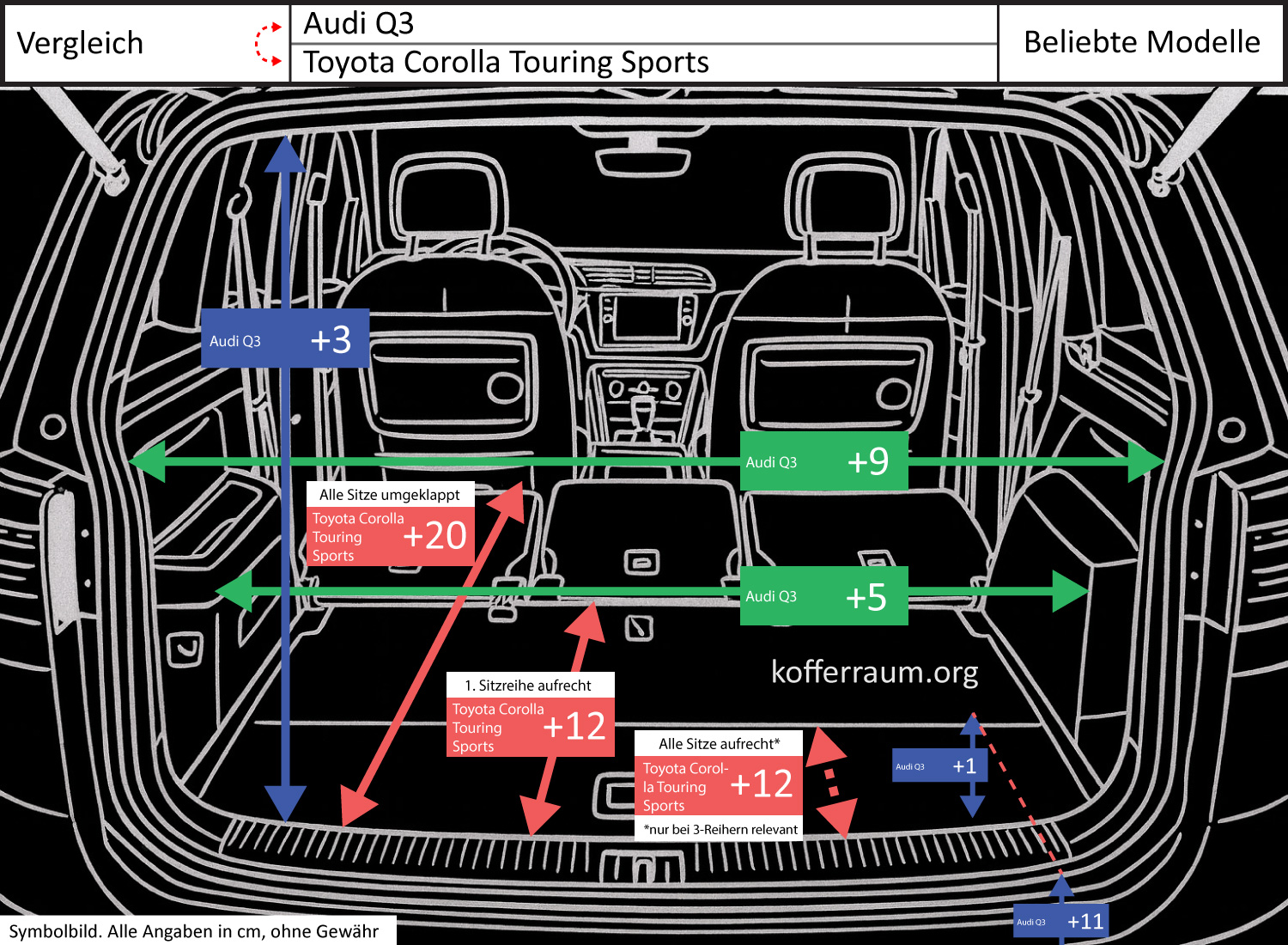
In terms of trunk volume, the Toyota Corolla Touring Sports leads: with the seats folded down, it offers +7.9 in (12%) longer cargo space and with the first row of seats upright +4.7 in (13%) more length than the Audi Q3. On the Audi Q3 side, two differences over 10% should be noted: the trunk depth (loading edge to trunk floor) is +0.4 in (13%) greater and the loading edge is +4.3 in (17%) higher above the road than on the Corolla.
Smaller differences under 10% concern the width at the narrowest point (+2 in, 5%), the width of the trunk opening (+3.5 in, 9%), and the height of the opening (+1.2 in, 4%) — in favor of the Audi Q3, but not highlighted here.
What are the practical implications of these differences?
The longer cargo floors of the Corolla (each >10%) make it more practical for longer items and, if needed, larger overall cargo space with the seats folded down. This specifically affects transporting skis, long furniture parts, or multiple suitcases: the Corolla offers noticeably more usable length or loading length.
The higher loading floor of the Audi (loading edge +4.3 in) makes loading and unloading heavy or bulky items more difficult — lifting over a greater height is more strenuous and requires more strength or aids.
The slightly greater trunk depth of the Audi (+0.4 in, here noted as >10%) creates minimally more interior height or space between the loading edge and floor, which slightly favors stacking very flat cargo, but is much less relevant in practice than the longer cargo floors of the Corolla.
In summary: For longer or more extensive loads (family vacations, long items), the Toyota Corolla Touring Sports is the more practical choice.
For loading bulky but rather flat or wider items and when somewhat more opening width is available, the Audi Q3 has slight advantages — however, the higher loading edge distance is a disadvantage when handling heavy loads.