
Trunk comparison: Audi Q3 vs VW T-Roc
Key Differences
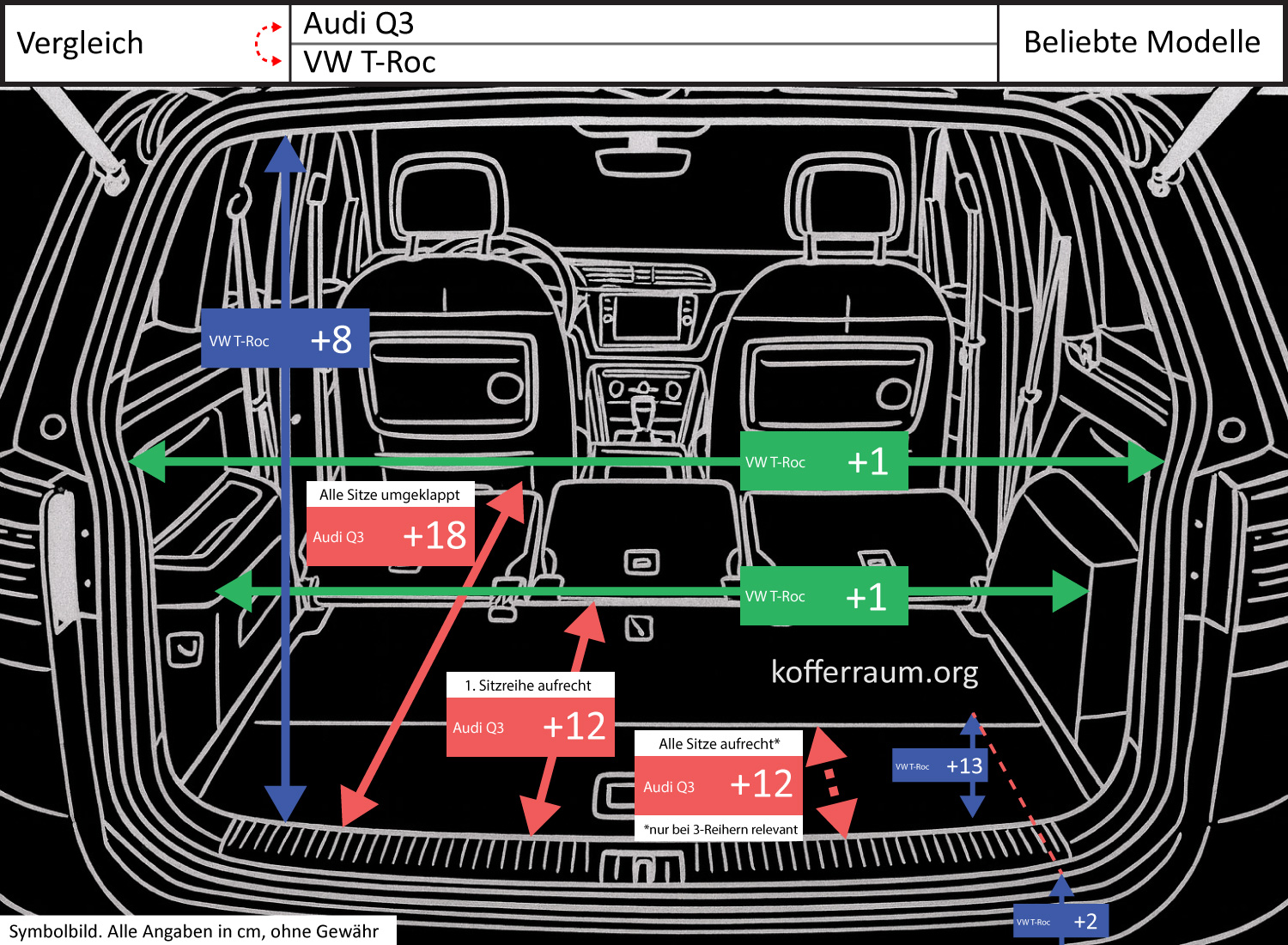
In terms of cargo space, the Audi Q3 differs from the VW T‑Roc mainly in usable length: The Audi Q3 offers +7.1 in (12%) more loading length with the seats folded down and +4.7 in (15%) more loading length with the rear seats upright than the T‑Roc.
Another notable difference is the significantly greater depth of the VW T‑Roc: the distance from the loading edge to the trunk floor is +5.1 in (144%) larger in the T‑Roc than in the Q3. Other differences are smaller: the trunk opening of the T‑Roc is +3.1 in (10%) higher, the loading edge is +0.8 in (3%) higher, and the width differences are about +0.4 in (1%) in favor of the T‑Roc.
Impact on Usability
The longer loading surface of the Audi Q3 makes it more practical for long items such as slats, skis, or longer furniture parts and for situations where maximum loading length is required by folding down the seats.
Those who frequently transport longer cargo or need to accommodate bulky, lengthwise-oriented items have a clear advantage with the Q3.
The VW T‑Roc offers more vertical space behind the loading edge due to its significantly greater depth, which favors stackable or bulky but not necessarily long items (e.g., taller boxes, larger bags, or bulky cartons).
However, the loading edge of the T‑Roc is slightly higher (+0.8 in), making lifting heavy loads minimally more strenuous. The slightly higher trunk opening (+3.1 in) makes loading tall items somewhat easier but is not a major difference.
Laterally (width at the narrowest point and opening), both models are practically the same; width differences of ~0.4 in are negligible in everyday use.
In summary: the Audi Q3 is better suited for longer cargo, while the VW T‑Roc offers advantages for taller or bulkier cargo due to its greater depth, although the slightly higher loading edge slightly complicates handling.