
Trunk comparison: Audi Q5 vs BMW X3


Key Differences
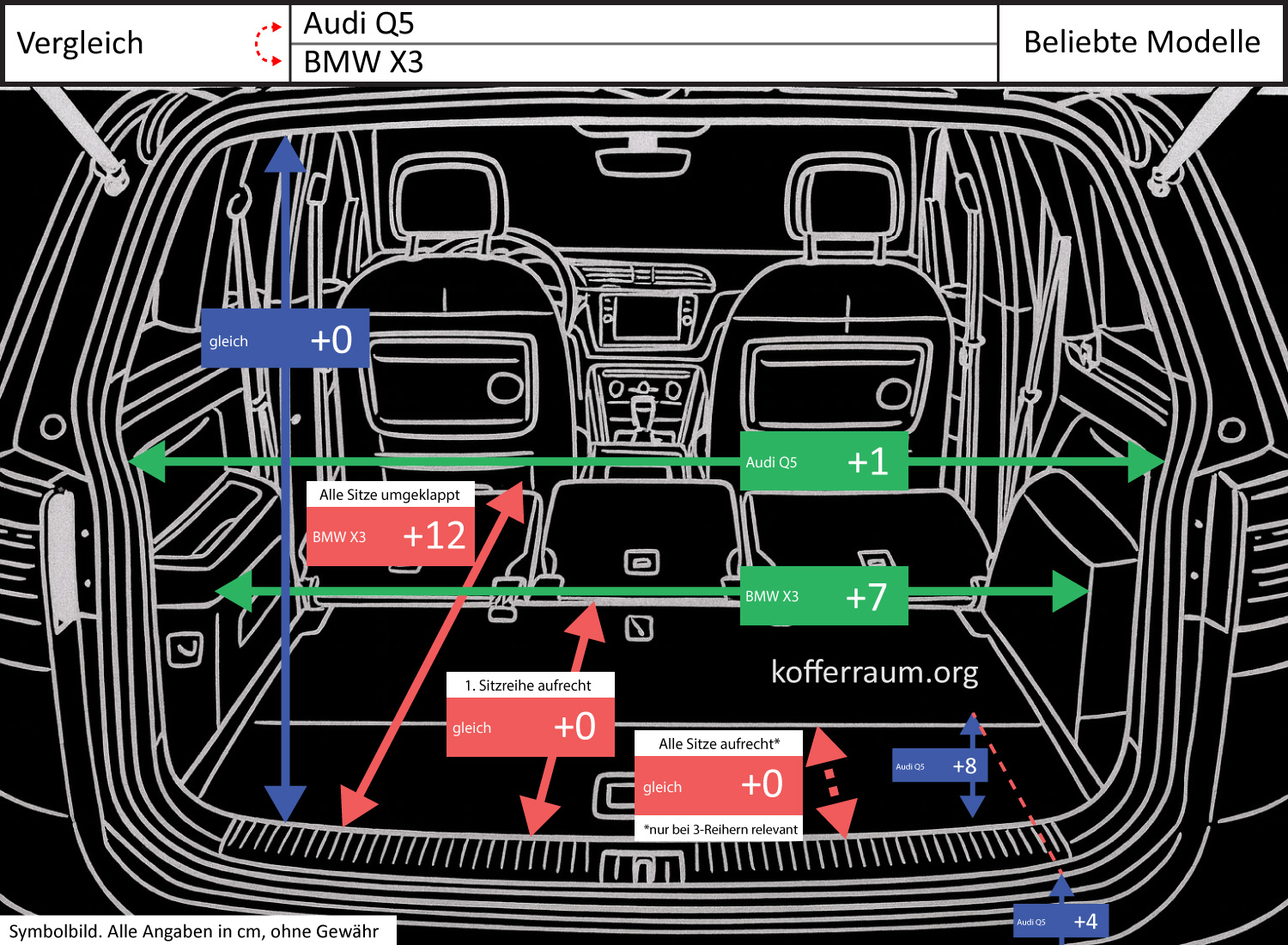
The most noticeable difference concerns the depth of the trunk (loading edge to trunk floor): The Audi Q5 has 3.1 in more depth (+700%) compared to the BMW X3. All other measured differences are below the 10% threshold.
With the first row of seats upright, the trunk lengths are the same. With the seats folded down, the BMW X3 is 4.7 in (7%) longer. The height of the trunk opening is the same for both models.
The loading edge of the Audi Q5 sits 1.6 in (6%) higher above the road. The narrowest width in the trunk is 2.8 in (7%) larger in the BMW X3; the width of the trunk opening is 0.4 in (1%) larger in the Audi Q5.
Impact on Usability
The significantly greater depth in the Audi Q5 means more space between the loading edge and the trunk floor.
Practically, this means that deeper, bulky, or less delicate items can be stored further down and better consolidated. At the same time, more concealed volume remains, which is advantageous when transporting luggage or boxes.
On the other hand, the Audi has a slightly higher loading edge (+1.6 in), which can make lifting heavy items into the trunk more difficult. This disadvantage reduces everyday practicality when frequently loading heavy or bulky loads.
The BMW X3 offers slight advantages for wide or very long items (e.g., furniture boards, long skis) with somewhat more width at the narrowest point (+2.8 in) and a longer loading length with folded seats (+4.7 in). The lower loading edge makes lifting and placing luggage overall somewhat easier.
In summary: For deep, bulky cargo, the Audi Q5 is more favorable; for wide or very long cargo and easier lifting, the BMW X3 offers advantages. The other differences are minor and only marginally affect everyday practicality.