
Trunk comparison: Audi Q5 vs Citroen C3

Key Differences
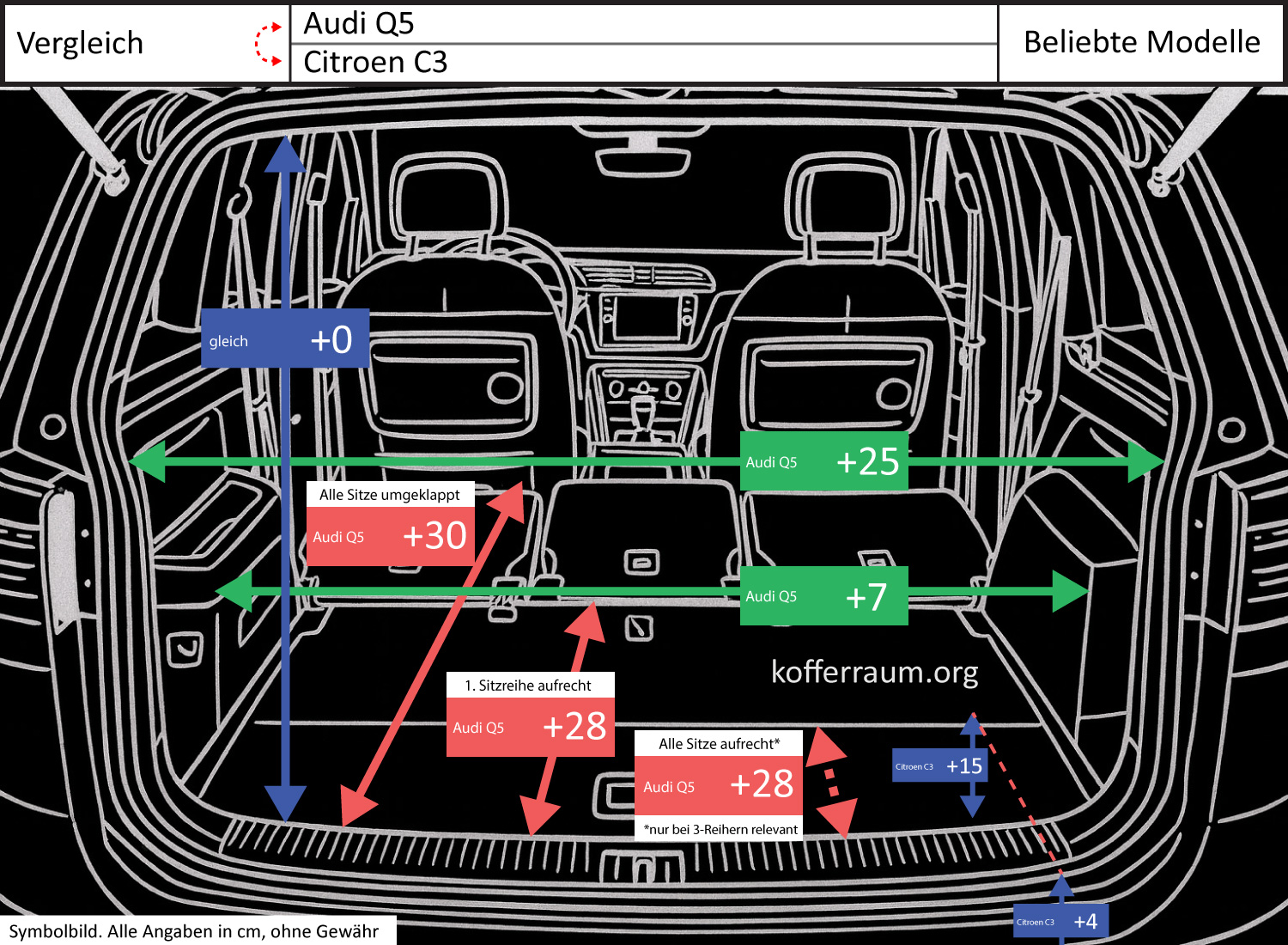
The Audi Q5 offers significantly more loading length than the Citroën C3: with the seats folded down, the trunk of the Q5 is +11.8 in (22%) longer, and with the first row of seats upright, even +11 in (42%) longer.
The loading opening of the Audi is also wider: the opening is +9.8 in (28%) wider than that of the C3. In contrast, the Citroën C3 has a significantly greater depth between the loading edge and the trunk floor: +5.9 in (188%) compared to the Audi Q5.
What this means for usability
Loading length and opening width in the Audi Q5 provide clear advantages when transporting long or bulky items (e.g., slats, skis, furniture parts, bicycles with the front wheel removed). The greater opening width also makes loading and unloading wide goods easier and reduces the risk of parts hitting the sides.
The significantly greater "depth" in the Citroën C3 (distance loading edge ↔ trunk floor) also has practical effects: it creates more usable space volume downward and lowers the trunk floor compared to the Audi.
Calculating the differences: the loading edge of the C3 is +1.6 in higher above the ground, but the interior depth is +5.9 in greater — net, the trunk floor of the C3 is about 4.3 in lower above the ground than that of the Q5. This means heavy or low-stored items need to be lifted less high in the C3, and bulky, tall items can be better stored in the recess.
However, the higher loading edge (considered alone only +5%, thus less relevant) can slightly complicate lifting over the threshold edge.
Differences under 10% — such as the narrower bottleneck in the C3 (-7%) or the loading edge height (+5% in favor of the C3) — are less significant in everyday use.
Overall, the Audi Q5 is the more practical choice for long and wide loads; the Citroën C3 scores with a lower loading floor and thus better use of the lower space as well as a somewhat different leverage effect when loading.