
Trunk comparison: Audi Q5 vs Hyundai i10
Key Differences
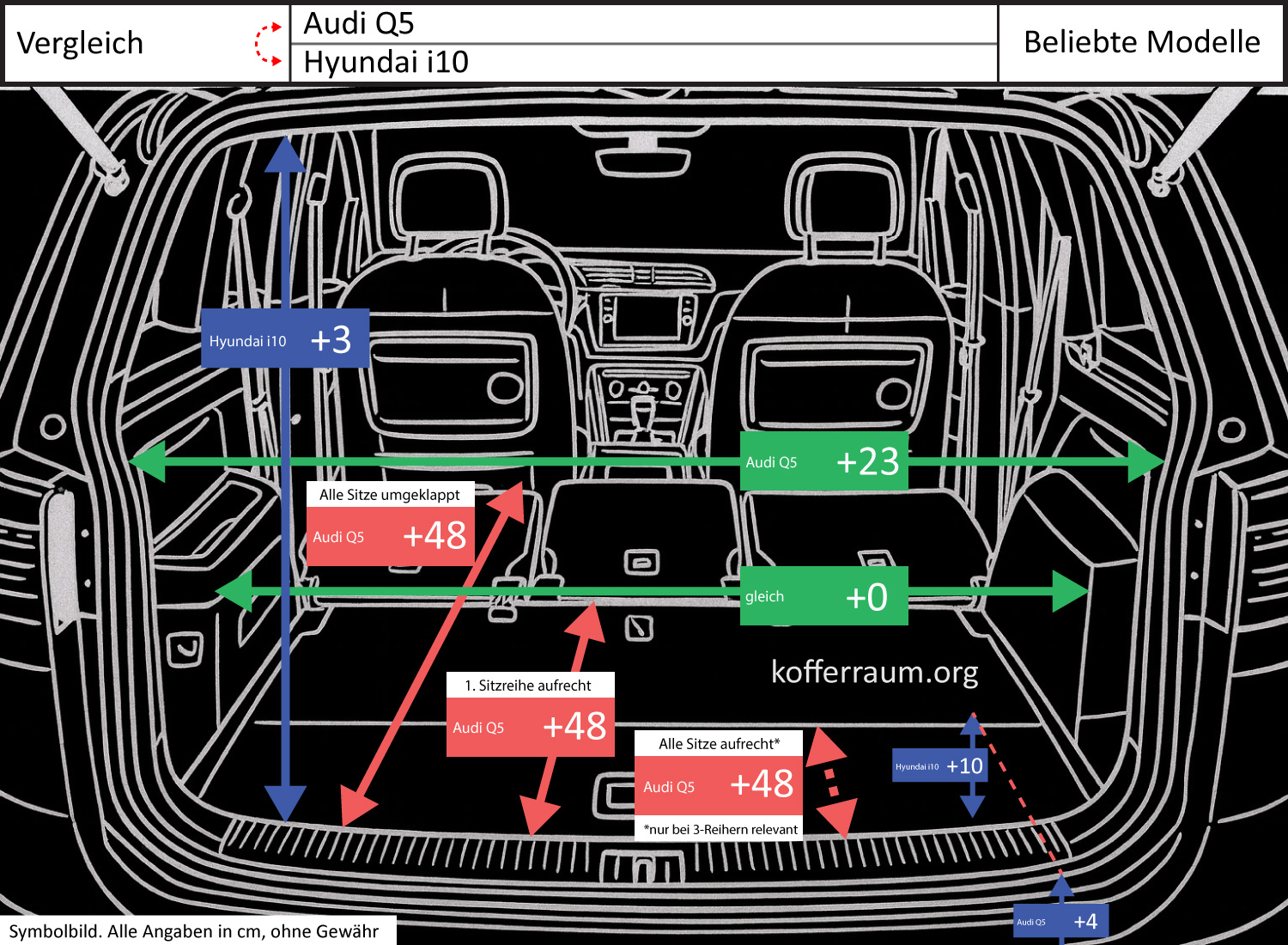
The Audi Q5 offers significantly more cargo length: with the rear seats folded down, its trunk is +18.9 in (41%) longer, and with the front seat row upright, it is also +18.9 in (102%) longer than the Hyundai i10. The width of the trunk opening is +9.1 in (26%) larger in the Audi.
Regarding the measurement from the loading edge to the trunk floor, the Hyundai i10 is +3.9 in (125%) "deeper" or has a greater depth than the Q5. The narrowest width inside the cargo area is the same for both models.
What are the practical implications of these differences?
More length and a wider opening in the Audi Q5 make it significantly more practical for long or bulky items (e.g., furniture parts, bicycles, skis, lumber). Even with the front seat row upright, the Q5 retains considerably more usable cargo space, making it more flexible for occasional transport of large goods.
The greater depth measurement in the Hyundai i10 means the space between the loading edge and the trunk floor is larger. This can be useful for storing flat or stacked items of low height more effectively.
However, combined with its overall smaller length and narrower opening, it does not offer comparable capability for carrying long or very wide loads.
Practical user takeaways in brief: - For transporting long or wide items, the Audi Q5 is clearly superior (more length + wider opening). - For smaller, deeper stackable loads, the i10 can be advantageous due to its greater trunk depth effect but remains limited in total volume and flexibility. - Both models have the same narrowest interior width, so there are no differences when sliding very narrow items through. - Minor differences such as a slightly higher trunk opening on the i10 (+1.2 in) or a slightly higher loading edge on the Q5 (+1.6 in) have only a minimal impact on everyday use.