
Trunk comparison: Audi Q5 vs Hyundai IONIQ
Key Differences
The biggest differences are in three areas:
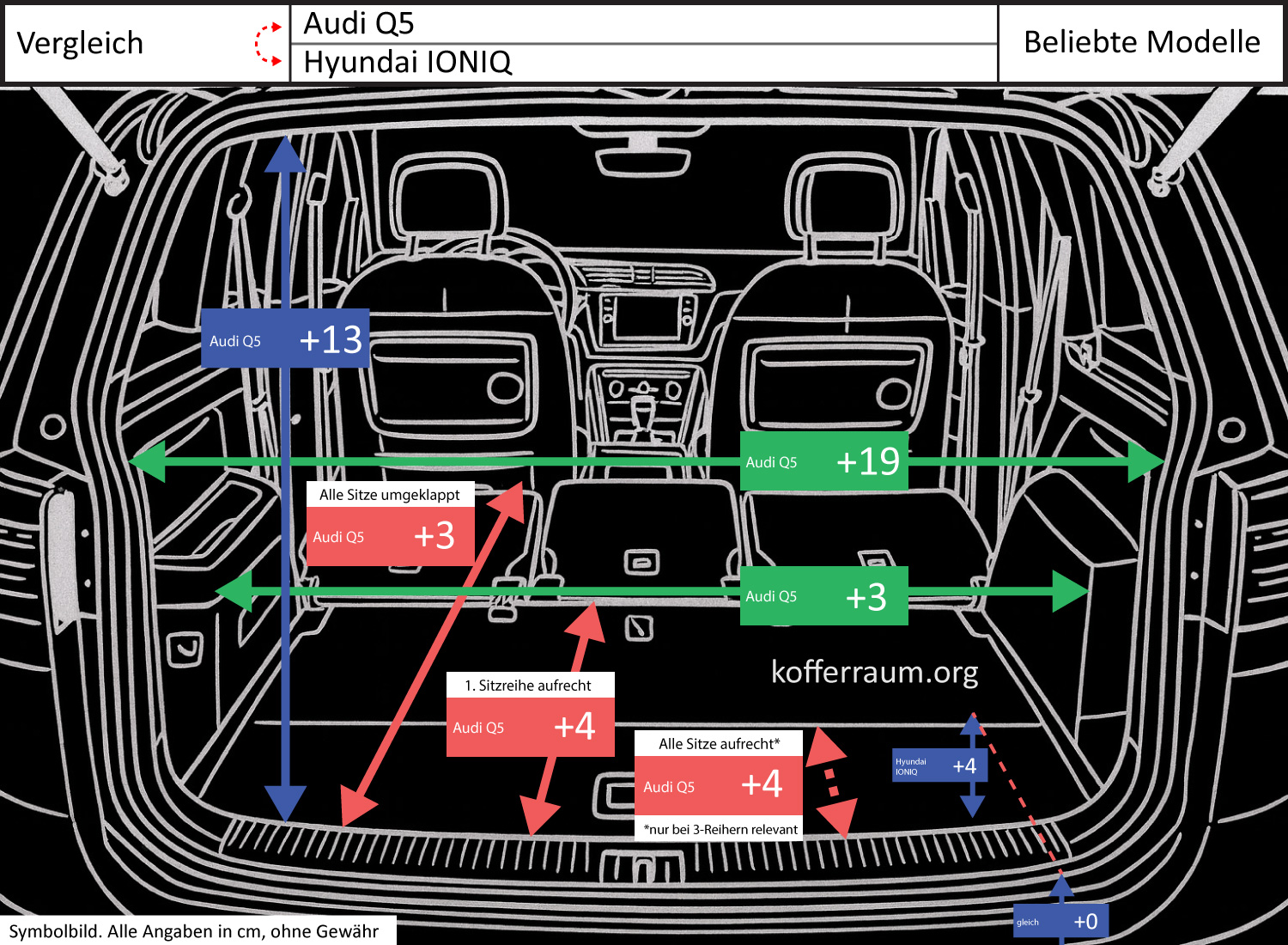
Height of the trunk opening: Audi Q5 is +5.1 in (20%) higher than the Hyundai IONIQ.
Width of the trunk opening: Audi Q5 is +7.5 in (20%) wider than the Hyundai IONIQ.
Depth of the trunk (loading edge → floor): Hyundai IONIQ is +1.6 in (50%) deeper/"larger" than the Audi Q5.
Smaller differences (under 10%) are: length with folded seats Audi +1.2 in (2%), length with upright first row Audi +1.6 in (4%), narrowest trunk width Audi +1.2 in (3%). The loading edge height is the same for both models.
Impact on Usability
Due to the significantly larger opening height and width of the Audi Q5 (+20%), wide and tall items can be loaded and unloaded much more easily.
Bulky furniture parts, boxes, or equipment are more likely to fit directly through the opening; maneuvering large loads with a hand truck or dolly is also easier. The larger opening dimensions ergonomically improve loading because fewer twists and less lifting up and down are necessary.
The deeper trunk floor of the Hyundai IONIQ (+50% depth) creates more usable vertical capacity below the loading edge. This is advantageous when items are to be "recessed into the trunk" (e.g., boxes that disappear under a shelf) or when more interior volume without high loads above the threshold is needed.
A disadvantage of the greater depth can be when heavy items must be lifted: lifting in and out requires more strength or more back work because the load is further below the loading edge.
The smaller length and width differences (<10%) hardly affect everyday usability. Since the loading edge height is identical, the loading and unloading behavior between the models does not change in this respect.
Conclusion: For frequent transport of wide or tall, bulky loads, the Audi Q5 is more advantageous due to the significantly larger opening.
For additional interior vertical capacity (more storage space below the loading edge), the Hyundai IONIQ offers an advantage through the deeper cargo floor, but this pays off more for lighter, stackable, or "recessable" loads.
/body>
/html>