
Trunk comparison: Audi Q5 vs Mazda Mazda CX-60


Key Differences
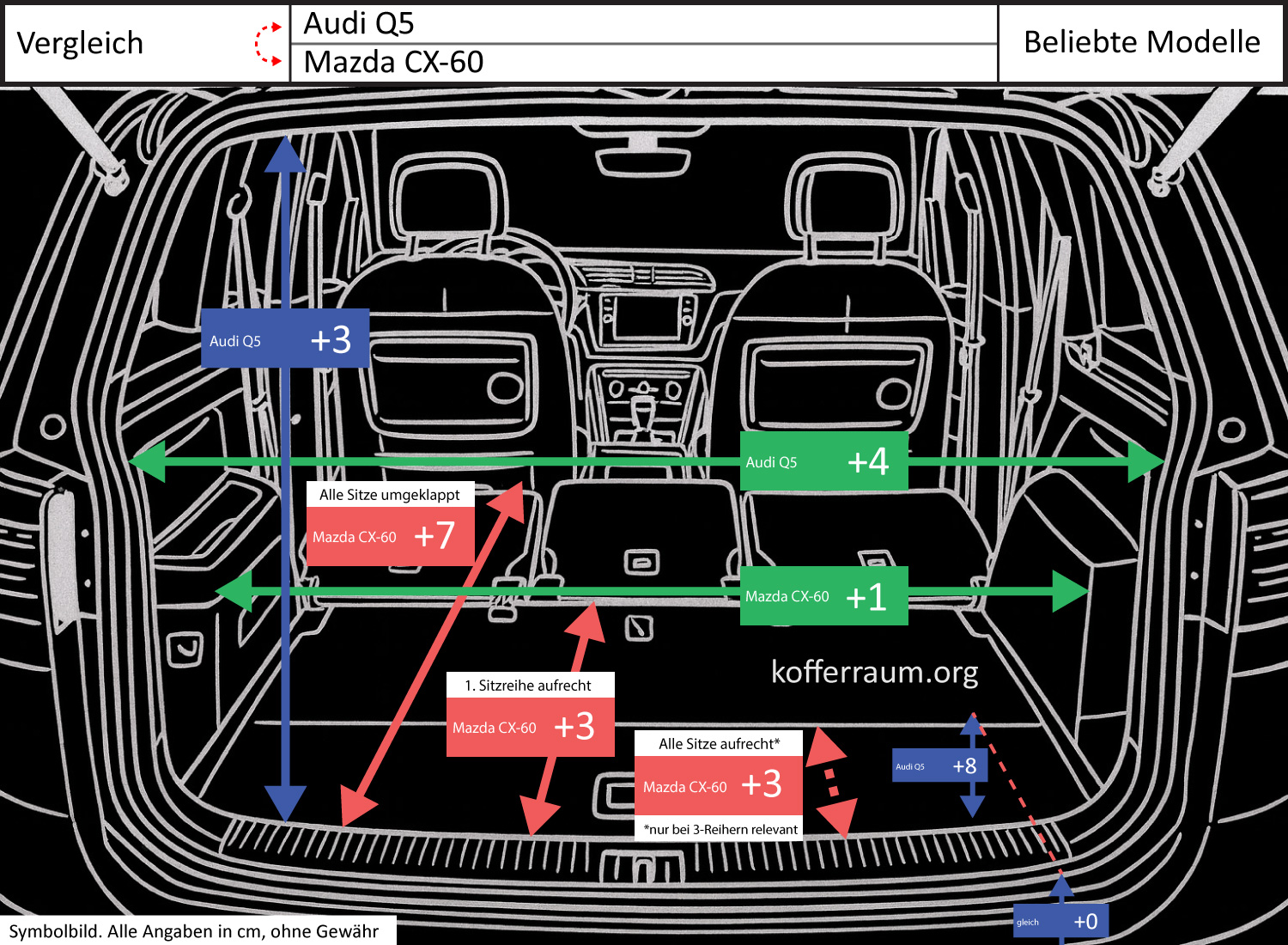
The most noticeable difference is in the depth of the trunk: The depth (loading edge → trunk floor) of the Audi Q5 is 3.1 in (+700%) greater than that of the Mazda CX‑60.
All other stated deviations are in the range of 1–4% (Mazda: +2.8 in overall length with folded seats or +1.2 in with the first row upright; Audi: +1.2 in height of the trunk opening, +1.6 in width of the trunk opening; Mazda: +0.4 in narrowest width) and are therefore comparatively small.
Impact on Usability
The significantly greater depth of the Audi Q5 practically means that the loading floor sits lower below the loading edge. Advantages: heavier or bulky items lie deeper in the cargo space and are better secured against shifting; visible cargo less often protrudes beyond the loading edge.
Disadvantages: lifting heavy items over the loading edge requires more lifting height and thus more effort; loading and unloading bulky, heavy objects can be less comfortable.
The smaller differences have only a minor impact in practice: Mazda offers slightly more length with folded seats (+2.8 in), which can be an advantage when transporting very long, flat-lying items.
Audi has a slightly higher and wider opening (+3–1.6 in), which makes maneuvering bulky parts easier when loading, but the effect is moderate. The minimally greater narrowest width on the Mazda (+0.4 in) is negligible in practice.
In summary: For users who often appreciate cargo stored deeper in the trunk (better organization, less visibility), the Audi Q5 offers a noticeable advantage.
For simply lifting heavy, bulky items or transporting very long, flat parts, the Mazda CX‑60 can be more practical due to the slightly greater length and shallower floor depth. All other differences are minor and have little effect in everyday use.