
Trunk comparison: Audi Q5 vs Mercedes Benz GLC


Outstanding Difference (>10%)
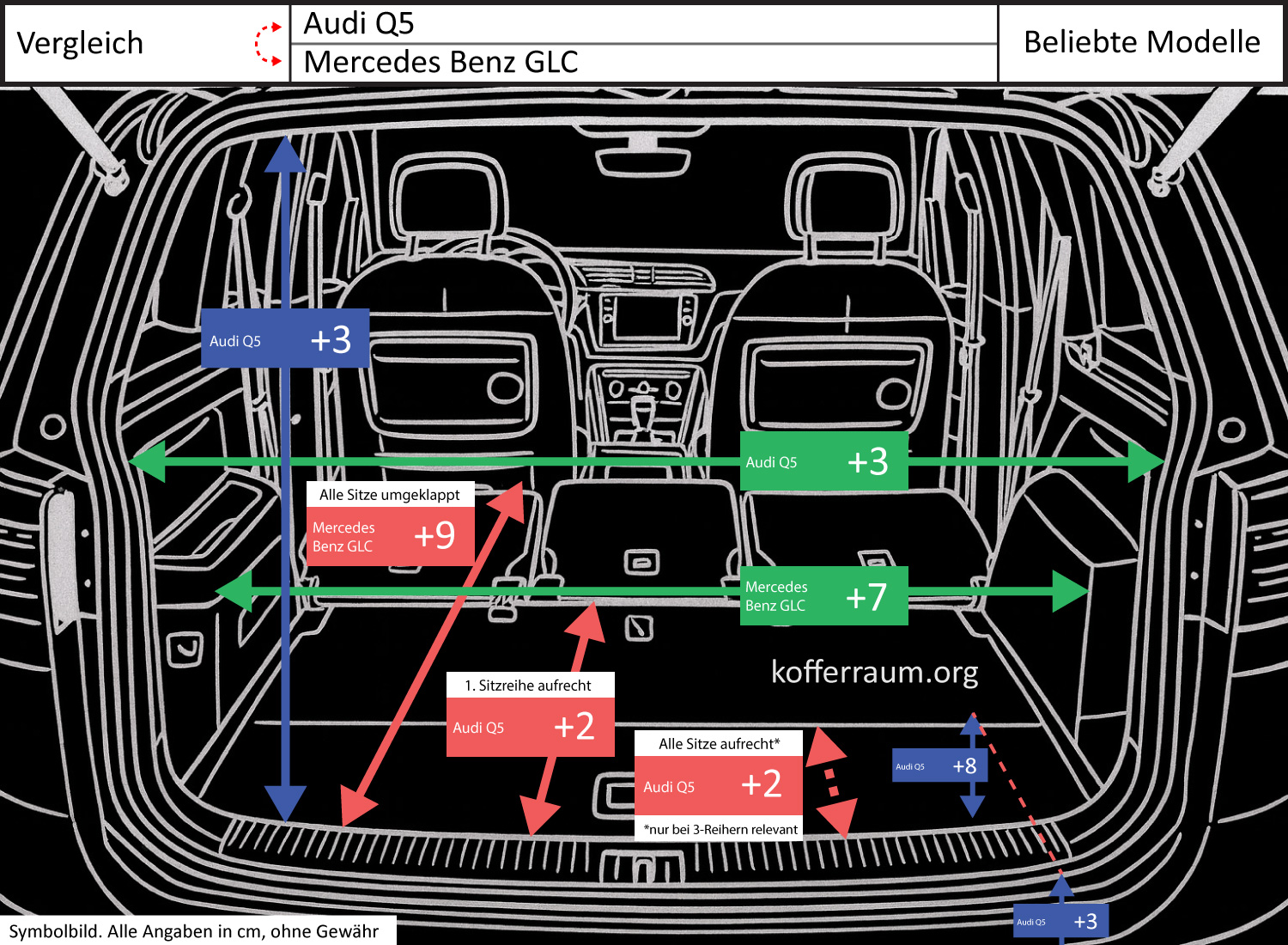
The depth of the trunk (loading edge to trunk floor) of the Audi Q5 is significantly greater (+3.1 in / 700%) than that of the Mercedes‑GLC. This difference is the only one exceeding the 10-percent mark and thus has the greatest practical impact on usability.
Impact on Usability
- The significantly greater floor depth of the Q5 allows bulky or tall items to be better recessed and transported stably (less shifting, better center of gravity). For moves or transporting larger boxes and equipment, the Q5 is therefore more practical in everyday use.
- The greater floor depth is accompanied by a slightly higher loading edge on the Q5 (+1.2 in). Heavy lifting over the loading edge therefore requires slightly more effort compared to the GLC, especially with repeated loading.
- Items that should be easily accessible (e.g., shopping bags) can be somewhat harder to reach in a deeper floor; at the same time, they are better protected from view and direct shifting.
Other, Smaller Differences (under 10%)
- Mercedes‑GLC has a 3.5 in (5%) longer load floor with seats folded down — advantageous for very long loads with folded seats.
- With the first row of seats upright, the Audi Q5 is 0.8 in (2%) longer — practically hardly noticeable in everyday use.
- The trunk opening of the Audi Q5 is 1.2 in (4%) higher, which can make loading tall items easier.
- The narrowest width in the trunk is 2.8 in (7%) larger in the GLC — advantageous when wide items need to be loaded precisely.
- The width of the trunk opening is 1.2 in (3%) larger on the Q5 — easier maneuvering of wide items through the opening.
Conclusion
The Audi Q5 offers the greatest practical advantage for transporting bulky or tall loads with its significantly deeper floor.
The Mercedes‑GLC scores with slightly more length when seats are folded down and a larger narrow width, which can be useful for long or very wide loads. Overall, the deeper loading floor of the Q5 determines the most noticeable difference in everyday usability.