
Trunk comparison: Audi Q5 vs Renault Clio


Main Differences (Summary)
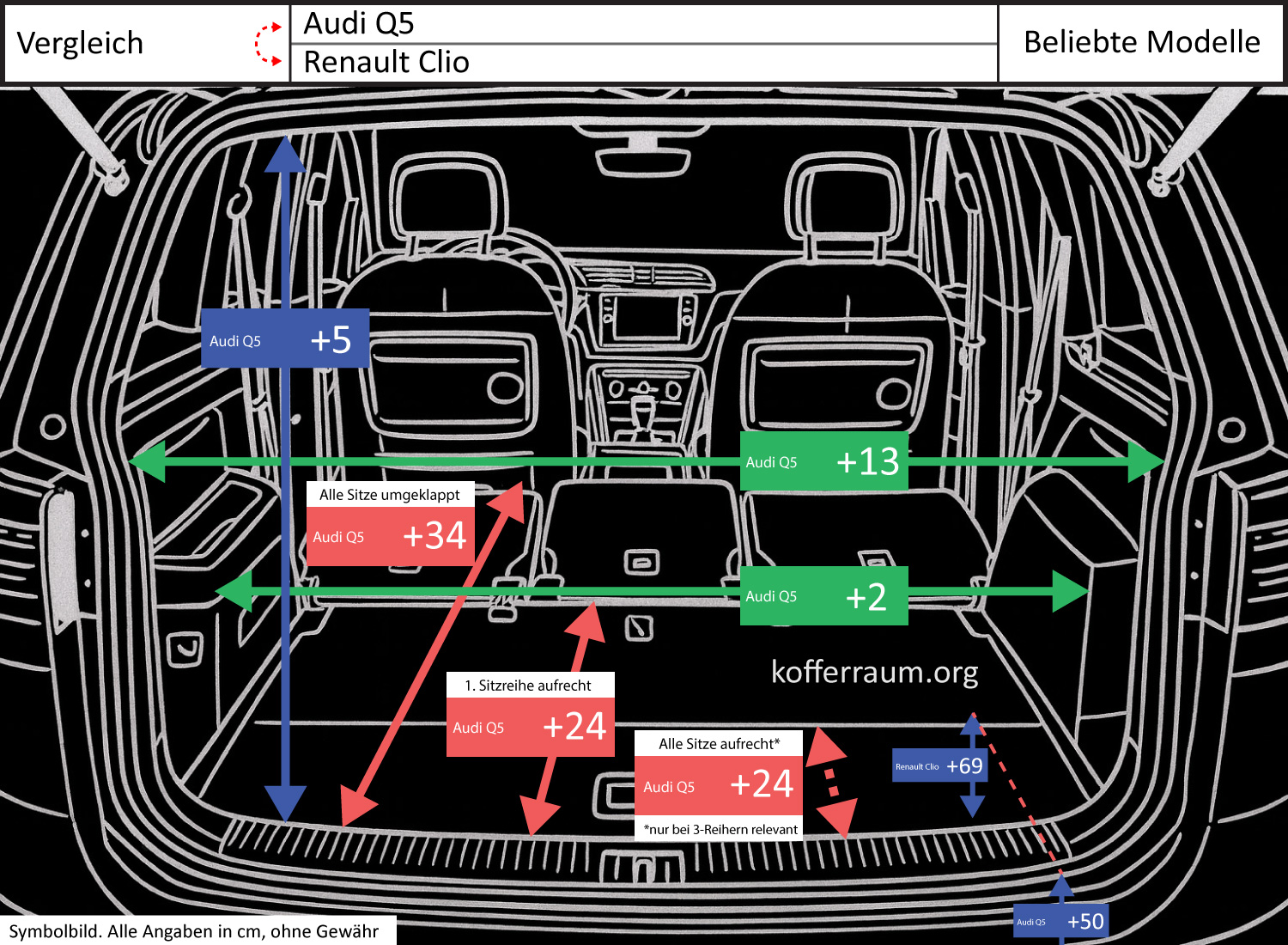
The Audi Q5 offers significantly more cargo length: with the seats folded down, the trunk is 13.4 in (+26%) longer, and with the first row upright, 13.4 in (+34%) longer than in the Renault Clio.
The width of the trunk opening is 5.1 in (+13%) larger in the Q5. In contrast, there is a very large difference in depth (loading edge → trunk floor): the Renault Clio has a value 27.2 in significantly greater here (+863%).
Additionally, the loading edge of the Audi Q5 is 19.7 in higher (+208%) above the road than in the Clio. Smaller differences (trunk opening height +2 in / +7% and narrowest trunk width +0.8 in / +2%) are negligible.
Implications for Usability
Space for long or bulky items: Due to the significantly greater cargo length, the Audi Q5 is better suited when regularly transporting long items (e.g., slats, skis, furniture parts) or more cargo volume with folded seats. The larger opening width facilitates loading wider items.
Lifting and accessibility: The significantly higher loading edge of the Q5 means more lifting effort is required when loading and unloading — heavy cargo must be lifted higher. The Clio, with its much lower loading edge, is ergonomically advantageous here, making it easier to load heavy boxes or suitcases.
Loading floor depth: The much greater depth in the Clio describes a deeper cargo area below the loading edge. Practically, this means the Clio can accommodate more "depth" vertically (space for taller items lower in the trunk), but the load sits further down and is harder to reach.
In the Q5, items lie flatter and are thus easier to access, but the vertical volume below the loading edge is more limited.
In summary: For longer, wider, or bulkier cargo and for users who value accessible cargo space with good side width, the Audi Q5 is the more practical choice.
For frequent lifting of heavy items or for preferred rollable and easily loaded luggage (lower loading edge), the Renault Clio can be more convenient in everyday use. Smaller percentage differences in opening height and narrowest width have little practical impact.