
Trunk comparison: Audi Q7 vs BMW X3


Key Differences (>10%)
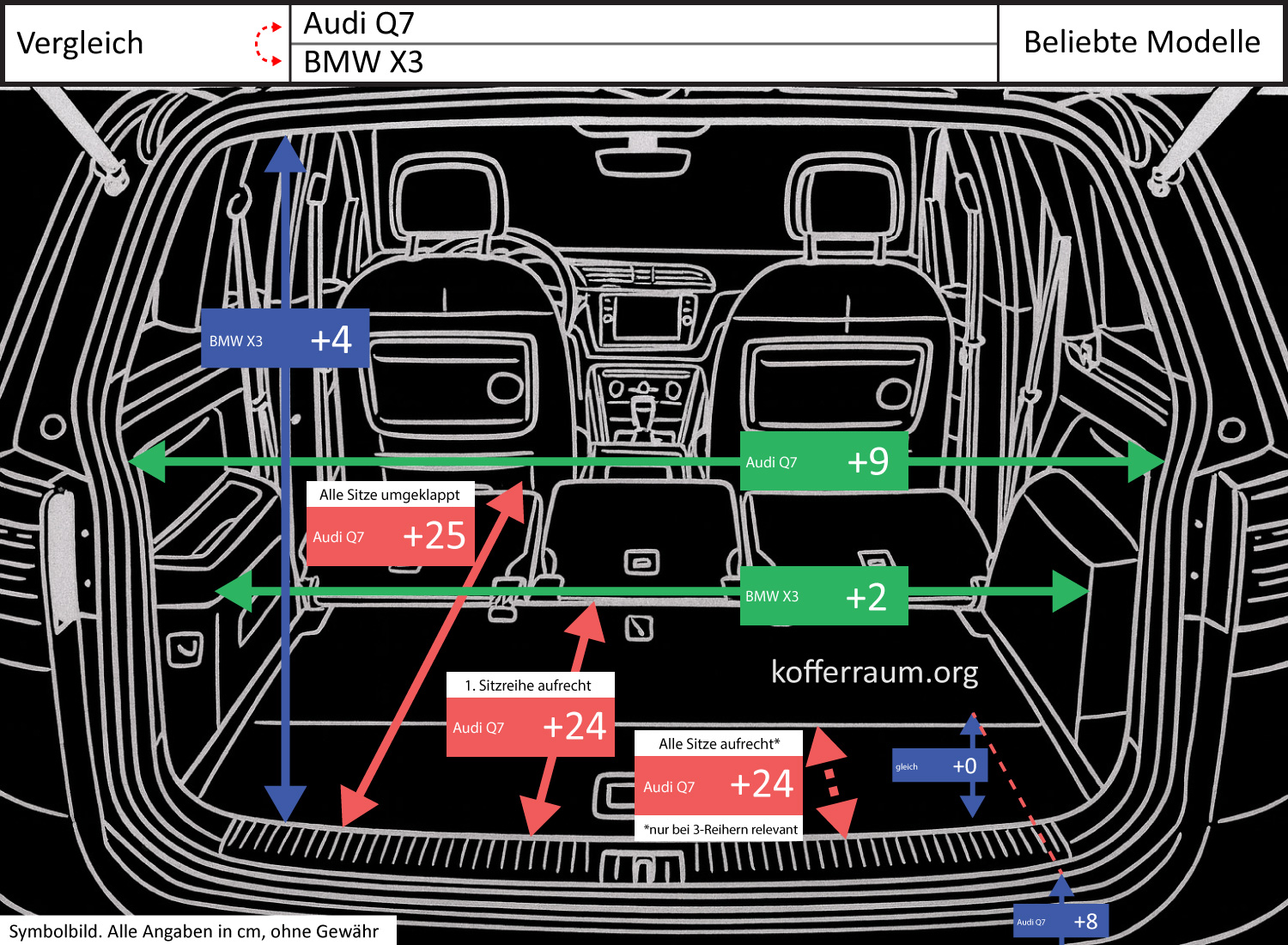
The measurable, relevant differences mainly concern the usable length and loading height: The Audi Q7 offers +9.8 in (≈14%) more cargo length with seats folded down and +9.4 in (≈25%) more with the first row upright than the BMW X3. Additionally, the loading edge of the Audi Q7 is +3.1 in (≈11%) higher above the ground than that of the BMW X3.
Impact on Usability
More cargo length in the Q7 clearly benefits transporting long items (e.g., slats, skis, furniture parts) and generally provides more flexibility for large cargo needs: with the first row upright, the Q7 retains significantly more usable storage space than the X3. This makes the Q7 better suited for moves, transports, or longer luggage.
However, the higher loading edge of the Q7 makes handling heavy or bulky loads more difficult: loading and unloading require more lifting strength or a ramp, and for users with limited mobility, loading is less comfortable than in the lower-built X3. The BMW X3 scores points for everyday loading (groceries, suitcases) due to easier lifting.
Other dimensions (trunk opening height, narrowest width, opening width) differ only below the 10% threshold and are thus less decisive; however, they can affect practicality when loading very wide or very tall items: the Q7 has a slightly larger opening width, the X3 a slightly higher opening height.