
Trunk comparison: Audi Q7 vs Jeep Avenger Electric
Key Differences (Brief)
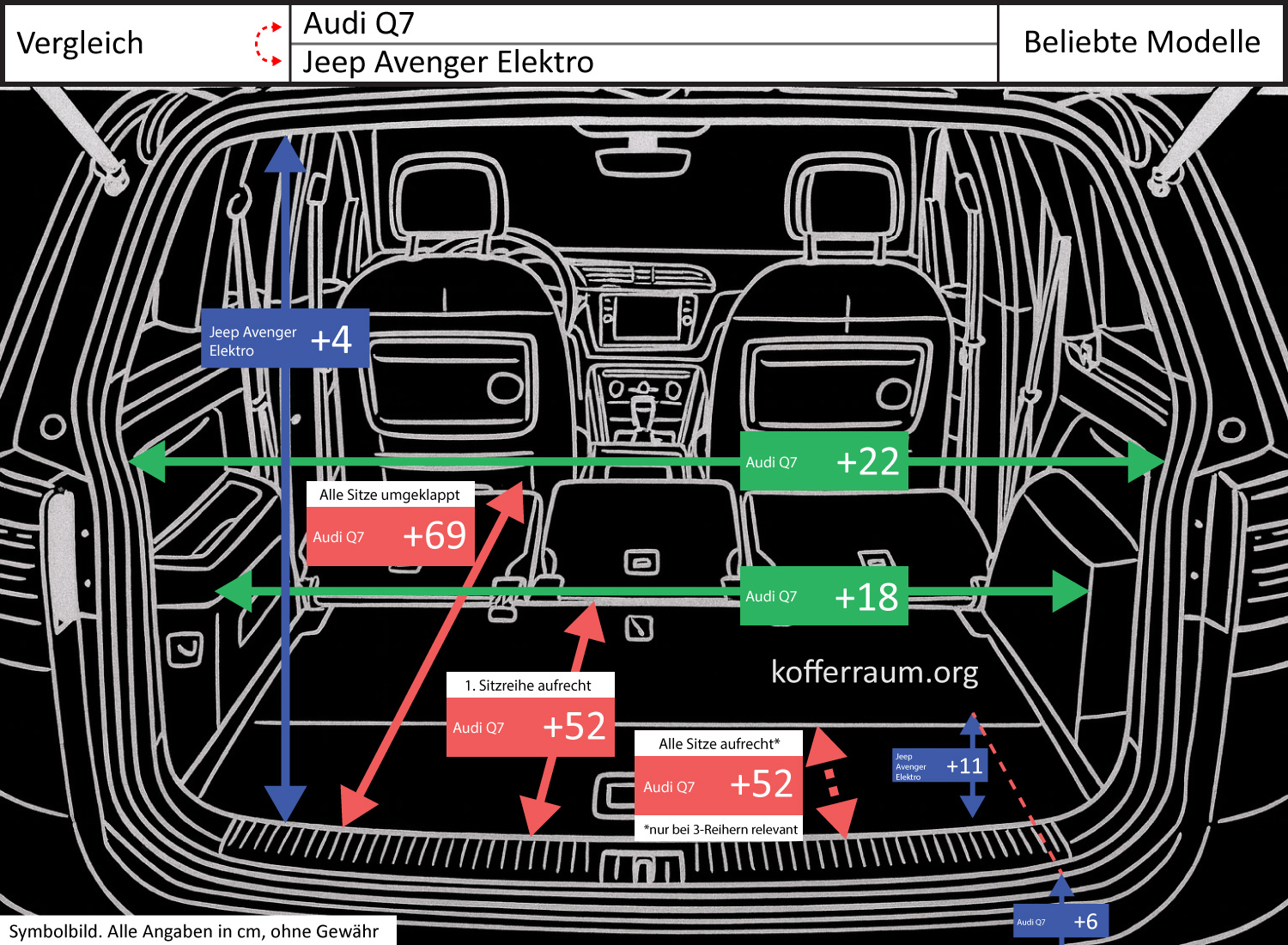
The Audi Q7 offers significantly more cargo length and width: with the seats folded down, its trunk is 27.2 in (≈51%) longer, and with the first row of seats upright, even 20.5 in (≈78%) longer than the Jeep Avenger Electric.
At the narrowest point, the Q7 is 7.1 in (≈20%) wider, and the trunk opening is 8.7 in (≈22%) larger than the Avenger. In contrast, the Jeep Avenger has a significantly deeper cargo floor relative to the loading edge: 4.3 in (≈1000%) more depth than the Q7.
What Impact Do These Differences Have on Usability?
Practically, this means: The Audi Q7 clearly has the advantage when it comes to long or wide cargo.
The significantly greater interior length (both with folded seats and with the front row upright), the greater width at the narrowest point, and the wider opening make it easier to store long items (e.g., slats, furniture parts, sports equipment) and wide or bulky goods.
Those who regularly transport long, flat, or wide cargo benefit from the Q7.
The Jeep Avenger, on the other hand, scores where vertical space or a deeper cargo floor matters. The greater depth between the loading edge and the trunk floor creates a deeper cargo well, which allows for storing taller or awkward items and in some cases offers better stacking of piled cargo.
Additionally, loading and unloading feel subjectively easier due to the (not highlighted) slightly higher opening height and the lower loading edge — advantageous when frequently lifting heavy individual items.
In summary: For maximum usable length and width as well as easy loading of long/bulky parts, the Audi Q7 is the stronger choice.
For deeper, potentially better stackable cargo wells and more ergonomic lifting of individual tall items, the Jeep Avenger can be more sensible. Which choice fits depends on the typical transport profile (long/wide vs. tall/compact loads).