
Trunk comparison: Audi Q7 vs Skoda Karoq
Biggest Differences (highlighted)
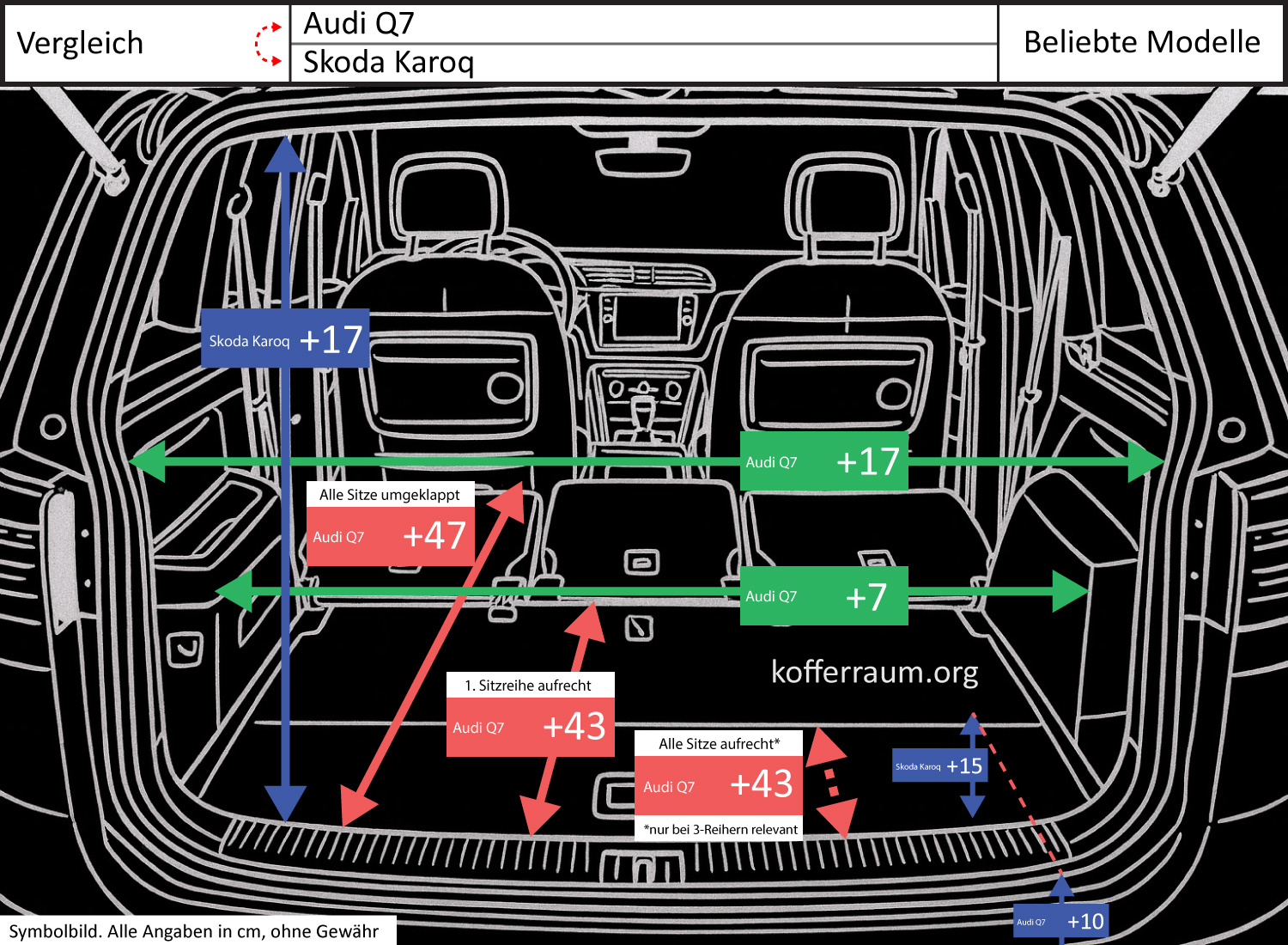
The Audi Q7 offers significantly more cargo length: with the seats folded down, the trunk of the Q7 is +18.5 in (30%) longer than the Karoq and with the first row upright, +16.9 in (57%) longer.
This directly affects the ability to transport long or bulky items (e.g., slats, skis, furniture parts, lots of luggage) — the Q7 clearly has the advantage here.
The Škoda Karoq, on the other hand, has a higher opening height and more interior depth: the trunk opening of the Karoq is +6.7 in (23%) higher than the Q7, and the depth (loading edge → trunk floor) is +5.9 in (1400%) greater.
Together with a lower loading edge (the Q7’s loading edge is +3.9 in (15%) higher above the road), this makes the Karoq more practical for loading heavy, tall, or bulky items — less lifting, more vertical space.
In terms of width, the Q7 scores at the opening: the width of the Q7’s trunk opening is +6.7 in (16%) larger than the Karoq. The narrowest interior width is +2.8 in (7%) larger in the Q7, but this difference is under 10% and less relevant.
Specific Effects on Usability
- Audi Q7: Better for long and wide loads. Longer cargo floor and larger opening width make it easier to store long items, multiple large suitcases, or wider parts. Downside: higher loading edge means more effort when loading heavy items.
- Škoda Karoq: Better for tall or bulky items and easier loading. The higher opening and greater interior depth provide more vertical space, and the lower loading edge reduces lifting effort when loading. Downside: shorter cargo floor limits transport of elongated goods.
Conclusion
For frequent transport of long or wide goods, the Audi Q7 is the more practical choice. For frequent loading of tall, bulky, or hard-to-lift items (or when lower loading edge resistance is desired), the Škoda Karoq is better suited.
The decision depends on typical loading profile: length/width → Q7; height/easier lifting → Karoq.