Trunk comparison: Audi Q7 vs Tesla Model 3
Key Differences and Their Consequences
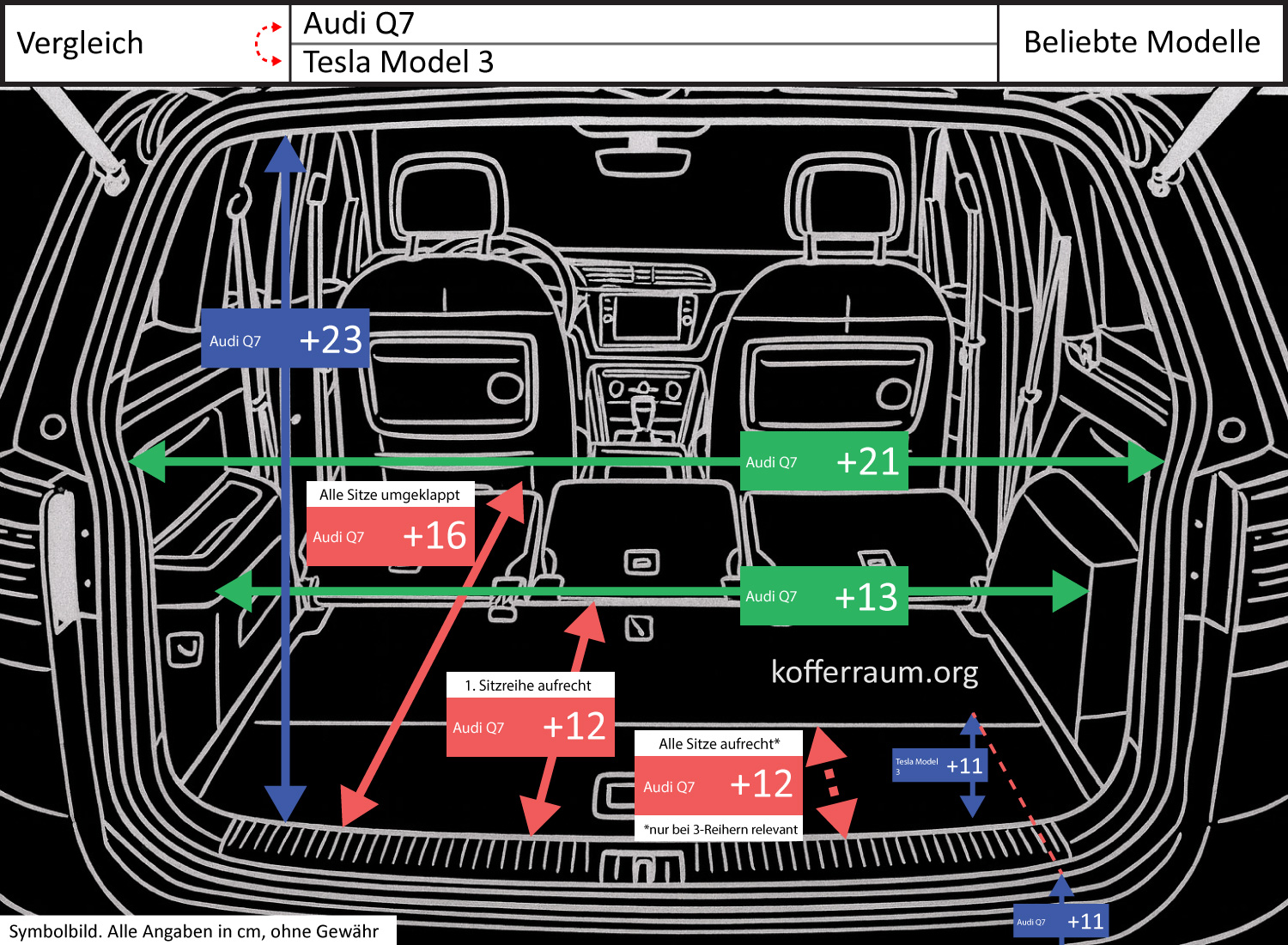
The Audi Q7 offers a significantly wider loading opening (+8.3 in / 21%) and at the narrowest point a larger interior space (+5.1 in / 14%), which makes loading wide items or bulky luggage considerably easier.
Additionally, the upper edge of the Q7's trunk opening is 9.1 in (44%) higher than that of the Model 3, allowing taller items to pass through the opening more easily.
In contrast, the Tesla Model 3 has a much greater depth between the loading edge and the trunk floor: the depth is 4.3 in (indicated as 1000%) larger, meaning the cargo volume below the loading edge is deeper/more spacious.
The Model 3 also has a lower loading edge; the Q7's loading edge is 4.3 in (16%) higher, making lifting heavy items in the Q7 more strenuous, while sliding or sideways pushing is noticeably easier in the Tesla.
Furthermore, the Audi is 4.7 in (11%) longer when loaded with the first row of seats upright than the Model 3, meaning longer items fit more often in the Q7 without folding down the seats, while the advantage when fully folding the seats with +6.3 in (9%) in favor of the Q7 falls below the 10% mark.
Practical consequences: For wide or very tall cargo (e.g., furniture parts, suitcases, bulky sports equipment), the Audi Q7 is better suited due to the greater opening height and width as well as the larger interior width.
On the other hand, for frequent loading of heavy items, easy sliding of boxes, or a deeper cargo area below the loading edge, the Tesla Model 3 is more practical because of the deeper loading floor and lower loading edge. For long items without folding the seats, the Q7 also has an advantage.