
Trunk comparison: Audi Q7 vs Toyota Corolla Wagon
Key Differences
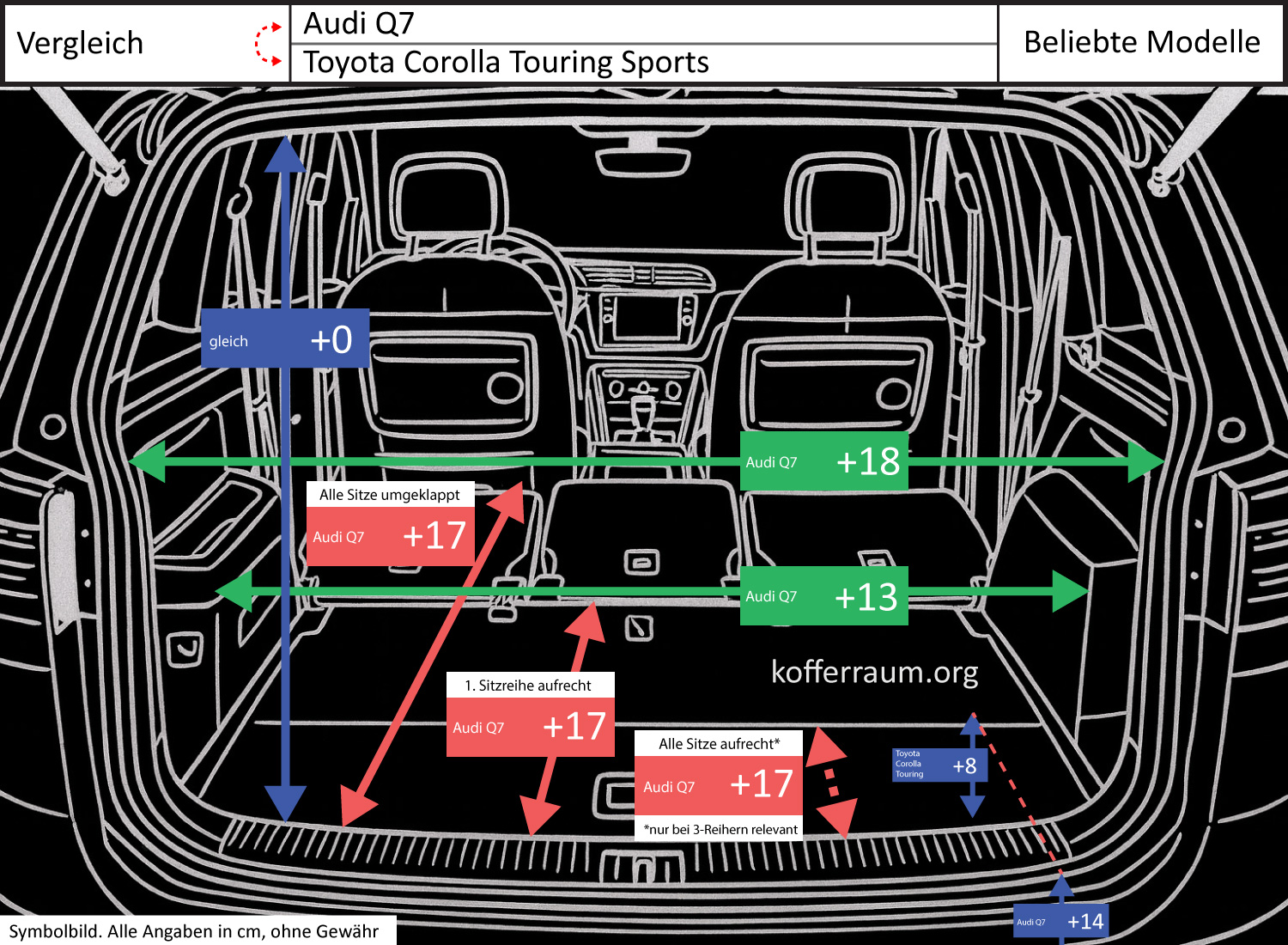
The Audi Q7 offers a significantly longer trunk with the first row of seats upright: +6.7 in (+17%) compared to the Toyota Corolla Touring Sports. The width of the trunk at its narrowest point is +5.1 in (+14%) greater in the Q7, and the width of the trunk opening is even +7.1 in (+17%) wider.
The loading edge of the Q7 sits higher: +5.5 in (+22%) above the ground.
In contrast, the Toyota Corolla Touring Sports has a significantly greater depth from the lip to the trunk floor: +3.1 in (700%) compared to the Q7. (The trunk opening height of both models is the same; with the seats fully folded down, the length differs by only +6.7 in or 9% — which is below the 10% threshold.)
Impact on Usability
The wider dimensions of the Q7 (both at the narrowest point and at the opening) make it easier to load wide or bulky items — furniture, large suitcases, or pallets fit more easily through the opening and into the cargo area.
The greater loading length with the rear seats upright means longer items can be transported without folding down the rear seats; this is practical when passengers are still seated in the back.
The higher loading edge of the Q7 makes lifting heavy loads more strenuous: more effort is required to lift over the edge. The Toyota benefits here from the lower loading edge — combined with the significantly greater depth from the lip to the trunk floor, this creates a deep cargo well.
This lowers the center of gravity of the load and can reduce shifting as well as make stacking luggage easier, but it also makes stepping into the trunk more pronounced and may require more bending when removing low-lying items.
In practical summary: For wide, bulky, or long cargo with rear seats occupied, the Audi Q7 is better suited. For frequent loading of heavy, compact loads that need to be secured close to the floor, or for easier lifting over the loading edge, the Toyota Corolla Touring Sports is more advantageous.