Trunk comparison: Audi Q7 vs VW T-Roc
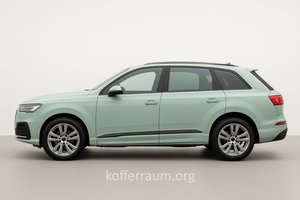
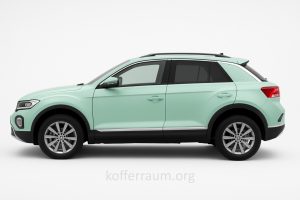
Main Differences (highlighted: >10%)
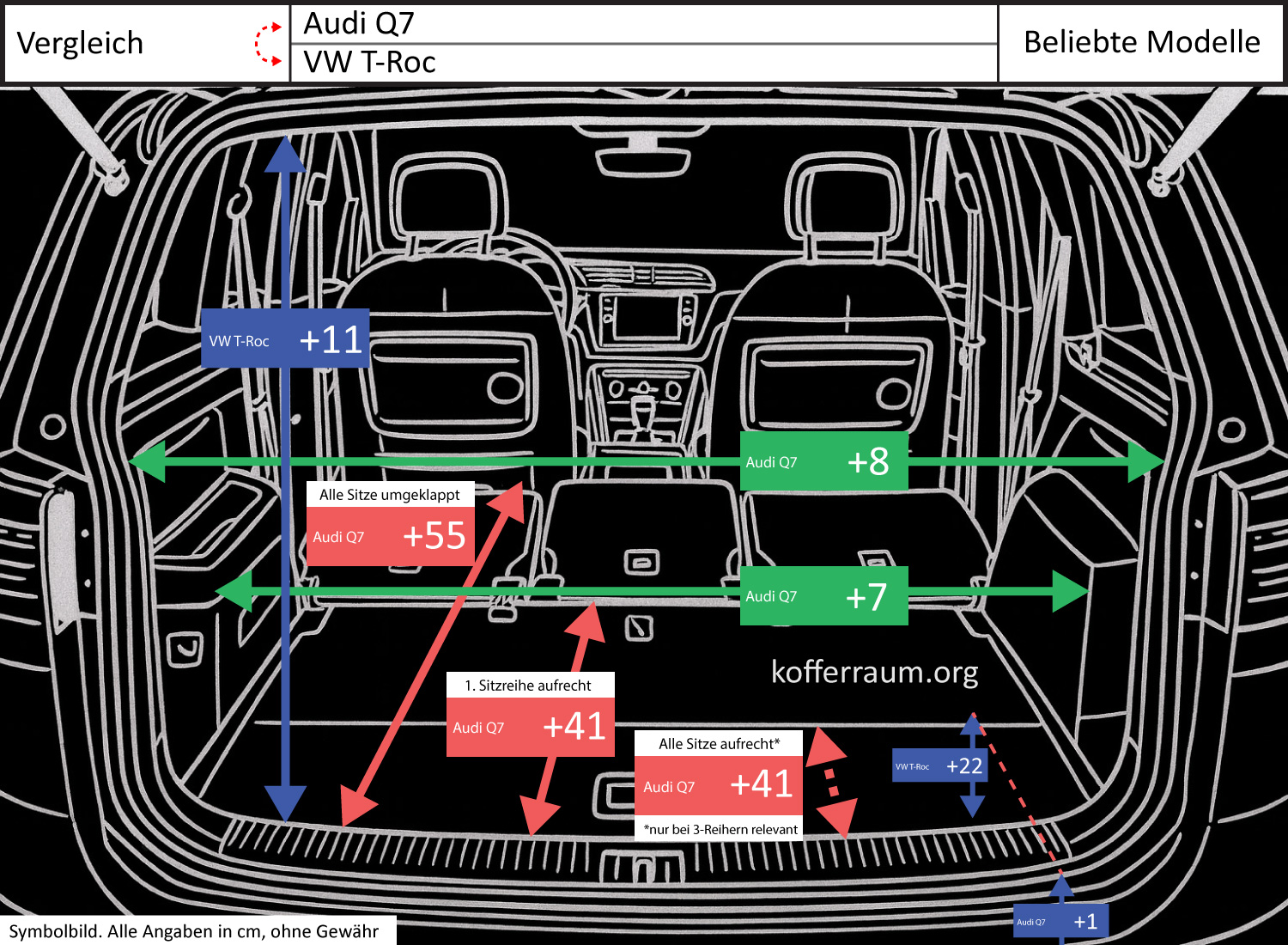
The Audi Q7 offers a cargo space length that is 21.7 in (37%) longer with the seats folded down than the VW T-Roc and a depth that is 16.1 in (53%) longer with the first row of seats upright.
In contrast, the VW T-Roc has a trunk opening that is 4.3 in (15%) higher and a depth between the loading edge and trunk floor that is 8.7 in (2100%) greater than the Q7.
What this means for usability
Longer cargo space in the Q7: The significantly longer cargo space of the Q7 (with seats folded down and with the first row upright) makes it better suited for long items (e.g., slats, furniture parts, long sports equipment) and for situations where lengthwise space is important.
Those who frequently transport long or bulky loads have noticeably more room in the Q7.
Higher trunk opening in the T-Roc: The higher opening of the T-Roc makes it easier to load tall items (e.g., boxes, tall luggage) and reduces the risk of hitting the top edge. Combined with the greater depth between the loading edge and trunk floor, the T-Roc offers more vertical space directly behind the opening.
Deeper distance loading edge → trunk floor (T-Roc): The significantly greater depth between the loading edge and floor in the T-Roc means more usable interior height behind the loading edge — good for bulky, taller cargo.
At the same time, a larger height difference can make lifting heavy items over the loading edge more difficult (greater force required to overcome the edge).
Small differences (not >10%): The loading edge of the Audi Q7 is only 0.4 in higher than that of the T-Roc, and the width at the narrowest point as well as the width of the opening are 7–3.1 in larger in the Q7 (about 7% each).
These deviations exist but only slightly affect practical usability — the main deciding factors remain length/side length (Q7) versus higher opening and greater interior height near the loading edge (T-Roc).