
Trunk comparison: Audi Q7 vs VW Taigo


Key Differences
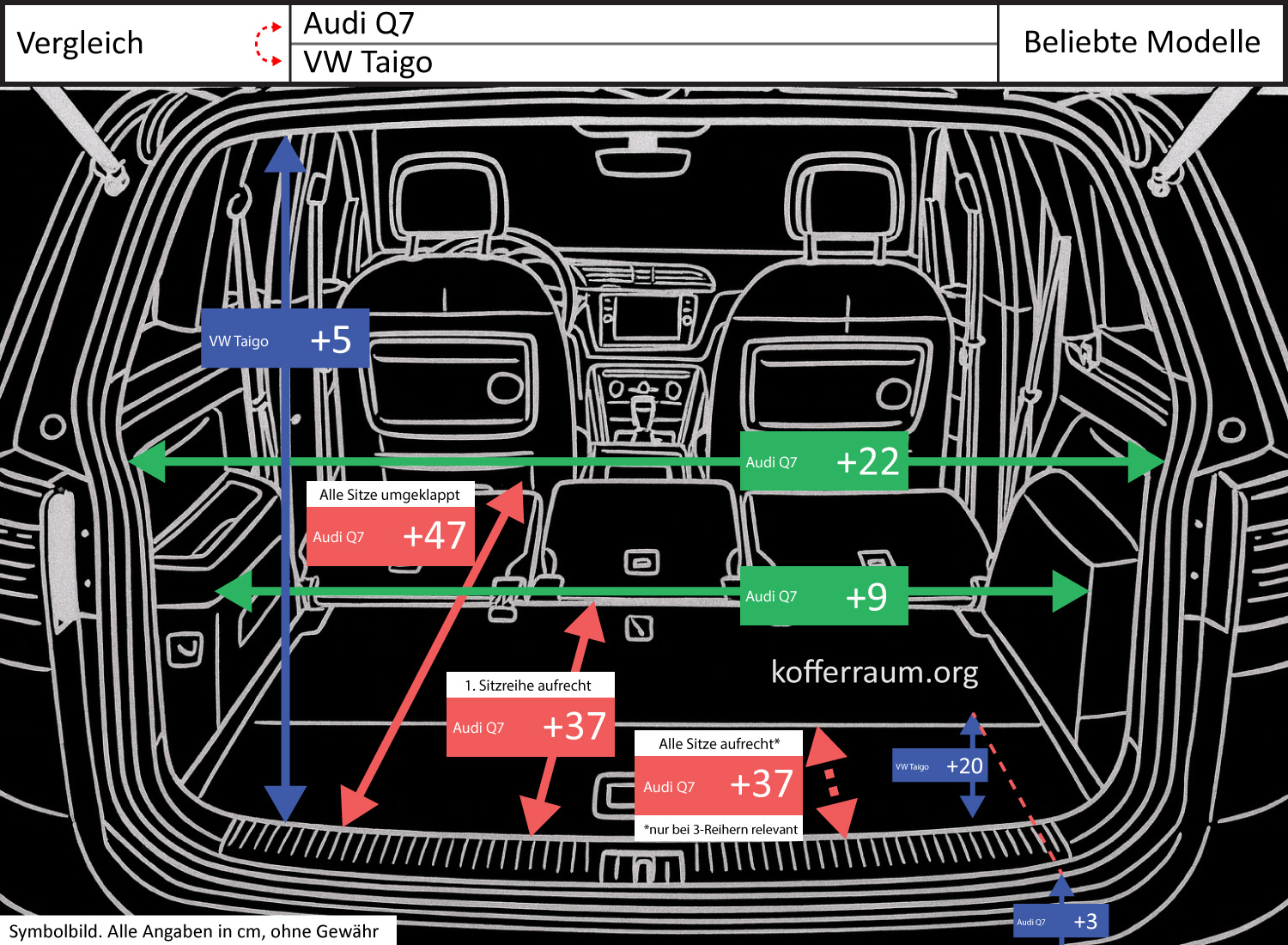
When comparing the trunk dimensions, four clear differences stand out: The Audi Q7 offers a significantly longer cargo space — +18.5 in (≈30%) when all seats are folded down and +14.6 in (≈45%) when the first row of seats is upright.
The width of the trunk opening of the Audi Q7 is significantly larger (+8.7 in / 22%). Conversely, the depth of the trunk (distance from loading edge → trunk floor) in the VW Taigo is significantly greater (+7.9 in / 1900%) — meaning the floor sits noticeably lower below the loading edge.
Impact on Usability
The longer cargo dimensions of the Q7 make it clearly better suited for long or flat loads (e.g., boards, furniture parts, skis), both with folded seats and with the first row upright.
The significantly wider trunk opening of the Q7 makes loading and unloading wide items easier and reduces the risk of bulky parts getting caught on the opening.
The deeper trunk floor of the Taigo means items can sit further below the loading edge — this can lead to a larger usable volume for tall items or ensure that cargo protrudes less.
At the same time, a low-lying floor requires stronger vertical lifting motions when loading and unloading, which can make handling heavy items more difficult. The slightly lower loading edge of the Taigo (only ±1.2 in difference) slightly mitigates this effect but is not a major advantage.
Smaller differences (trunk opening height +2 in for the Taigo, narrowest trunk width +3.5 in for the Q7, loading edge height +1.2 in for the Q7) only marginally affect everyday usability and play a minor role in most practical situations.
Conclusion: For long or particularly wide loads, the Audi Q7 is better suited due to its longer cargo floor and wider opening.
For deeper-packed or bulky, tall cargo, the VW Taigo can offer advantages thanks to its significantly deeper trunk floor — albeit at the cost of somewhat less comfortable lifting when loading and unloading.