
Trunk comparison: BMW 5 Series Touring vs Skoda Fabia


Key Differences
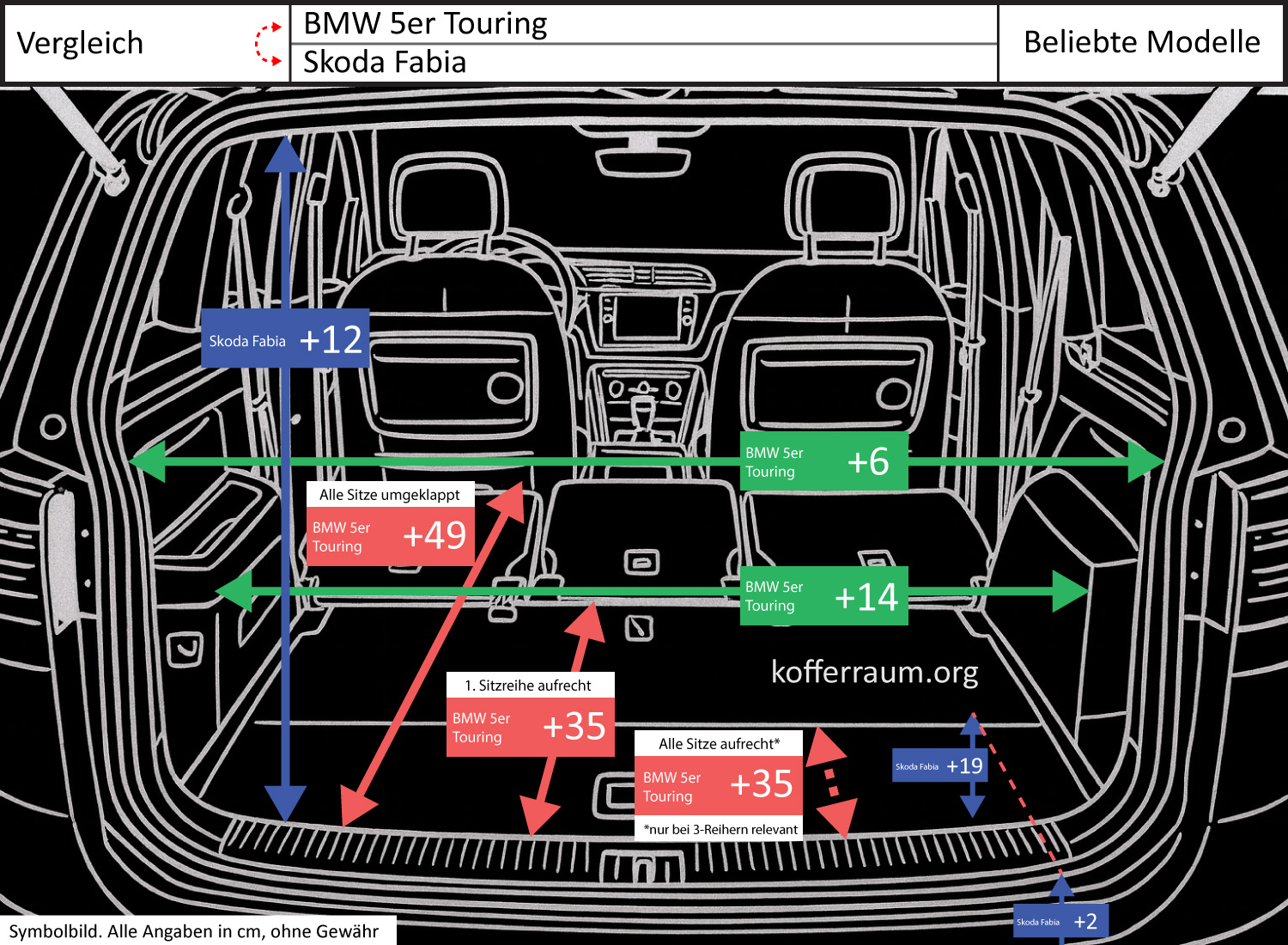
The biggest differences are mainly in the cargo length, trunk depth, and usable width: The BMW 5 Series Touring offers a cargo area that is +19.3 in (35%) longer with the seats folded down and +13.8 in (47%) longer with the front seats upright compared to the Škoda Fabia.
The narrowest width in the trunk is +5.5 in (15%) greater in the BMW. The Škoda has a trunk opening that is +4.7 in (17%) higher and a significantly greater trunk depth (from loading edge to trunk floor), namely +7.5 in (1800%).
Two values are less pronounced: the width of the trunk opening favoring the BMW (+2.4 in / 6%) and the loading edge height of the Škoda (+0.8 in / 3%) — these differences are under 10% and are therefore not highlighted here.
What are the practical implications of these differences?
BMW 5 Series Touring – Strengths: The significantly longer cargo area (both with folded seats and with upright seats) and the greater narrowest width make the BMW better suited for long or flat items such as slats, boards, skis, (disassembled) bicycles, or longer furniture parts.
Even when bulky items need to be placed crosswise, the larger minimum width helps them fit more easily. Overall, the BMW is more practical when length and continuous width are decisive.
Škoda Fabia – Strengths: The higher trunk opening and the significantly greater depth below the loading edge favor loading tall or bulky items that need to stand upright (boxes, plants, tall cartons). The deeper pocket or floor design can also cause bulky items to sit lower and sway less during transport.
Practical consequences: For users who frequently transport long or flat items (craftsmen, athletes with long equipment), the BMW 5 Series Touring is generally more suitable. For users who more often transport tall boxes or upright cargo, the Škoda Fabia is advantageous due to the higher opening and greater depth.
The very high percentage figure for trunk depth (1800%) indicates a very small base value and should be supplemented with concrete volume or dimension data when making a purchase decision.