
Trunk comparison: BMW i4 vs BMW X3


Main Differences
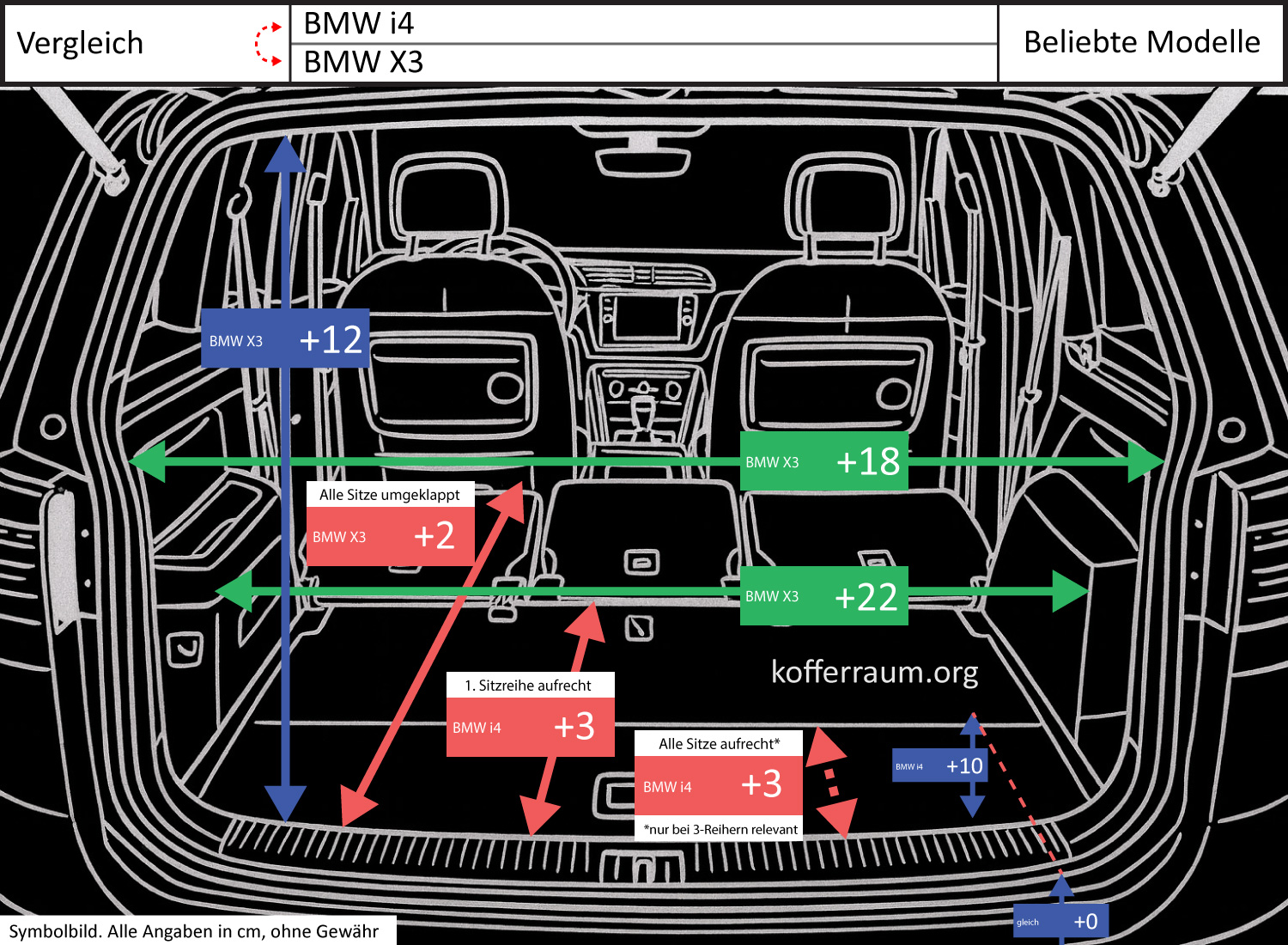
The biggest relevant differences lie in four points: The height of the trunk opening of the BMW X3 is +4.7 in (18%) higher than that of the i4, the depth of the i4 (loading edge → trunk floor) is +3.9 in (900%) larger, the smallest interior width of the trunk in the X3 is +8.7 in (25%) larger, and the width of the trunk opening of the X3 is +7.1 in (19%) larger.
Smaller differences – about +0.8 in (1%) with folded seats or +1.2 in (3%) with the front seat row upright – are marginal and hardly affect practical use. The loading edge height is the same for both models.
Impact on Usability
The greater opening height and the wider dimensions of the X3 make loading and unloading bulky, wide, or tall items significantly easier: baskets, boxes, furniture parts, or even strollers can be maneuvered in and out without much tilting.
The larger narrow interior width also reduces the risk of wide items getting stuck at tight spots.
The significantly greater depth value of the i4, on the other hand, favors longer, flat-lying cargo: boards, skis, longer boxes, or flat pallets can be pushed further forward in the i4 and thus stored better.
However, the narrower opening and smaller interior cross-section of the i4 limit the handling of very bulky or irregularly shaped parts.
Since the loading edge is at the same height, the required lifting effort when loading does not differ between the models. In summary: the X3 is more practical for wide, tall, and bulky cargo; the i4 has advantages with long, flat-loadable items.