
Trunk comparison: BMW i4 vs Citroen C3
Key Differences and Impact on Usability
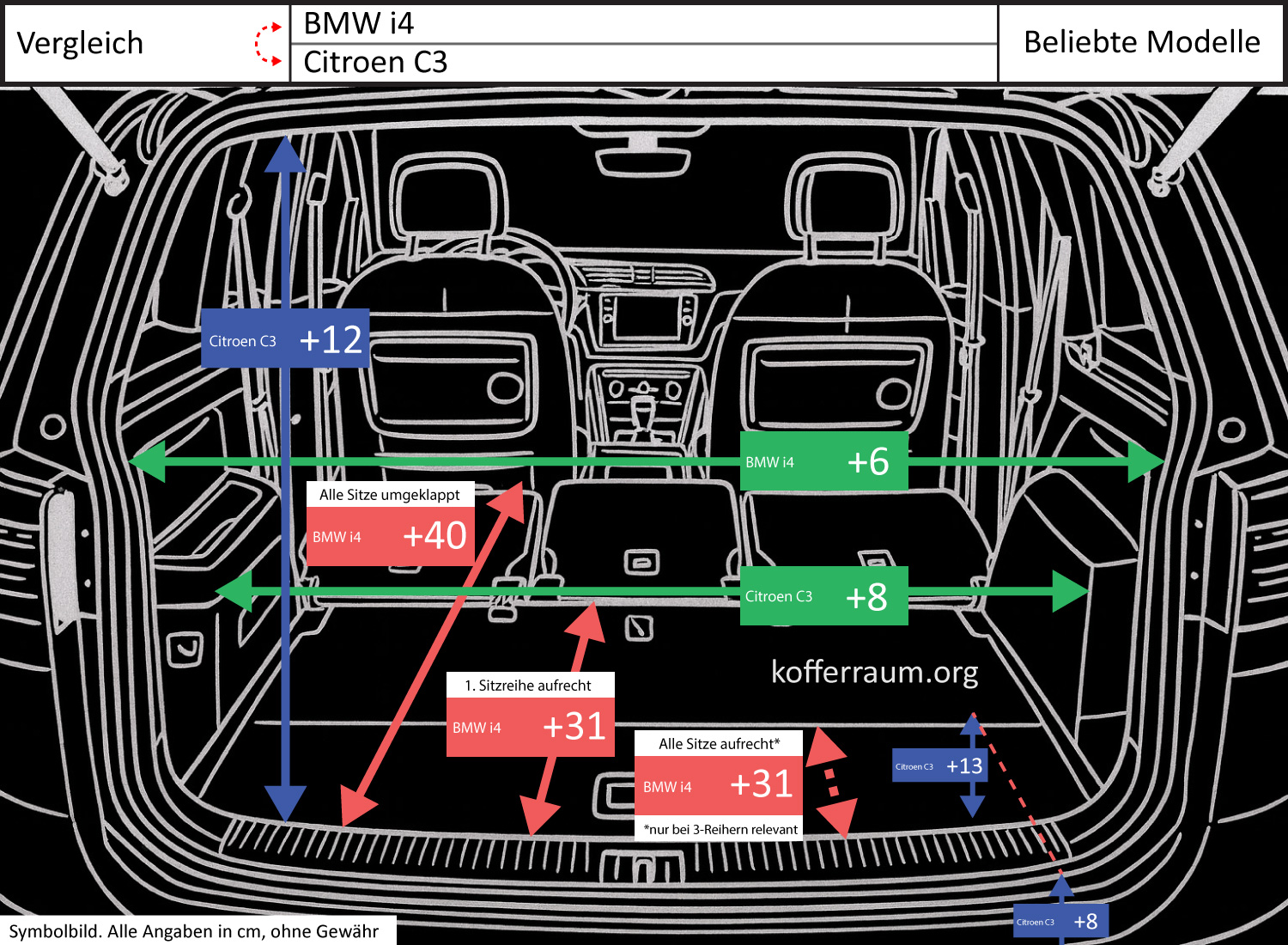
The BMW i4 offers significantly more loading length: with the seats folded down, the i4's trunk is +15.7 in (29%) longer, and with the front seats upright, it is +12.2 in (46%) longer than the Citroën C3. This makes the i4 clearly more practical for long items (e.g., boards, skis, furniture parts) and for transports where length is more important than height.
The Citroën C3, on the other hand, scores with vertical usability: the trunk opening is +4.7 in (18%) higher and the depth from the loading edge to the trunk floor is +5.1 in (130%) greater than in the BMW i4. Additionally, the loading edge of the C3 is +3.1 in (11%) higher above the ground.
This means that higher or bulky items can be more easily accommodated upright in the C3 because more interior height is available.
At the same time, the higher loading sill requires more effort to lift items in, and the greater depth changes the loading feel (a steeper "drop" from the loading floor to the loading edge).
Regarding width differences, deviations remain small (<10%): the narrowest point in the trunk is 3.1 in (9%) larger in the C3, while the opening width is 2.4 in (7%) larger in the BMW i4. These differences are mostly uncritical in everyday situations but can be relevant in individual cases with very wide items.
Conclusion: For frequent transport of long items or flexible use with folded seats, the BMW i4 is the better choice. For transporting tall or upright items, the Citroën C3 offers more interior height but requires somewhat more effort when loading due to the higher loading sill.