
Trunk comparison: BMW i4 vs Durchschnitt Subcompact
Key Differences (>10%)
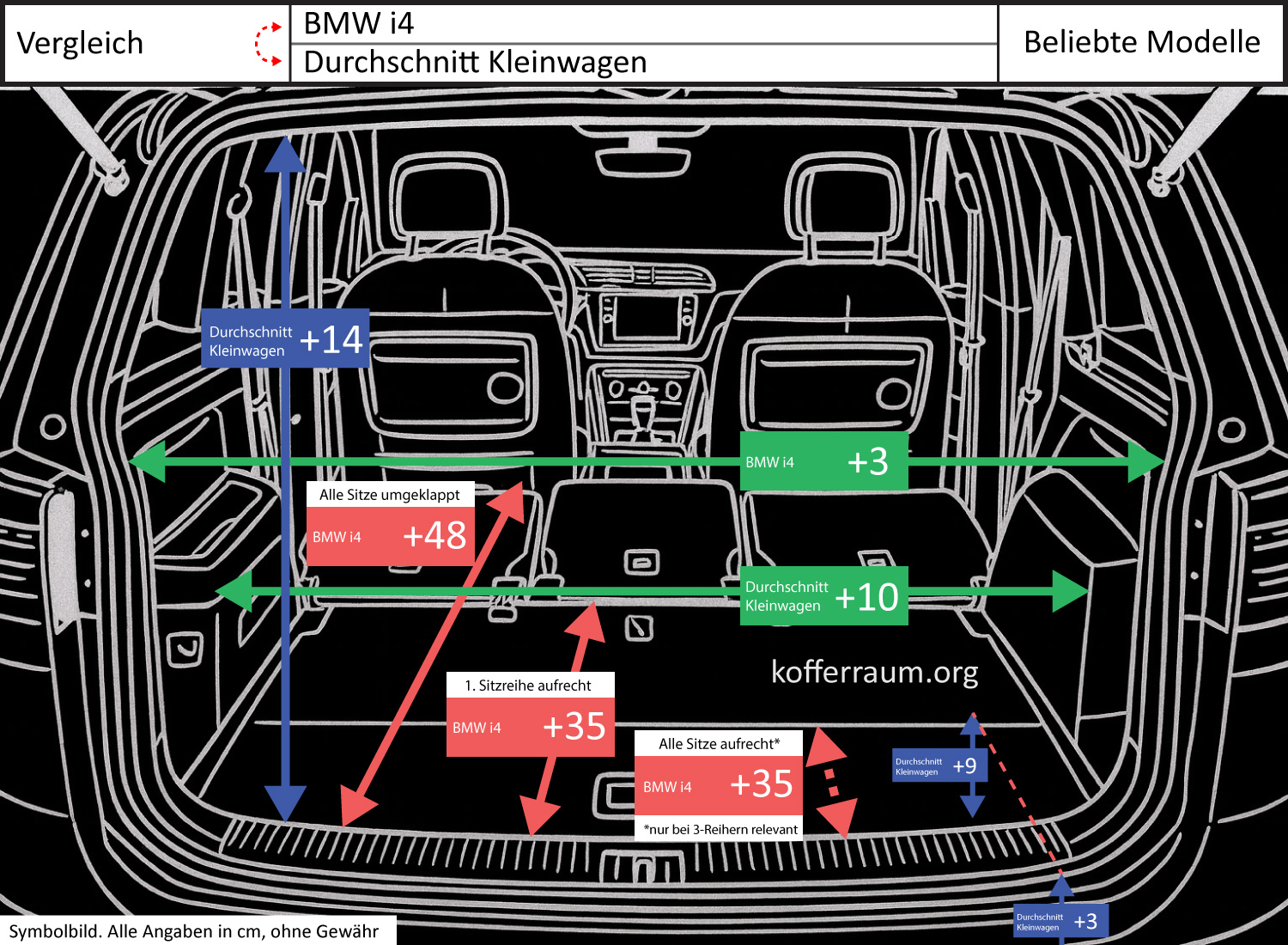
The BMW i4 offers significantly more loading length: with the seats folded down, the advantage is +18.9 in (≈38%), and with the front seats upright even +13.8 in (≈56%). At the same time, the average subcompact has a noticeably greater trunk opening height: +5.5 in (≈21%) in favor of the subcompact.
The depth of the trunk (distance from loading edge → trunk floor) is 3.5 in (≈90%) larger in the average subcompact than in the BMW i4. Additionally, the width at the narrowest point in the average subcompact is 3.9 in (≈11%) larger than in the BMW i4.
Implications for Usability
The greater loading length of the BMW i4 means practical advantages for long items: skis, slats, long furniture parts, or components can be more easily accommodated crosswise or lengthwise, often without roof racks or special extensions. For transports where length is crucial, the i4 is thus better suited.
The greater opening height and larger depth of the average subcompact, on the other hand, offer advantages for tall and bulky loads: bulky boxes, crates, or tall luggage can be more easily stood upright and better stacked because the loading opening is higher and there is more space below the loading edge.
The greater narrowest interior width of the subcompact (≈11% more) means that wide cargo parts are more likely to fit inside a subcompact than in the i4; in the BMW i4, wide items may rest on the narrowest point or cannot be placed parallel, even if the opening is comparatively wide.
In summary: If you frequently transport long, flat, or elongated loads, the BMW i4 clearly has the advantage in everyday use.
If, on the other hand, you often need to load tall, bulky, or wide items (stackable crates, tall boxes), the average subcompact offers more flexibility due to the higher opening, greater depth, and somewhat more interior width.