Trunk comparison: BMW i4 vs Durchschnitt Wagon
Key Differences
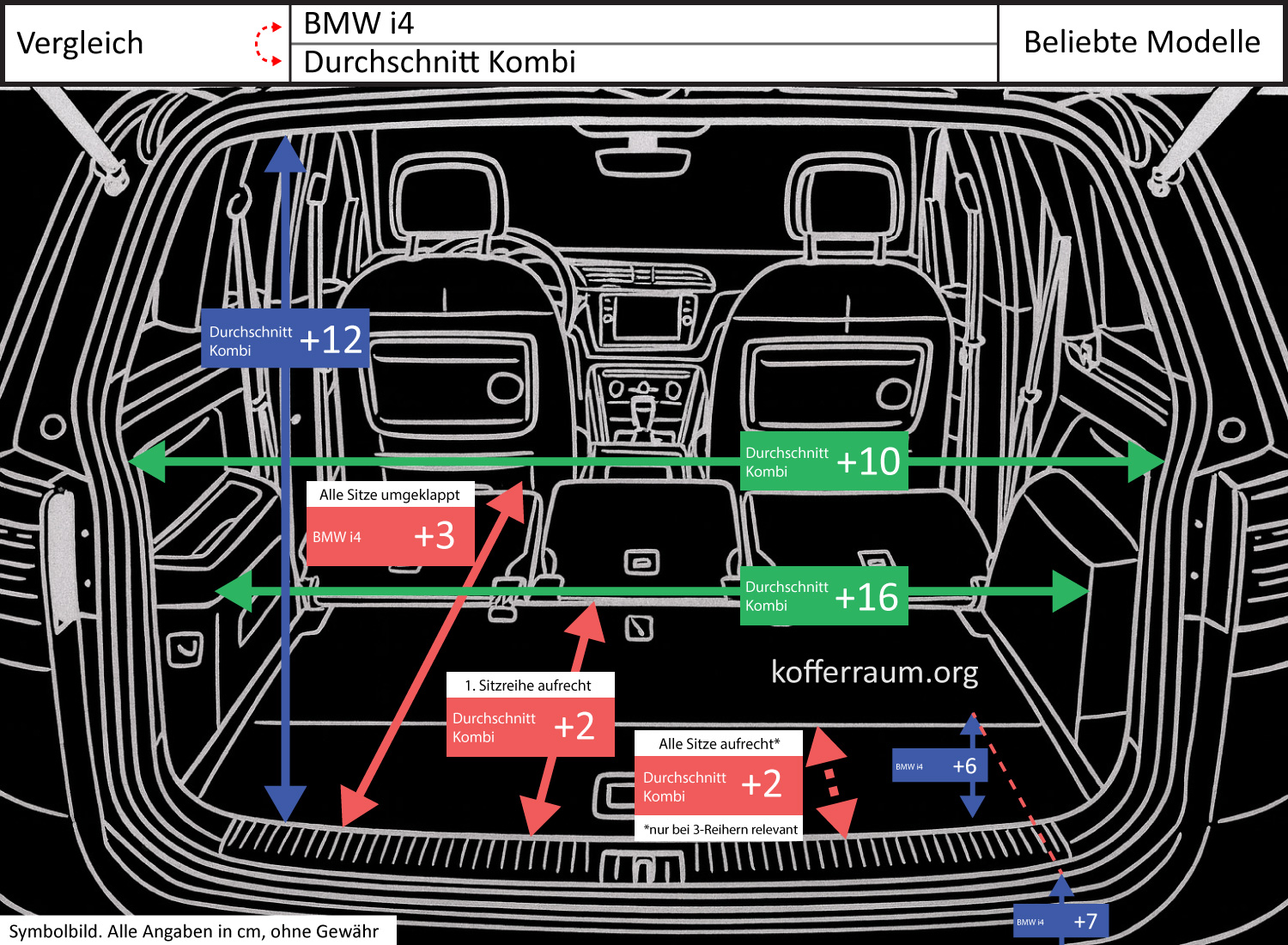
The average wagon has a significantly higher trunk opening (+4.7 in / +18%) and is noticeably wider (+6.3 in / +18%) at the narrowest point in the cargo area. Additionally, the width of the wagon's trunk opening is +3.9 in (+11%) larger.
Together, these points mean: wider and taller loading capacity in the wagon. On the other hand, the BMW i4 has a significantly greater depth between the loading edge and the trunk floor (+2.4 in / +150%) and a higher loading edge above the road (+2.8 in / +11%).
Impact on Usability
Practically, this means: the wagon is better suited for wide or bulky items (e.g., furniture parts, wide boxes, strollers) because the opening and the narrowest point in the cargo area are noticeably larger. The higher opening also makes it easier to load tall items.
The BMW i4 offers a deeper cargo compartment due to the significantly greater depth, providing more usable volume in terms of vertical space or sinking luggage — useful if you want to store items recessed in the floor or have the load sit lower.
At the same time, the i4's loading edge is higher, making it initially more strenuous to lift heavy loads in.
The differences in total cargo length with folded seats (+1.2 in / 2% in favor of the i4) and with the first row upright (+0.8 in / 2% in favor of the wagon) are marginal and have little practical relevance.
In short: Wagon = better for wide and tall or bulky loads due to larger opening and width. BMW i4 = deeper cargo compartment with more recessing options, but higher loading edge and narrower opening, which can make handling and loading large/bulky items more difficult.